Rivers of rock

Jun 25, 2012 By Jason Major
Credits: NASA/GSFC/Arizona State University

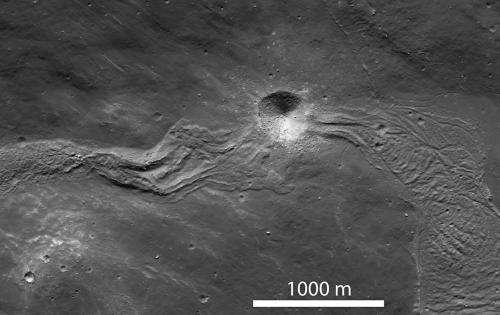
The Moon may not have ever had liquid water on its surface — despite the use of the term mare, Latin for “sea” and moniker for the large regions of darker material visible from Earth — but liquid did indeed flow on the Moon in ages past… liquid rock, briefly set loose by the impacts that formed its ubiquitous craters.

When large meteorites impacted the , crust at the site would melt and get flung outwards, flowing downhill as rivers of rock and creating streams and pools of melted material before cooling and solidifying. There the rivers would remain, a permanently-hardened testament to the event that made them.

The image above, part of a NAC scan acquired by NASA’s Lunar Reconnaissance Orbiter on March 9, shows a solidified melt flow dating back to the creation of Tycho crater approximately 108 million years ago –which may sound like a long time but it’s actually very recent for large-scale lunar features.
The flow is interrupted by a younger, 400-meter-wide crater that impacted the lunar surface along its length. Since it punches through the melt flow as well as the local surface, it would be a great place for future astronaut geologists to explore!

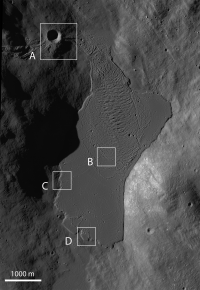
Taken under slightly different lighting conditions, the image below shows a large melt pond that the flow above terminates in. The pond is about 4500 meters long by 2100 meters across (2.8 x 1.3 miles).

Such images wouldn’t be possible without the awesome Lunar Reconnaissance Orbiter. Launched on June 18, 2009, LRO explores the surface from an altitude of only 50 km (31 miles).

Explore further: Mice, gerbils perish in Russia space flight

More information: lroc.sese.asu.edu/news/index.php?/archives/591-River-of-Rock.html#extended

Related Stories

Sunrise view of Tycho crater's peak

Jun 30, 2011

(PhysOrg.com) -- On June 10, 2011, NASA's Lunar Reconnaissance Orbiter spacecraft angled its orbit 65° to the west, allowing the LRO Camera NACs to capture a dramatic sunrise view of Tycho crater.

Scientists suggest evidence of recent lunar volcanism

Apr 16, 2012

A team of researchers at India’s Physical Research Laboratory (PRL) claims it has found evidence of relatively recent volcanic activity on the Moon, using data from NASA’s Lunar Reconnaissance Orbiter ...

A 'melted' moon makes for bad future landing sites

Mar 05, 2012

The miniature radio frequency (min-RF) radar instrument aboard the Lunar Reconnaissance Orbiter (LRO) is revealing some interesting things about how impact melts form around craters on the Moon. Impacts produce ...

The Floor of Tycho Crater

Jan 14, 2010

(PhysOrg.com) -- Tycho Crater is an one of the most prominent craters on the moon. It appears as a bright spot in the southern highlands with rays of bright material that stretch across much of the nearside. ...

Face-to-face with some shattered lunar boulders

Feb 28, 2012

Breaking up may be hard to do, but these two lunar boulders seem to have succeeded extremely well! Imaged by the Lunar Reconnaissance Orbiter Camera (LROC) in October of 2009, this crumbled couple was recently ...

LRO lets you stand on the rim of Aristarchus crater

Dec 30, 2011

Have you ever you looked up at the bright, cavernous Aristarchus Crater on the Moon through a telescope or binoculars and wondered what it would be like to stand on the rim and peer inside? Spectacular new ...

Recommended for you

Mice, gerbils perish in Russia space flight

6 hours ago

A number of mice and eight gerbils sent into space in a Russian capsule destined to find out how well organisms can withstand extended flights perished during their journey, scientists said Sunday as the ...

Mars rover Opportunity examines clay clues in rock

May 18, 2013

(Phys.org) —NASA's senior Mars rover, Opportunity, is driving to a new study area after a dramatic finish to 20 months on "Cape York" with examination of a rock intensely altered by water.

NASA's STEREO detects a CME from the sun

May 17, 2013

On 5:24 a.m. EDT on May 17, 2013, the sun erupted with an Earth-directed coronal mass ejection or CME, a solar phenomenon that can send billions of tons of solar particles into space that can reach Earth ...

Nine-year-old Mars rover passes 40-year-old record

May 17, 2013

While Apollo 17 astronauts Eugene Cernan and Harrison Schmitt visited Earth's moon for three days in December 1972, they drove their mission's Lunar Roving Vehicle 19.3 nautical miles (22.210 statute miles ...

Bright explosion on the Moon

May 17, 2013

For the past 8 years, NASA astronomers have been monitoring the Moon for signs of explosions caused by meteoroids hitting the lunar surface. "Lunar meteor showers" have turned out to be more common than anyone ...

User comments : 0

More news stories

Bold action, big money needed to curb Asia floods

Asia's flood-prone megacities should fund major drainage, water recycling and waste reduction projects to stem deluges and secure clean supply for their booming populations, experts said Sunday.

Heat-related deaths in Manhattan projected to rise

Residents of Manhattan will not just sweat harder from rising temperatures in the future, says a new study; many may die. Researchers say deaths linked to warming climate may rise some 20 percent by the 2020s, ...

Mice, gerbils perish in Russia space flight

A number of mice and eight gerbils sent into space in a Russian capsule destined to find out how well organisms can withstand extended flights perished during their journey, scientists said Sunday as the ...