Research helps quantum computers move closer
The quantum computer is a futuristic machine that could operate at speeds even more mind-boggling than the world's fastest super-computers.
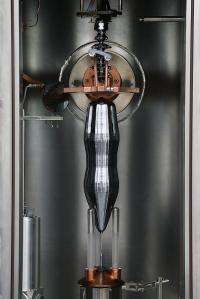
Research involving physicist Mike Thewalt of Simon Fraser University offers a new step towards making quantum computing a reality, through the unique properties of highly enriched and highly purified silicon.
Quantum computers right now exist pretty much in physicists' concepts, and theoretical research. There are some basic quantum computers in existence, but nobody yet can build a truly practical one—or really knows how.
Such computers will harness the powers of atoms and sub-atomic particles (ions, photons, electrons) to perform memory and processing tasks, thanks to strange sub-atomic properties.
What Thewalt and colleagues at Oxford University and in Germany have found is that their special silicon allows processes to take place and be observed in a solid state that scientists used to think required a near-perfect vacuum.
And, using this "28Silicon" they have extended to three minutes—from a matter of seconds—the time in which scientists can manipulate, observe and measure the processes.
"It's by far a record in solid-state systems," Thewalt says. "If you'd asked people a few years ago if this was possible, they'd have said no. It opens new ways of using solid-state semi-conductors such as silicon as a base for quantum computing.
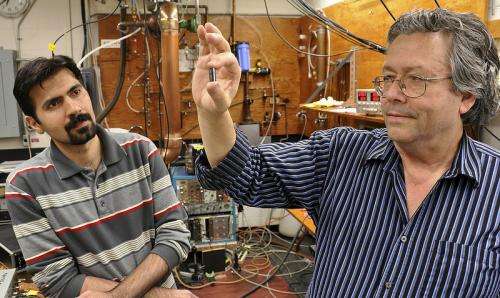
"You can start to do things that people thought you could only do in a vacuum. What we have found, and what wasn't anticipated, are the sharp spectral lines (optical qualities) in the 28Silicon we have been testing. It's so pure, and so perfect. There's no other material like it."
But the world is still a long way from practical quantum computers, he notes. Quantum computing is a concept that challenges everything we know or understand about today's computers.
Your desktop or laptop computer processes "bits" of information. The bit is a fundamental unit of information, seen by your computer has having a value of either "1" or "0".
That last paragraph, when written in Word, contains 181 characters including spaces. In your home computer, that simple paragraph is processed as a string of some 1,448 "1"s and "0"s.
But in the quantum computer, the "quantum bit" (also known as a "qubit") can be both a "1" and a "0"—and all values between 0 and 1—at the same time.
Says Thewalt: "A classical 1/0 bit can be thought of as a person being either at the North or South Pole, whereas a qubit can be anywhere on the surface of the globe—its actual state is described by two parameters similar to latitude and longitude."
Make a practical quantum computer with enough qubits available and it could complete in minutes calculations that would take today's super-computers years, and your laptop perhaps millions of years.
The work by Thewalt and his fellow researchers opens up yet another avenue of research and application that may, in time, lead to practical breakthroughs in quantum computing.
Their paper will be published Friday in Science.
Journal information: Science
Provided by Simon Fraser University


