Ports are hotspots for exotic sea star orgies
Jun 26, 2012
Ports are hotspots for exotic sea star orgies

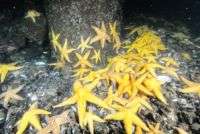
Marine biologists have found that port environments are enabling invasive sea stars to breed at a rapid rate.

In a new research article, researchers found that these environments can facilitate the invasion of a significant marine pest by driving overwhelming reproductive success.

Dr. Scott Ling, from the UTAS Institute of Marine and Antarctic Studies (IMAS), is the lead author of the paper published in .

"The sea star must release eggs in close proximity to sperm sources because chances of fertilization decline drastically with increasing distance between spawning ," he said.

"Beneath wharves a super abundant supply of food leads to a veritable orgy of highly aggregated and fecund sea stars that achieve great fertilisation success".

Dr. Ling said the research found that wharf populations, while representing less than 10 per cent of the total sea star population in an estuary and concentrated in less than 0.1 per cent of the estuary area, can contribute up to a massive 90 per cent of all larval production in an estuary.

"A big part of the problem is that in human-dominated environments, very few native species compete with the invasive sea star," he said.

Dr. Ling said that while long-term protection of key sources of larval production is a common goal in marine reserve design and , the same ecological concept, but in reverse - whereby larval production is minimised at key sources - is a concept yet to be broadly applied to the management of established marine pests.

"Restoring values to achieve a more natural in makes sense on many levels - here we have an example of what might be achievable to reduce the dominance of an exotic pest.

"While transfer of marine pests has increased globally with international shipping, the success of species once they arrive in new places can largely be determined by the ecological dynamics of the system they find themselves in," Dr. Ling said.

"There are consequences when we modify the marine environment, and exotic species can and will capitalize on opportunities to flourish."

Explore further: Serengeti road divides biologists: Will a road across the northern tier of Serengeti National Park ruin it?

More information: onlinelibrary.wiley.com/doi/10.1111/j.1365-2664.2012.02133.x/full

add to favorites email to friend print save as pdf

Related Stories

Carbon dioxide poses risk to marine life survival

Aug 06, 2008

(PhysOrg.com) -- Climate change and the subsequent acidification of the world's oceans will significantly reduce the successful fertilisation of certain marine species by the year 2100, an international team ...

Pollution forms an invisible barrier for marine life

Mar 10, 2011

Over 50 percent of the population in the United States and over 60 percent in the world live in coastal areas. Rapidly growing human populations near the ocean have massively altered coastal water ecosystems.

Mediterranean Sea invaded by alien species

May 23, 2011

More than 900 new alien species have been encountered in the coastal environments of the eastern Mediterranean Sea in recent decades, including the poisonous pufferfish. The invasion of alien species has had ...

Sea urchins cannot control invasive seaweeds

Jul 13, 2011

Exotic marine species, including giant seaweeds, are spreading fast, with harmful effects on native species, and are increasingly affecting the biodiversity of the Mediterranean seabed. Some native species, ...

Recommended for you

Wildlife losses now stabilising

2 hours ago

Efforts to conserve biodiversity in the UK, Belgium and Netherlands may be working, despite the widespread perception that wildlife is in terminal decline, a new study suggests.

Drought makes Borneo's trees flower at the same time

May 22, 2013

Tropical plants flower at supra-annual irregular intervals. In addition, mass flowering is typical for the tropical forests in Borneo and elsewhere, where hundreds of different plant timber species from the ...

User comments : 0

More news stories

Unlocking secrets of cell reproduction

Research published in Open Biology today identifies, for the first time, nearly all the genes required for reproduction of a cell in a living organism.

Engineers pioneer flat spray-on optical lens

A University of British Columbia engineer and a team of U.S. researchers have made a breakthrough utilizing spray-on technology that could revolutionize the way optical lenses are made and used.

Major human drug trial underway for Alzheimer's

A potentially ground-breaking human drug trial is currently underway, which aims to discover whether blood pressure medication can slow or halt the progression of Alzheimer's Disease (AD). This is the latest ...