Physicists discover mechanisms of wrinkle and crumple formation
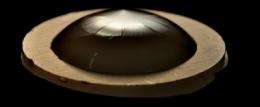
Smooth wrinkles and sharply crumpled regions are familiar motifs in biological and synthetic sheets, such as plant leaves and crushed foils, say physicists Benny Davidovitch, Narayanan Menon and colleagues at the University of Massachusetts Amherst, but how a featureless sheet develops a complex shape has long remained elusive.
Now, in a cover story of the journal, Proceedings of the National Academy of Sciences, the physicists report that they have identified a fundamental mechanism by which such complex patterns emerge spontaneously.
Davidovitch says they were inspired and moved toward a solution by thinking about how a familiar birthday balloon, made of two circular mylar foils, wrinkles and crumples (two separate processes). The two foils start flat, but when glued together around their edges and injected with helium gas to create higher-than-atmospheric pressure inside, they spontaneously changes shape to accommodate the gas.
"This simple process leads to a fascinating pattern of wrinkles and crumples that emerge spontaneously near the perimeter of each foil," Davidovitch points out. "What we discovered is an unusual sequence of transitions that underlie this and possibly other types of morphological complexity."
In the laboratory, rather than balloons, the researchers including doctoral student Hunter King, who conducted many of the experiments, and postdoctoral researcher Robert Schroll, who carried out theoretical calculations, used microscopically thin films and a drop of water to model the effects they wished to study. They cut a circle of ultra-thin film from a sheet 10,000 times thinner than a piece of paper, only tens of nanometers thick, and place it flat on the water drop nestled in a circular collar, where surface tension holds it in place.
"We then very, very gently inject more and more water into the bubble, very gradually, so it becomes more and more curved without spilling over," says Davidovitch. "When the radius of the drop gets small enough, the thin film starts to develop fine radial wrinkles near its outer perimeter as the water pressure increases If you keep adding pressure, decreasing the radius further, a second transition takes place and the film starts to crumple and to look more like a table cloth, draping with sharp creases over the edge of a flattened top," he adds.
Watching this process through incremental steps, the researchers were able to observe and describe through mathematical formulas how the drop imposes confinement on circles of latitude of the sheet. "The degree of this confinement increases as the drop's radius decreases, and an unusual sequence of transitions can then be observed," says Davidovitch.
With this work the investigators, who had earlier proposed quantitative predictions of wrinkle patterns in ultra-thin sheets by following the principle that such sheets must be free of compression, confirm their theoretical predictions. The current experiments also suggest that the wrinkle-to-crumple transition reflects a dramatic change called "symmetry breaking" in the distribution of stresses in the sheet, rather than just a further disruption of its symmetric shape, Davidovitch points out.
The researchers are now working on new puzzles regarding the formation of crumpled features posed by the experiment.
Journal information: Proceedings of the National Academy of Sciences
Provided by University of Massachusetts Amherst


