Nepal launches drones to combat poachers
Jun 20, 2012
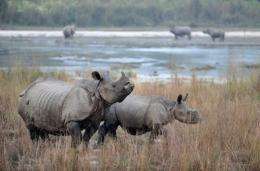
An Indian Rhinoceros takes its calf to water in the Maghauli Chitwan forest, southwest of Kathmandu. Conservationists in Nepal are to send drone aircraft into the skies in the battle to save the Himalayan nation's endangered tigers and rhinos from poachers.

Conservationists in Nepal are to send drone aircraft into the skies in the battle to save the Himalayan nation's endangered tigers and rhinos from poachers.

WWF Nepal said it had successfully tested two unmanned "conservation drones" earlier this month in Chitwan National Park, in Nepal's southern plains, the home of a number of the world's rarest animals.

The remote-controlled aircraft, being used for the first time in Nepal, would monitor the animals and via cameras and GPS to capture images and video, the organisation said in a statement earlier this week.
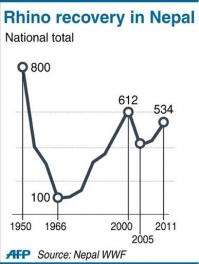
Thousands of tigers and greater one-horned rhinos, also known as the Indian rhinoceros, once roamed Nepal and northern India but their numbers plunged over the last century due to poaching and human encroachment on their habitat.

The aircraft, with a two-metre (6.5-foot) wing span and a range of 25 kilometres (15.5 miles), can stay in the air for 45 minutes, flying at an altitude of up to 200 metres.

"WWF Nepal has been introducing new science and technology to aid ongoing in Nepal. The conservation drones are the latest addition," said Anil Manandhar, the organisation's representative in Kathmandu.

"We believe that this technology will be instrumental in monitoring Nepal's flagship species and curbing ."

Thousands of tigers and greater one-horned rhinos, also known as the Indian rhinoceros, once roamed Nepal and but their numbers plunged over the last century due to poaching and human encroachment on their habitat.

are killed for their horns, which are prized for their reputed medicinal qualities in China and southeast Asia, while tiger skins, meat and bones are also in high demand.

Explore further: Scientists present new insights on climate change and species interactions

add to favorites email to friend print save as pdf

Related Stories

Nepal's rhino numbers 'recovering' after war

Apr 24, 2011

The number of rhinos living wild in Nepal has risen above 500 for the first time since a civil war that led to rampant poaching of the endangered animals, the government said Sunday.

Nepal expands critical tiger habitat

Oct 27, 2009

The Government of Nepal announced today an expansion of Bardia National Park in the Terai Arc Landscape by 900 sq km, which will increase critical habitat for tigers.

Nepal uses satellites to track rare tiger

Jan 24, 2011

An injured wild tiger that strayed into a tourist resort in Nepal has been moved to a new home in the jungle and fitted with a satellite collar so its progress can be tracked, the government said.

Nepal orders probe into slaughter of rhinos

Jun 14, 2010

(AP) -- Nepal's government was investigating the poaching of rhinos in the Himalayan nation after 28 of the endangered animals were killed over the past 11 months, an official said Monday.

Recommended for you

Dubai seizes 259 smuggled African ivory tusks

9 hours ago

A shipment of 259 elephant tusks smuggled out of Africa has been seized in the United Arab Emirates, the International Wildlife Fund for Animal Welfare said Tuesday.

New method for assessing future tree and plant disease risks

15 hours ago

A new method for assessing the impacts and risks of potential future tree and plant pest and disease outbreaks has been developed by the University's Professor Robert Fraser as one of the key recommendations of the government ...

User comments : 0

More news stories

If you can remember it, you can remember it wrong

(Medical Xpress)—Native peoples in regions where cameras are uncommon sometimes react with caution when their picture is taken. The fear that something must have been stolen from them to create the photo ...

B vitamins could delay dementia

(Medical Xpress)—Despite spending billions of dollars on research and development, drug companies have been unable to come up with effective treatments for dementia and Alzheimer's Disease (AD). Now, A. ...

Reducing caloric intake delays nerve cell loss

Activating an enzyme known to play a role in the anti-aging benefits of calorie restriction delays the loss of brain cells and preserves cognitive function in mice, according to a study published in the May ...

New method for producing clean hydrogen

Duke University engineers have developed a novel method for producing clean hydrogen, which could prove essential to weaning society off of fossil fuels and their environmental implications.