NASA sees Tropical Depression Talim becoming disorganized
Jun 21, 2012
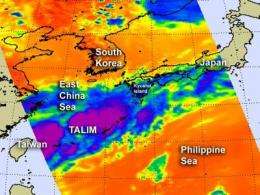
NASA's AIRS instrument (on the Aqua satellite) captured this infrared image of Tropical Depression Talim on June 21 at 3:29 a.m. EDT. The remaining scattered strongest thunderstorms have high, cold cloud tops of -63F (-52C). Credit: NASA/JPL, Ed Olsen

Tropical Storm Talim has weakened overnight due to stronger wind shear and land interaction and is now a depression. NASA satellite data from June 21 revealed that the thunderstorms that make up the tropical cyclone are scattered and disorganized.

NASA's Aqua satellite Atmospheric Infrared Sounder (AIRS) instrument captured an infrared image of Tropical Depression Talim on June 21 at 3:29 a.m. EDT. The imagery showed several areas of strong thunderstorms, but they're now scattered in nature as a result of the two factors. As Talim moved over Taiwan and interacted with the land it weakened. Another factor that added to its rapid weakening was an increase in (winds that batter a storm)from a nearby frontal system. The AIRS data did reveal that some of those scattered thunderstorms were still strong and had high, cold cloud tops of -63 Fahrenheit or -52 Celsius. Those thunderstorms were still dropping heavy rainfall and were occurring mostly over open water at the time of the AIRS image.

On June 21, 2012 at 0000 UTC (June 20 at 8 p.m. EDT/U.S.), Talim's were down to 25 knots (28.7 mph/46.3 kph). At that time, Talim was 100 nautical miles (115 miles/185 km) northeast of Taipei, Taiwan and moving east-northeast at 15 knots (17.2 mph/27.7 kph).

Forecasters at the Joint expect the depression to dissipate later today as it interacts with a frontal boundary that stretches from the to the South China Sea. That system is expected to brush Kyushu Island, Japan.

Explore further: NASA reveals heaviest rainfall in Tropical Storm Talim's southwestern side

add to favorites email to friend print save as pdf

Related Stories

NASA sees some heavy rainfall in tropical storm Talim

Jun 20, 2012

Tropical Storm Talim formed in the South China Sea yesterday, June 18, just south of Hainan Island, China, and NASA's TRMM satellite captured rainfall data right after its birth, revealing some heavy rain.

Recommended for you

Alaska volcano shoots ash 15,000 feet into the air

May 18, 2013

(AP)—One of Alaska's most restless volcanoes has shot an ash cloud 15,000 feet into the air in an ongoing eruption that has drawn attention from a nearby community but isn't expected to threaten air traffic.

NASA sees Cyclone Mahasen hit Bangladesh

May 17, 2013

NASA's Tropical Rainfall Measuring Mission satellite known as TRMM measured Cyclone Mahasen's rainfall rates from space as it made landfall on May 16. Mahasen has since dissipated over eastern India.

Rapid climate change ruled out ice age trees

May 17, 2013

Short, sharp fluctuations in the Earth's climate throughout the last ice age may have stopped trees from getting a foothold in Europe and northern Asia, scientists say.

User comments : 0

More news stories

Heat-related deaths in Manhattan projected to rise

Residents of Manhattan will not just sweat harder from rising temperatures in the future, says a new study; many may die. Researchers say deaths linked to warming climate may rise some 20 percent by the 2020s, ...

Mice, gerbils perish in Russia space flight

A number of mice and eight gerbils sent into space in a Russian capsule destined to find out how well organisms can withstand extended flights perished during their journey, scientists said Sunday as the ...

Kinks and curves at the nanoscale

One of the basic principles of nanotechnology is that when you make things extremely small—one nanometer is about five atoms wide, 100,000 times smaller than the diameter of a human hair—they are going ...

Honeybees trained in Croatia to find land mines

(AP)—Mirjana Filipovic is still haunted by the land mine blast that killed her boyfriend and blew off her left leg while on a fishing trip nearly a decade ago. It happened in a field that was supposedly ...