Earth threatened by glowing green asteroid?
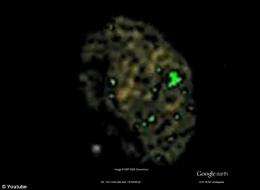
The Daily Mail is reporting that a youtube user has found a strange object while poking around in Google Sky. It looks suspiciously like a glowing green asteroid and he claims it’s heading right for us. But before we call in the experts, let’s do a little bit of critical analysis on our own.
First off, the image raises alarm bells because of the apparent size of the object. Without knowing how far away it may be, it’s hard to say how large it would actually be, but we can put some limits on it. I looked up the region on Aladin and the angular distance between the two stars just to the upper right of the object is 1 arc minute. The object seems to be about that size, so we can use that as a baseline.
Assuming that the object was somewhere in the vicinity of Pluto (roughly 6 billion km), doing a bit of quick geometry means the object would be somewhere around 580,000 km. To put that in context, that’s about 40% the diameter of the Sun. If that were the case, this wouldn’t be an asteroid, it would be a small star. The funny thing about stars is that they tend to be somewhat bright and a lot more round. So that rules out that extreme.
But what if it were very close? At the distance of the moon, that would mean the object would be about 300 km in diameter which would make this thing slightly smaller than the largest asteroid, Ceres. However, this raises another issue: With that much mass, the object should still be pretty round. Additionally, with such a size and distance, it would be very bright. And it’s not.
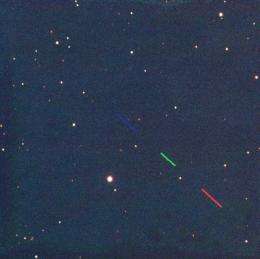
Even closer we run into additional issues. Astronomical images aren’t taken as a single color image. Images like this are taken in 3 filters (RGB) and then combined to make a color image. If the object is nearby, it moves from image to image, showing up in the final image in 3 places, each as a different color. For example, here’s an image of 2011 MD illustrating the effect. Given the object in question doesn’t have this tri-color separation going on, it can’t be nearby.
So this has pretty much ruled out anything anywhere in our solar system. If it’s close, it should have color issues and be bright. If it’s far, it’s too massive to have been missed. Outside of our solar system and it wouldn’t have any apparent motion and should be visible in other images. And it’s not.
In fact, searching the various databases from which Google Sky draws its data (SDSS, DSS, HST, IRAS, and WMAP), the killer asteroid doesn’t appear at all. Thus, it would seem that this object is nothing more than a technical glitch introduced by Google’s stitching together of images. Sorry conspiracy theorists. No Planet X or Nibiru out there this time!
Source: Universe Today


