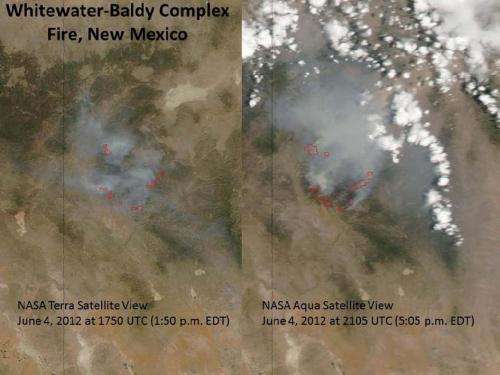
Double-Satellite view of Whitewater-Baldy complex fire
Jun 06, 2012
Credit: NASA Jeff Schmaltz, MODIS Rapid Response Team. Text: NASA Goddard Space Flight Center, Rob Gutro

(Phys.org) -- NASA’s Terra and Aqua satellites circle the globe in formation and capture images of the Earth from their orbit in space. In the “A-train of satellites,” Terra comes before Aqua, and both of them recently captured visible images of the large Whitewater-Baldy Complex Fire burning in western New Mexico.

Both satellites have the same instrument onboard: the Moderate Resolution Imaging Spectroradiometer, or MODIS instrument and it can capture visible or infrared imagery. On June 4, 2012, Terra captured a visible image of the fire at 1750 UTC (1:50 p.m. EDT) and Aqua followed at 2150 UTC (5:05 p.m. EDT). The winds appeared to be lighter when Terra flew overhead because of a temperature inversion. The winds picked up in a north-northeasterly direction as smoke increased in that direction on Aqua imagery. In addition, the morning image from Terra did not contain any clouds, whereas the later image revealed white puffy pyrocumulus clouds – a type of cumulonimbus cloud that forms as a result of the heat generated from the fires.

The fire has now consumed 250,524 acres and is now 20 percent contained, according to the U.S. Forest Service from Gila National Forest. The wildfire is located in rugged terrain and is burning timber, mixed conifer, ponderosa pine, pinon/juniper and grasses, as well as dead vegetation. For updated information on the , visit Inciweb at: http://www.inciweb.org/incident/2870/ .

Explore further: Smoke from Whitewater-Baldy Complex fire affecting 6 states

add to favorites email to friend print save as pdf

Related Stories

Image: Whitewater-Baldy complex fire

May 31, 2012

This image of the Whitewater-Baldy fire, in western New Mexico, was taken on Tuesday, May 29, 2012 at 2000 UTC (4:00 p.m. EDT) from the Moderate Resolution Imaging Spectroradiometer (MODIS) instrument that ...

Colorado's 'Reservoir Road Fire' can be seen from space

Sep 14, 2010

NASA's Aqua satellite flies around the Earth twice a day and captures visible and infrared imagery. On Sept. 12 at 19:20 UTC (3:20 p.m. EDT), the Moderate Resolution Imaging Spectroradiometer (MODIS) instrument ...

Recommended for you

Strong earthquake at exceptional depth

18 hours ago

This morning at 05:45 CEST, the earth trembled beneath the Okhotsk Sea in the Pacific Northwest. The quake, with a magnitude of 8.2, took place at an exceptional depth of 605 kilometers. Because of the great ...

Marine forecasting on the horizon for Indian Ocean Rim

19 hours ago

Nearly all of the member countries of the Indian Ocean Rim Association for Regional Cooperation (IOR-ARC) will attend the week-long workshop to further cooperation and understanding on international ocean ...

Russia evacuates drifting Arctic research station

May 23, 2013

Russia has ordered the urgent evacuation of the 16-strong crew of a drifting Arctic research station after ice floe that hosts the floating laboratory began to disintegrate, officials said Thursday.

User comments : 0

More news stories

Galaxies fed by funnels of fuel

(Phys.org) —Computer simulations of galaxies growing over billions of years have revealed a likely scenario for how they feed: a cosmic version of swirly straws.

Dark, massive asteroid to fly by Earth on May 31

It's 1.7 miles long. Its surface is covered in a sticky black substance similar to the gunk at the bottom of a barbecue. If it impacted Earth it would probably result in global extinction. Good thing it is ...

Source of life running out: water scientists

The majority of people on Earth people will face severe water shortages within a generation or two if pollution and waste continues unabated, scientists warned at a conference in Bonn Friday.