Combining crystallography and visible spectroscopy to understand enzymes
Jun 29, 2012
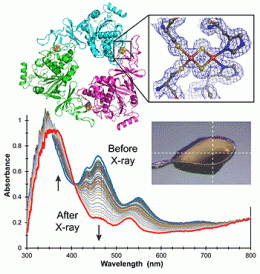
The research team focused on the stachydrine demethylase from Sinorhizobium meliloti 1021. The applications of electronic absorption and resonance Raman spectroscopies, in conjunction with x-ray diffraction, all derive from the same ~25 µm2 region of the crystal (intersection of the cross hairs). The x-ray beam alters the visible spectrum of the crystal with each exposure required to determine the crystal structure of the trimeric enzyme and the Fe-S cluster within each subunit.

Structure and function are intimately linked, but do not necessarily predict the other. For example, x-ray crystallography provides 3D atomic structural information about biological macromolecules but does not define important details about metal ions.

However, the oxidation state of metal ions at an enzyme’s active site has a critical effect on enzyme behavior. Thus, an enzyme’s catalytic function derives from the electronic structure of those atoms influencing or directly participating in the reaction, information not revealed by the scattering methods used in x-ray .

A new technology has been developed that simultaneously carries out crystallography and UV-visible and Raman spectroscopy to determine the atomic structure of the entire protein, and electronic and vibrational structures of the or cofactors within. The combined instrumentation has been used to study the process of demethylation of an organic substrate molecule by an enzyme whose active site includes an iron-sulfur cluster.

The researchers used spectroscopy to follow the change in the of the cluster during the crystallography data collection, and to formulate a mechanism for the overall enzyme reaction mechanism. The results provide insight into a new demethylation reaction, an important class of phenomena that control cellular behavior.

The technology was developed by scientists at the Protein Crystallography Research Resource at the National Synchrotron Light Source at Brookhaven National Laboratory. The new study was led by Allen M. Orville of Brookhaven and Pinghua Liu and Karen N. Allen of Boston University, and is published in the Journal of the American Chemical Society.

Explore further: Long distance calls by sugar molecules

Related Stories

The hidden lives of proteins

Dec 02, 2009

An important Brandeis study appearing in the December 3 issue of Nature raises the curtain on the hidden lives of proteins at the atomic level. The study reports that for the first time, researchers used x ...

Unlocking the function of enzymes

Nov 06, 2007

Fitting a key into a lock may seem like a simple task, but researchers at Texas A&M University are using a method that involves testing thousands of keys to unlock the functions of enzymes, and their findings could open the ...

Scientists find E. coli enzyme must move to function

Apr 07, 2011

Slight oscillations lasting just milliseconds have a huge impact on an enzyme's function, according to a new study by Scripps Research Institute scientists. Blocking these movements, without changing the enzyme's overall ...

Recommended for you

Long distance calls by sugar molecules

9 hours ago

All our cells wear a coat of sugar molecules, so-called glycans. ETH Zurich and Empa researchers have now discovered that glycans rearrange water molecules over long distances. This may have an effect on ...

Researchers discover a way to detect new viruses

Jun 17, 2013

(Phys.org) —In research published in Biochemical and Biophysical Research Communications, Saint Louis University researchers describe a technology that can detect new, previously unknown viruses. The te ...

Genomic assay as an alternative to animal testing

Jun 14, 2013

The method developed by the group in Lund is based on human cells grown in a laboratory. The cells are exposed to a chemical and then parts of their genetic content are filtered out and transferred to a microchip.

User comments : 0

More news stories

Long distance calls by sugar molecules

All our cells wear a coat of sugar molecules, so-called glycans. ETH Zurich and Empa researchers have now discovered that glycans rearrange water molecules over long distances. This may have an effect on ...

Counting small RNA in disease-causing organisms

Small molecules of RNA (tens to hundreds of nucleotides in length) play a key regulatory role in bacteria. Due to their small size, directly measuring the number of small RNA (sRNA) present in a single bacterium ...

3D printing tiny batteries

(Phys.org) —3D printing can now be used to print lithium-ion microbatteries the size of a grain of sand. The printed microbatteries could supply electricity to tiny devices in fields from medicine to communications, ...