Manipulating chromatin loops to regulate genes may offer future treatments for blood diseases
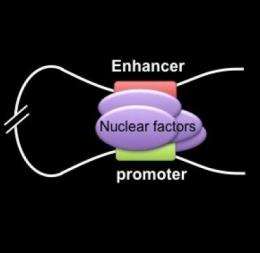
In exploring how proteins interact with crucial DNA sequences to regulate gene activity, researchers have shed light on key biological events that may eventually be manipulated to provide new disease treatments.
Within a cell's nucleus, regulatory elements in DNA called promoters and enhancers communicate with each other in carrying out gene activity, often over large genomic distances, hundreds of thousands of chemical bases apart from each other in chromosomes. As these elements physically contact each other, the intervening DNA sequences bend into loops made of chromatin fiber—the substance of chromosomes.
"Many researchers, including ourselves, have shown that chromatin looping is widespread during gene expression," said study leader Gerd A. Blobel, M.D., Ph.D., holder of the Frank E. Weise III Endowed Chair in Pediatric Hematology at The Children's Hospital of Philadelphia. "However, many details remain uncertain—even whether chromatin loops are a cause or effect of gene transcription. Our current study investigated some of these fundamental questions."
Blobel and first author Wulan Deng, a Ph.D. student at the University of Pennsylvania, are publishing their study in the June 8, 2012 print edition of Cell.
The study focused on gene transcription—the fundamental process by which information encoded in a gene's DNA is converted into RNA before the RNA information is translated into a protein.
Blobel and Deng used blood-forming cells in mice, studying a portion of DNA called the beta-globin locus that expresses part of the hemoglobin molecule. The study team already knew that a chromatin loop forms when a distant enhancer touches the promoter in the beta-globin gene and gives rise to gene expression. They did not know all the proteins that were necessary to generate chromatin loops, nor exactly how such proteins functionally interact with other proteins during gene transcription.
The study team sought to identify a looping factor, a protein that triggers chromatin looping. "We had a strong candidate for a looping factor—a molecule called Ldb1," said Deng. In the current study, Blobel and Deng made use of a specialized tool--a genetically engineered DNA binding protein called a zinc finger (ZF) protein, designed to specifically latch onto a chosen gene location.
They attached Lbd1 to a ZF, thereby tethering it to the target site in the beta-globin promoter. This caused a chromatin loop to form between the enhancer and promoter and allowed high-level gene transcription to occur.
"We showed that Ldb1 is a key factor in these long-range chromatin interactions that drive gene expression," said Blobel. "Moreover, our results suggest that chromatin looping is a cause, not an effect, of gene transcription. We will further study whether and how we can use forced chromatin looping to manipulate gene expression for scientific or therapeutic purposes."
Potential therapeutic implications: "One possible application of forced chromatin looping," added Blobel, "might be in hemoglobin diseases. For example, hematologists have a long-standing goal of reactivating dormant fetal hemoglobin genes to benefit children and adults with sickle cell anemia. It is worth testing whether our approach might force cells to produce fetal hemoglobin and treat sickle cell disease." More broadly, he added, forced chromatin looping might also enable researchers to turn off the expression of specific genes known to drive particular diseases.
More information: "Controlling Long-Range Genomic Interactions at a Native Locus by Targeted Tethering of a Looping Factor," Cell, published online June 7, 2012, and in print on June 8, 2012.
Journal information: Cell
Provided by Children's Hospital of Philadelphia


