Wi-Fi Alliance announces Passpoint program to start in June
May 09, 2012 by Bob Yirka report

(Phys.org) -- The Wi-Fi Alliance, an industry group bent on making Wi-Fi access more available more easily, has announced that it will begin certifying devices and hot-spot providers (using the Hotspot 2 definition) starting next month as part of its Passpoint program, whose purpose is to allow Smartphones and other mobile devices to automatically connect to Wi-Fi hotspots without having to go through a login process.

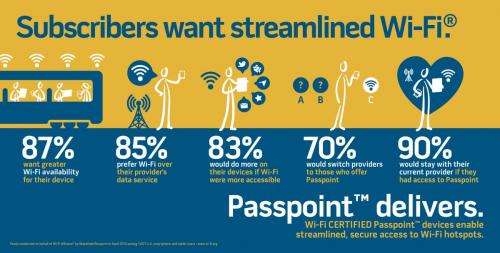
Along with its announcement, the Wi-Fi Alliance also released the results of a survey conducted by Wakefield Research on its behalf that found that of 1000 mobile users polled, 87% said they wanted greater Wi-Fi availability, 85% said they prefer Wi-Fi over wireless data service, 83% would use such services more if they had it, 70% would switch providers to get no-login hot-spot access and 90% would stay with their provider if they offered no-login hot-spot access.

In addition to allowing users to connect to Wi-Fi hot-spots without logging in, the Passpoint program would also institute WPA2 to make using hot-spots a more secure proposition for . To authenticate devices, the program relies on data obtained from the devices .

While the benefits to users are easily seen, free Internet access, those for carriers are less clear. After all, if users start using more, they’ll quite naturally use their wireless data service less, which would imply less profit. But, the Alliance points out, that’s just the point. The big carriers are overwhelmed with data overload at this point and will likely be eager to see some traffic diverted to Wi-Fi. But, other than T-Mobile, which has been supporting the Wi-Fi Alliance since it was formed, none of the big carriers have said whether they will support the program. If they don’t opt in, the Passpoint program won’t have much of an impact.

On the other hand, if all the big carriers do jump in, Wi-Fi traffic from hot-spots would increase dramatically, possibly to the point that carriers might just start charging hot-spot providers by volume, which would mean the end of free hot-spots. And if that happened, a whole new addition would have to be added to the Passpoint program to allow automatic logins with individual agreements based on charges incurred from different hot-spot providers.

This announcement by the Wi-Fi Alliance comes nearly at the same time as a new revision to IEEE's 802.11 WiFi standard has been approved that will allow for faster devices and an improvement in handoff technology. The Alliance said the new revisions are already incorporated into the Passpoint certification program.

Explore further: Internet cable from Cuba to Jamaica comes online

Related Stories

Beware of highway robbers on Wi-Fi

Oct 12, 2009

As the number of Wi-Fi hot spots grows, travelers might want to heed a word of caution from the Wi-Fi Alliance, a nonprofit industry group that promotes Wi-Fi technology: Think security.

Wi-Fi for travelers becomes Web marketing lure

Nov 10, 2009

(AP) -- Google, Yahoo, eBay and Microsoft, competitors on the Web, all have the same idea for marketing themselves this holiday season: temporarily providing free Wi-Fi access in airports, airplanes and public places.

Verizon gives free Wi-Fi to Internet customers

Jul 27, 2009

(AP) -- Verizon is giving some of its home broadband customers free access to thousands of Wi-Fi hotspots in airports and other public places, taking a page from competitors that already offer wireless Internet access.

Fundamental Shift in Embedded Wi-Fi Market

Aug 24, 2004

A wireless LAN is one in which a mobile user can connect to a local area network (LAN) through a wireless (radio) connection. One of the hottest technology markets, Wireless LAN (WLAN), or Wi-Fi, is undergoing a fundamental shift, according to In-Stat/MDR ...

Recommended for you

Internet cable from Cuba to Jamaica comes online

May 21, 2013

A new branch of the Venezuela-to-Cuba undersea fiber-optic cable has reportedly come online, linking the island to nearby Jamaica, increasing Cuba's potential international communications bandwidth and providing a backup ...

Carlos Slim company to buy US mobile phone firm

May 20, 2013

Mexican phone giant America Movil, owned by billionaire Carlos Slim, announced Monday that its US unit reached a deal to acquire US mobile phone company Start Wireless Group.

User comments : 2

Adjust slider to filter visible comments by rank

Display comments: newest first

Tenche
not rated yet May 09, 2012
Oooo Goodie. Time to start hacking.
alfie_null
not rated yet May 10, 2012
Oooo Goodie. Time to start hacking.

Yes! Analogously (somewhat), I wouldn't give my paper mail to some stranger with assurances he will deliver it (unopened). But phones are appliances. They are supposed to just work without troubling us with technical details.

More news stories

Google Drive sports new view and scan enhancements

(Phys.org) —Google Drive has a new look and functions. The makeover in Google Drive features scanning and interface enhancements that put the user into "card" mode. The enhancements make it easy for the ...

Solar Kettle allows for boiling water off the grid

(Phys.org) —A company called Contemporary Energy has unveiled a new device it calls the Solar Kettle. It looks very much like a normal coffee thermos, but has flaps on one side that open to allow for collecting ...

Review: Google music plan solid, serendipitous

Google's new music service offers a lot of eye candy to go with the tunes. The song selection of around 18 million tracks is comparable to popular services such as Spotify and Rhapsody, and a myriad of playlists ...

Controlling mood through the motions of mitochondria

(Medical Xpress)—Regulating the distribution of power in neurons is done by a system that makes the national electric grid look simple by comparison. Each neuron has several thousand mitochondria confined ...

A quantum simulator for magnetic materials

Physicists understand perfectly well why a fridge magnet sticks to certain metallic surfaces. But there are more exotic forms of magnetism whose properties remain unclear, despite decades of intense research. ...

A hidden population of exotic neutron stars

(Phys.org) —Magnetars – the dense remains of dead stars that erupt sporadically with bursts of high-energy radiation - are some of the most extreme objects known in the Universe. A major campaign using ...