SpaceX cargo vessel prepares to leave space station (Update 2)
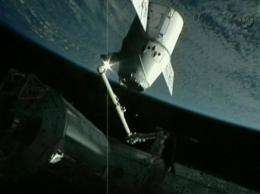
US company SpaceX's Dragon cargo ship is preparing to make its return journey to Earth after a landmark mission to the International Space Station, NASA and SpaceX representatives said Wednesday.
The release of the unmanned Dragon is set for 5:35 am Eastern time (0935 GMT) on Thursday, with an intact splashdown in the Pacific Ocean off California planned for 1544 GMT, SpaceX said.
"We have a lot ahead of us on the SpaceX side," said mission director John Couluris in a briefing with reporters on the eve of the spacecraft's return after a seven-day mission to the orbiting outpost.
"We have done it once," he said, referring to the Dragon's test flight in December 2010 when the capsule entered and returned safely from orbit for the first time.
"But it is still a very challenging phase of flight," he added. "We are not taking this lightly at all."
The ISS crew is to wake up at 0400 GMT Thursday, unhook the capsule from space station power sources and complete final preparations, according to Holly Ridings, NASA flight director.
After that, a short series of maneuvers will set the stage for Dragon's departure.
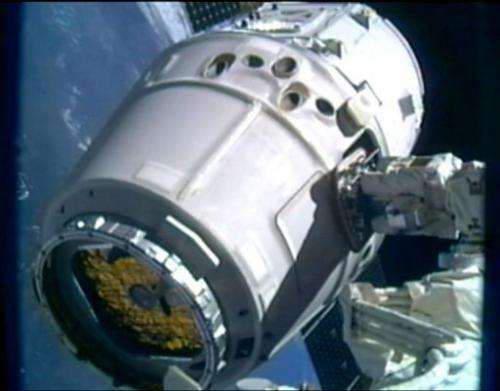
The station's robotic arm, which grabbed the capsule on its approach May 22, and helped bring the cargo vessel in closer for station berthing, has already been re-grappled to the Dragon, she said.
"You do the unberth from the space station and then you move the arm out to a release position," she said.
The detachment from the space station is set for 0805 GMT, with the release by the robotic arm following about an hour and a half later.
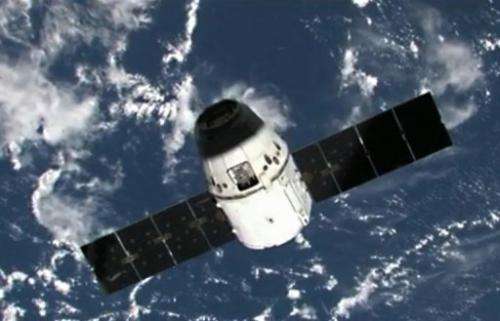
Then, the Dragon engines will fire -- first two small burns and then one big burn -- as its heads away from the space station.
The capsule is supposed to make an ocean landing 490 nautical miles (907 kilometers) southwest of Los Angeles, where three vessels are standing by as recovery boats.
It will then be transported to Texas so that the cargo it is bringing back can be returned to NASA, though the US space agency cautioned that if anything goes wrong, there is nothing crucial on board.
"There is not anything coming home that we couldn't afford to not get back," said Ridings.
Couluris added that regardless of what happens to the capsule on Thursday, the mission has been "a major success" for both NASA and SpaceX.
The cargo ship launched on May 22 carrying 521 kilograms (1,148 pounds) of gear for the space lab, including food, supplies, computers, utilities and science experiments. It plans to return a 660-kilogram load to Earth.
On May 25, the Dragon became the first privately owned spacecraft to berth with the ISS, an event that NASA and White House officials hailed as the start of a new era in spaceflight in which commercial enterprise will take on a larger role.
The United States retired its space shuttle fleet last year, leaving cargo missions up to the space agencies of Russia, Japan and Europe.
Only Russia can return its cargo capsules intact. The other supply ships burn up on reentry to Earth's atmosphere.
Until private US ventures come up with a vehicle that can replace the shuttle and carry humans to the $100 billion orbiting lab, the world's astronauts must rely on Russia's Soyuz capsules at $63 million a ticket.
US astronaut Don Pettit, who is part of the six-member crew at the ISS and helped unload and restock the capsule, described the Dragon as "roomier than a Soyuz" and said it boasts about as much space for cargo as his pickup truck.
The white Dragon capsule stands 4.4 meters (14.4 feet) high and is 3.66 meters in diameter, and could carry as much as 3,310 kilograms split between pressurized cargo in the capsule and unpressurized cargo in the trunk.
It was also built to carry up to seven humans to the ISS. The Soyuz carries three at a time.
California-based SpaceX, owned by billionaire Internet entrepreneur Elon Musk, says it aims to begin taking people to the space station by 2015.
Using some of their own money and some funds from NASA, SpaceX and its competitor Orbital Sciences Corporation will likely become the chief cargo servicers of the space station, which is set to remain operational until 2020, NASA has said.
SpaceX has a $1.6 billion contract with NASA to supply the station in coming years, and Orbital Sciences has a $1.9 billion contract to do the same. Orbital's first test flight is scheduled for later this year.
(c) 2012 AFP


