South Korea approves emissions trading scheme
May 03, 2012
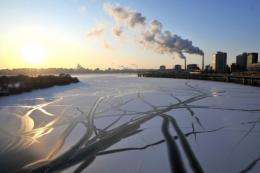
File photo shows the frozen Han river in Seoul, South Korea, in 2010. South Korea's parliament has approved a long-delayed bill to start trading carbon dioxide emissions in 2015, joining the vanguard of countries battling climate change.

South Korea's parliament has approved a long-delayed bill to start trading carbon dioxide emissions in 2015, joining the vanguard of countries battling climate change.

The legislation approved late Wednesday means it will become one of the first Asian countries to implement a nationwide cap-and-trade system.

Such a scheme limits industry emissions of carbon dioxide, but allows companies to buy credits if they want to emit more, or to sell credits if they can cut emissions.

Annual greenhouse gas emissions by have doubled in the past two decades to about 600 million tons from about 300 million tons in 1990, a government official said.

The limits will apply to companies that discharge 125,000 tons or more of annually or workplaces that emit at least 25,000 tons a year.

The bill was first submitted to parliament in April last year but faced strong opposition from the Federation of Korean Industries which represents big conglomerates. They said it would hurt export competitiveness.

The Knowledge Economy Ministry said emission limits would be decided six months before the scheme goes into force.

An exchange would be either designated or created to ensure stable trading of emissions credits and the cost of such credits would be decided by the market, the ministry said.

Companies which exceed emissions limits would pay a penalty equal to three times the market value of the credits -- but the penalty would be limited to a maximum 100,000 won ($88.5) per ton of emission.

The New York-based Environmental Defense Fund (EDF) hailed the legislation, which secured near-unanimous approval in parliament.

"South Korea's bold move is evidence that fast-growing economies can put a limit on dangerous with broad support from elected leaders, and of the mounting desire and momentum to curb across both the developed and developing world," said its Asia director Richie Ahuja.

"Such visionary actions by countries is how the global climate race will be won," Ahuja said in a statement.

The EDF said the legislation would cover about 60 percent of the country's , putting it on track to fulfill its pledge to reduce emissions 30 percent from projected levels by 2020.

South Korea, Asia's fourth largest economy, is now following a similar timetable to China, which plans to start a nationwide carbon-trading programme in 2015.

Australia and New Zealand have already approved carbon-trading systems.

Explore further: Sunken WWII ships may pollute US waters

add to favorites email to friend print save as pdf

Related Stories

China plans carbon-trading pilot scheme

Jul 18, 2011

China will introduce a pilot scheme for carbon emissions trading and gradually develop a national market as the world's largest polluter seeks to reduce emissions and save energy, state media said.

NZ carbon price system hikes household costs

Jul 01, 2010

(AP) -- New carbon-trading laws intended to reduce climate-changing pollution emissions took effect Thursday in New Zealand, immediately sending gas prices higher.

EU extends hacker-induced emissions trading halt

Jan 27, 2011

The EU extended a freeze Thursday on trading in carbon credits ordered after hackers broke into national trading registries and stole and then sold millions of euros worth of polluting rights.

China looks at carbon tax, official says in US

Jan 11, 2012

China's lead negotiator on climate change said Wednesday that the world's largest emitter is considering imposing a tax on carbon to reduce the use of dirty energy as its economy grows.

EU backs climate change measures

Mar 05, 2008

The European Union has voted to support climate change proposals to cut emissions and increase energy efficiency.

EU to ban China, India carbon credits trade

Jan 21, 2011

Europe is to ban a highly lucrative trade in polluting rights obtained by European-based companies under a UN scheme to favour environmentally-friendly industrial investment in the likes of China or India.

Recommended for you

Unraveling the Napo's mystery

1 hour ago

In the United States, rivers and their floodplains are well-documented and monitored. Ecuador's largest river, however, remains largely mysterious. Research led by Michigan State University is helping the ...

Hong Kong launches plan to tackle waste crisis

1 hour ago

Hong Kong on Monday launched a ten-year plan to reduce waste by 40 percent per person as part of efforts to catch up with other leading Asian cities and avert a looming environmental crisis.

User comments : 0

More news stories

Unraveling the Napo's mystery

In the United States, rivers and their floodplains are well-documented and monitored. Ecuador's largest river, however, remains largely mysterious. Research led by Michigan State University is helping the ...

Slow earthquakes: It's all in the rock mechanics

(Phys.org) —Earthquakes that last minutes rather than seconds are a relatively recent discovery, according to an international team of seismologists. Researchers have been aware of these slow earthquakes, ...

Hong Kong launches plan to tackle waste crisis

Hong Kong on Monday launched a ten-year plan to reduce waste by 40 percent per person as part of efforts to catch up with other leading Asian cities and avert a looming environmental crisis.

Study shows how bilinguals switch between languages

(Medical Xpress)—Individuals who learn two languages at an early age seem to switch back and forth between separate "sound systems" for each language, according to new research conducted at the University of Arizona.

Non-wetting fabric drains sweat

(Phys.org) —Waterproof fabrics that whisk away sweat could be the latest application of microfluidic technology developed by bioengineers at the University of California, Davis.

Lab sets a new record for creating heralded photons

(Phys.org) —Entanglement, by general consensus of physicists, is the weirdest part of quantum science. To say that two particles, A and B, are entangled means that they are actually two parts of an inseparable ...