Building a better solar panel -- one molecule at a time
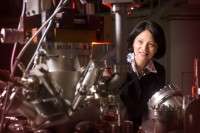
(Phys.org) -- One of the fundamental building blocks in modern chemistry, an organometallic chemical compound called ferrocene, has never been structurally defined - until now.
Millions of dollars are being spent investigating opportunities to develop solar panels out of the synthetic material because it is stable and inexpensive to produce. Unlocking the properties of ferrocene will help pave the way to the development of a global solar power industry.
In a paper published in the Journal of Organometallic Chemistry, Swinburne University of Technology Professor Feng Wang has described the structure of the compound for the first time.
"Ferrocene is one of the most important compounds in chemistry, so we are very excited to be playing a small part in unravelling its secrets," Professor Wang said.
"The discovery of ferrocene in the 1950s prompted the evolution of a whole new branch of chemistry - but until now, nobody has been able to conclusively prove its molecular structure.
"The sandwich complex which combines two pentagons with an iron atom in the centre with two conformers is a little like twin children - they look like each other but have different functions, depending on the angle they have to each other. This difference in response to each other creates different levels of iron vibration. By measuring this vibration, we can identify how the ferrocene molecules align to each other."
Professor Wang is an expert in molecular structures, working at the intersection of chemistry and physics, using Swinburne's supercomputer to develop molecular models for projects ranging from cancer drug targeting to solar cell development.
When conducting tests on the properties of ferrocene, she noticed some slight irregularities in the compound's properties when analysed at particular infrared (IR) spectra using computer simulated IR spectra. Closer examination and testing indicated the behaviour of ferrocene molecules at different wavelengths - triggering the discovery.
Light-sensitive solar dyes incorporated into ferrocene/ferrocenium have been demonstrated to have great potential for ferrocene-based electrolytes in solar cell applications. An appropriate understanding of the properties of the compound is particularly important in this development.
Professor Wang will collaborate with colleagues from the University of Melbourne and the Australian Synchrotron to conduct further research into the exact nature of ferrocene using the Australian Synchrotron later this year.
Journal information: Journal of Organometallic Chemistry
Provided by Swinburne University of Technology


