Rice students invent slingshot-driven test for Air Force
May 31, 2012
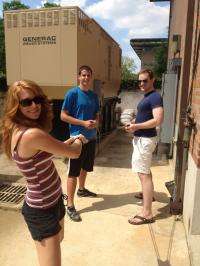
From left, Rice University students Autumn Allen, Tremayne Kaseman and Duncan Eddy test the slingshot that powers their impact-testing device, developed for the Air Force. (Credit: Rice University)

What do you get when you combine a slingshot, a fish tank, a stack of 2-by-4s and five engineering students determined to help the United States Air Force?

For Team CADET at Rice University, the answer is a device to stop high-velocity projectiles without destroying them. With the Air Force's current methods, artillery shells are destroyed beyond recovery. The Air Force wants to know more about their behavior as they accelerate and decelerate.

"The challenge was to simulate high-acceleration impacts in a nondestructive way," said Duncan Eddy, a junior in mechanical engineering and member of the Controllable Acceleration-Deceleration Equipment Tester design team. "The problem turned out to have a hands-on, mechanical engineering focus."

The other team members, Autumn Allen, Tremayne Kaseman, William Li and John Stretton, recently earned their degrees in mechanical engineering from Rice. Their adviser is Andrew Dick, assistant professor of .

This video is not supported by your browser at this time.

Currently, the Air Force simulates deceleration by firing cannons into walls. The strategy is expensive and the sensor module and target are typically destroyed in the process. Team CADET's goal was to sustain deceleration for at least 10 milliseconds, and without destruction. They machined a cylinder of aircraft-gauge aluminum and sealed a digital accelerometer inside. Next, they built a 14-foot wooden frame to hold a track fashioned from angle iron.

On one end, they attached a slingshot made from surgical tubing; on the other, above the track, they fitted a 20-gallon fish tank with transparent plastic. Into the bottom of the tank they drilled a line of 40 holes and sealed them with a removable rubber sheet.

When the cylinder holding the is fired with the slingshot, reaching a maximum velocity of about 50 miles per hour, the sheet is pulled off and the water is released from the tank. The falling water slows the cylinder, and the rate of is measured and recorded on the digital device. The cylinder and its contents remain undamaged and the test can be repeated indefinitely.

"Nothing is destroyed. You just fill the tank with water again and reload the slingshot," said Eddy, who stressed that the prototype can be scaled to any size.

"We started last fall with a ton of different ideas but ended up with a plan that is simple and inexpensive, and the scale can easily be changed – a bigger tank, more water, more holes, a longer track, a bigger slingshot," Eddy said.

In April, the team visited Eglin Air Force Base in Florida and met with members of the Munitions Directorate of the Research Laboratory, which commissioned the project. The team presented a video demonstration and PowerPoint explanation, and submitted their 65-page final report.

"They liked what they saw and said they were interested in exploring the idea further. We know we've created something entirely new. The parts are not new but the combination is. Also -- and this is important -- we came in under budget," Eddy said.

Explore further: Sensitive bomb detector to rove in search of danger

add to favorites email to friend print save as pdf

Related Stories

Experimental Scramjet aircraft set for test flight

Mar 23, 2011

The X-51A Waverider hypersonic scramjet project is set for its second test flight today, and the U.S. Air Force hopes it will demonstrate technology that can eventually be used for more efficient transport ...

Raytheon Focuses Radar Expertise on Ground Targets in Motion

Jul 24, 2005

Seeking more protection for ground forces without enhancing risk to aviators, the U.S. Air Force has engaged Raytheon Company to devise a way for aircraft, from a safe distance, to detect, track and target hostile forces ...

Swimming led to flying, physicists say

May 03, 2011

(PhysOrg.com) -- Like a fish paddles its pectoral fins to swim through water, flying insects use the same physics laws to "paddle" through the air, say Cornell physicists.

Recommended for you

Sensitive bomb detector to rove in search of danger

May 24, 2013

European researchers have developed and tested a light-weight device capable of detecting extremely minute quantities of explosives from up to 20 metres away, providing an invaluable law-enforcement tool ...

How soon could car seats enter the 3-D comfort zone?

May 23, 2013

New 3D textiles made of recyclable polyester fibres could contribute help cars be easier to recycle. But recycling technology has yet to progress in separating seat material from other car components.

NASA: Austin, calling Austin. 3-D pizzas to go

May 22, 2013

(Phys.org) —The idea of living with 3-D printed food is neither unthinkable nor new; designers and futurists have been looking to 3-D printing as food's next frontier. In 2012, there was news that the Thiel ...

User comments : 2

Adjust slider to filter visible comments by rank

Display comments: newest first

hyongx
5 / 5 (1) May 31, 2012
star this comment if you clicked on this article for the cute redhead in the picture. :)
Lex Talonis
1 / 5 (1) May 31, 2012
Mmmmm Ginger Minge!!!!

More news stories

Yahoo, pay-TV operators among Hulu bidders

Online video site Hulu is again up for sale, with Yahoo and pay TV operators DirecTV and Time Warner Cable among the seven bidders, according to a person with direct knowledge of the matter.

Radiation leak at Japan lab; small impact expected

An atomic research lab in northern Japan has reported a radiation leak that may have affected about 50 people, though none were hospitalized and no impact was expected outside the facility, the lab's operator ...

Google eyes emerging markets networks

Google has become deeply involved in a series of projects to build and operate wireless networks in emerging markets including sub-Saharan Africa and Southeast Asia, a report said Friday.

Galaxies fed by funnels of fuel

(Phys.org) —Computer simulations of galaxies growing over billions of years have revealed a likely scenario for how they feed: a cosmic version of swirly straws.