Move over pie charts, here come FatFonts
May 30, 2012
Move over pie charts, here come FatFonts
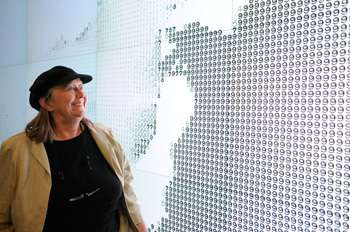
University of Calgary computer science professor Sheelagh Carpendale helped develop FatFonts which aligns the two aspects of data—numeric value and visual representation. You can both read the numbers and interpret the data visually. Photo by Riley Brandt

(Phys.org) -- Researchers in the computer science department at the University of Calgary have developed a new font for numbers that represent their relative value. Unlike the usual numeric typefaces, the amount of ink—or dark pixels—used for each digit in FatFonts is proportional to its quantitative value.

Miguel Nacenta, formerly a post doc (now an assistant professor at University of St Andrews in Scotland), came up with the idea and worked with Sheelagh Carpendale, a computer science professor and Uta Hinrichs, a PhD student specializing in Computational Media Design.

Nacenta presented the work at the important Advanced Visual Interfaces (AVI) conference last week in Naples, Italy.

The core idea of FatFonts is to align the two aspects of data—numeric value and visual representation. "We use numbers to represent exact data values; but when something more visual is needed then we transform this data into graphs or pie charts," explains Nacenta. "The problem is by transforming data into visuals it makes it more difficult to access the actual data values."
Move over pie charts, here come FatFonts
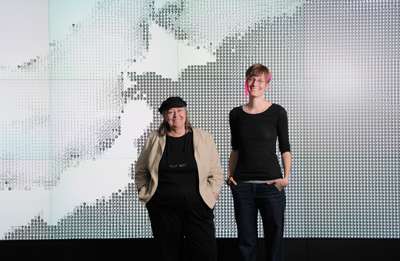
Carpendale (left) and PhD student Uta Hinrichs showcase FatFonts presenting data of wave size predictions of the devastating tsunami that took place on the eastern coast of Japan in 2011. Photo by Riley Brandt

With FatFonts, the amount of ink used for each digit is related to the value of the digit it represents. "The digit '3' uses three times the amount of ink than digit '1,'" says Hinrichs. "When you put FatFonts in a grid, they work like a table where you can read the numbers but also as an image that you can interpret visually."

Scientists can use FatFonts for large numeric data sets where it's important to see both individual data values and an overview of the information—for example, most data that's represented as a heat map can be represented via FatFonts. "They're particularly interesting to use on large high-resolution wall displays or large posters," says Nacenta, "stepping back provides you an overview image while walking closer to the display reveals the data values."

FatFonts are getting a lot of attention. Beyond academia, artists, designers and typographers are also interested.

"People have started to use FatFonts for their own visualizations and even created their own FatFont types. We have even heard from artists who want to design FatFont jewelry," says Hinrichs. "We are really excited that the idea is spreading and we're hoping that FatFonts will become common in infographics, data representations and posters."

Explore further: New database tracks 11,000 global rendition flights

add to favorites email to friend print save as pdf

Related Stories

Researchers solve mystery of disappearing bird digit

Sep 04, 2011

Evolution adds and subtracts, and nowhere is this math more evident than in vertebrates, which are programmed to have five digits on each limb. But many species do not. Snakes, of course, have no digits, and ...

Finger ratio points to penile length

Jul 05, 2011

The ratio between the second and fourth digits is linked to stretched penile length according to a study published online this week in Asian Journal of Andrology. This finding suggests that digit ratio can predict adult ...

Color my numbers

Dec 17, 2009

For as many as 1 in 20 people, everyday experiences can elicit extra-ordinary associated sensations. The condition is known as synaesthesia and the most common form involves "seeing" colours when reading words and numbers. ...

Time and numbers mix together in the brain

Jul 19, 2011

(Medical Xpress) -- Clocks tell time in numbers -- and so do our minds, according to a new study which will be published in an upcoming issue of Psychological Science, a journal of the Association for Psychological Scienc ...

300-dpi: Epson, E-ink give ePaper a resolution boost

May 18, 2011

(PhysOrg.com) -- For the most part when we think about E-Ink technology high resolution are not the words that come to mind. We all love our e-readers, such as the Nook and the Kindle, because they give us ...

Recommended for you

Drones may violate international law

6 hours ago

(Phys.org) —As President Obama gives a speech on national security—including defending U.S. use of drones to combat terrorism—Leila Sadat, JD, international law expert and professor of law at Washington University in ...

Text in on smarter phones

May 22, 2013

Alternative input methods for smart phones, such as Swype and SwiftKey, offer substantial benefits to users and are comparable with common typing speeds found on computer keyboards, according to a report published by researchers ...

AP probe further strains Obama, press rapport

May 20, 2013

Reports emerged last week that the Department of Justice had secretly obtained two months' worth of phone records of journalists at The Associated Press as part of a larger investigation into a failed al-Qaida ...

User comments : 0

More news stories

Mobile app to help fight against racism in France

A French anti-racism association is launching a mobile application it hopes will help eradicate racist graffiti by enabling users to take photos of offensive tags, geo-locate them and get them removed.

Review: HP Sleekbook 15 combines size, style

My experience with Windows 8 has been limited to a few devices, including the Microsoft Surface, so I was happy to get the opportunity to review the Hewlett-Packard Pavilion Sleekbook 15, a fairly inexpensive ...