NASA satellite sees Tropical Storm Sanvu pass Guam, strengthen
May 22, 2012
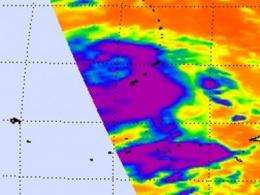
This infrared image of Tropical Storm Sanvu was captured from the AIRS instrument on NASA's Aqua satellite on May 22, and shows a large area of very strong thunderstorms near the center of circulation. The purple color indicates the coldest cloud top temperatures, and strongest thunderstorms with the heaviest rainfall. Credit: Credit: NASA JPL, Ed Olsen

Tropical Depression 03W in the western North Pacific did exactly what forecasters expected over the last twenty-four hours: it became a tropical storm named Sanvu and passed west of Guam on a northwesterly track.

On May 22 at 0900 UTC (5 a.m. EDT), Tropical Storm Sanvu was more than 100 miles west-northwest of Andersen Air Force Base, Guam, and still over 600 nautical miles south of Iwo To, Japan and headed in that direction. Sanvu's center was located near 15.2 North and 141.9. East. It was still churning up rough surf around Guam. Sanvu has near 45 knots (52 mph/83 kph) with higher gusts. Sanvu is a compact tropical storm, with tropical-storm-force winds extending out 90 miles from the center, making it about 180 miles in diameter.

An of Tropical Storm Sanvu was captured from the Atmospheric Infrared Sounder (AIRS) instrument onboard NASA's Aqua satellite on May 22, and shows a large area of very strong thunderstorms near the center of circulation. Forecasters at the Joint noted the AIRS imagery "shows the system has further consolidated and convection has resurged, especially along the northeast flank."

Forecasters expect Sanvu to keep intensifying as it moves closer to Iwo To because of warm and light wind shear. Thereafter it is expected to curve to the northeast and transition to an extra-tropical storm.

Explore further: NASA's BARREL mission launches 20 balloons

add to favorites email to friend print save as pdf

Related Stories

Recommended for you

NASA's BARREL mission launches 20 balloons

6 hours ago

(Phys.org) —In Antarctica in January, 2013 – the summer at the South Pole – scientists released 20 balloons, each eight stories tall, into the air to help answer an enduring space weather question: ...

Power of US tornado dwarfs Hiroshima bomb

7 hours ago

Wind, humidity and rainfall combined precisely to create Monday's massive killer tornado in Oklahoma. The awesome amount of energy released dwarfed the power of the atomic bomb that leveled Hiroshima.

Origins of human culture linked to rapid climate change

13 hours ago

Rapid climate change during the Middle Stone Age, between 80,000 and 40,000 years ago, during the Middle Stone Age, sparked surges in cultural innovation in early modern human populations, according to new research.

User comments : 0

More news stories

NASA's BARREL mission launches 20 balloons

(Phys.org) —In Antarctica in January, 2013 – the summer at the South Pole – scientists released 20 balloons, each eight stories tall, into the air to help answer an enduring space weather question: ...

Power of US tornado dwarfs Hiroshima bomb

Wind, humidity and rainfall combined precisely to create Monday's massive killer tornado in Oklahoma. The awesome amount of energy released dwarfed the power of the atomic bomb that leveled Hiroshima.

Encouraging signs for bee biodiversity

Declines in the biodiversity of pollinating insects and wild plants have slowed in recent years, according to a new study. Researchers led by the University of Leeds and the Naturalis Biodiversity Centre in the Netherlands ...

If you can remember it, you can remember it wrong

(Medical Xpress)—Native peoples in regions where cameras are uncommon sometimes react with caution when their picture is taken. The fear that something must have been stolen from them to create the photo ...

B vitamins could delay dementia

(Medical Xpress)—Despite spending billions of dollars on research and development, drug companies have been unable to come up with effective treatments for dementia and Alzheimer's Disease (AD). Now, A. ...