NASA preparing to launch NuSTAR, its newest X-ray eyes
May 30, 2012
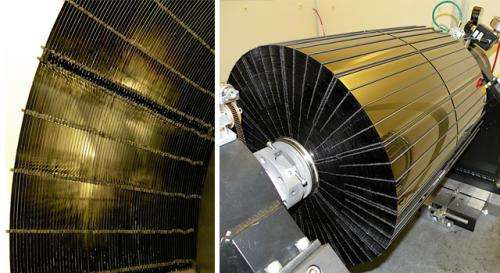
NASA's Nuclear Spectroscopic Telescope Array, or NuSTAR, has a complex set of mirrors, or optics, that will help it see high-energy X-ray light in greater detail than ever before. These images show different views of one of two optic units onboard NuSTAR, each consisting of 133 nested cylindrical mirror shells as thin as a fingernail. The mirrors are arranged in this way in order to focus as much X-ray light as possible. Image credit: NASA/JPL-Caltech

(Phys.org) -- NASA's Nuclear Spectroscopic Telescope Array, or NuSTAR, is being prepared for the final journey to its launch pad on Kwajalein Atoll in the central Pacific Ocean. The mission will study everything from massive black holes to our own sun. It is scheduled to launch no earlier than June 13.

"We will see the hottest, densest and most energetic objects with a fundamentally new, high-energy X-ray telescope that can obtain much deeper and crisper images than before," said Fiona Harrison, the NuSTAR principal investigator at the California Institute of Technology in Pasadena, Calif., who first conceived of the mission 20 years ago.

The observatory is perched atop an Orbital Sciences Corporation Pegasus XL rocket. If the mission passes its Review on June 1, the rocket will be strapped to the bottom of an aircraft, the L-1011 Stargazer, also operated by Orbital, on June 2. The Stargazer is scheduled to fly from Vandenberg Air Force Base in central California to Kwajalein on June 5 to 6.

After taking off on launch day, the Stargazer will drop the rocket around 8:30 a.m. PDT (11:30 a.m. EDT). The rocket will then ignite and carry NuSTAR to a low orbit around Earth.

"NuSTAR uses several innovations for its unprecedented imaging capability and was made possible by many partners," said Yunjin Kim, the project manager for the mission at NASA's Jet Propulsion Laboratory in Pasadena, Calif. "We're all really excited to see the fruition of our work begin its mission in space."

NuSTAR will be the first to create focused images of cosmic X-rays with the highest energies. These are the same types of X-rays that doctors use to see your bones and airports use to scan your bags. The telescope will have more than 10 times the resolution and more than 100 times the sensitivity of its predecessors while operating in a similar energy range.
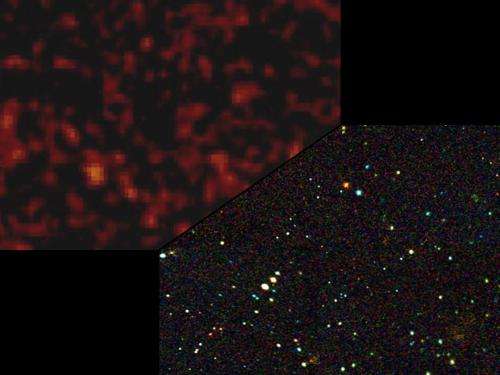
This image comparison demonstrates NuSTAR's improved ability to focus high-energy X-ray light into sharp images. The image on the left, taken by the European Space Agency's INTEGRAL satellite, shows high-energy X-rays from galaxies beyond our own. The light is "unresolved," meaning that individual objects creating the light -- in particular, the active supermassive black holes -- cannot be distinguished. Image credit: ESA/NASA/JPL-Caltech

The mission will work with other telescopes in space now, including NASA's Chandra X-ray Observatory, which observes lower-energy X-rays. Together, they will provide a more complete picture of the most energetic and exotic objects in space, such as , dead stars and jets traveling near the speed of light.

"NuSTAR truly demonstrates the value that NASA's research and development programs provide in advancing the nation's science agenda," said Paul Hertz, NASA's Astrophysics Division director. "Taking just over four years from receiving the project go-ahead to launch, this low-cost Explorer mission will use new mirror and detector technology that was developed in NASA's basic research program and tested in NASA's scientific ballooning program. The result of these modest investments is a small space telescope that will provide world-class science in an important but relatively unexplored band of the electromagnetic spectrum."

will study black holes that are big and small, far and near, answering questions about the formation and physics behind these wonders of the cosmos. The observatory will also investigate how exploding stars forge the elements that make up planets and people, and it will even study our own sun's atmosphere.

The observatory is able to focus the high-energy X-ray light into sharp images because of a complex, innovative telescope design. High-energy light is difficult to focus because it only reflects off mirrors when hitting at nearly parallel angles. solves this problem with nested shells of mirrors. It has the most nested shells ever used in a space telescope: 133 in each of two optic units. The mirrors were molded from ultra-thin glass similar to that found in laptop screens and glazed with even thinner layers of reflective coating.

The telescope also consists of state-of-the-art detectors and a lengthy 33-foot (10-meter) mast, which connects the detectors to the nested mirrors, providing the long distance required to focus the X-rays. This mast is folded up into a canister small enough to fit atop the Pegasus launch vehicle. It will unfurl about seven days after launch. About 23 days later, science operations will begin.

Explore further: NASA's NuSTAR gearing up for launch

Related Stories

NASA's NuSTAR gearing up for launch

May 23, 2012

(Phys.org) -- Final pre-launch preparations are underway for NASA's Nuclear Spectroscopic Telescope Array, or NuSTAR. The mission, which will use X-ray vision to hunt for hidden black holes, is scheduled to ...

Engineers tuck nuSTAR in its nose cone

Mar 05, 2012

(PhysOrg.com) -- Technicians at Vandenberg Air Force Base in central California are placing the two halves of the rocket nose cone, or fairing, around NASA's Nuclear Spectroscopic Telescope Array (NuSTAR), ...

NuSTAR mated to its rocket

Feb 20, 2012

(PhysOrg.com) -- NASA's Nuclear Spectroscopic Telescope Array (NuSTAR) is being mated, or attached, to its Pegasus XL rocket today at Vandenberg Air Force Base in central California.

NASA's NuSTAR ships to Vandenberg for March 14 launch

Jan 25, 2012

(PhysOrg.com) -- NASA's Nuclear Spectroscopic Telescope Array, or NuSTAR, shipped to Vandenberg Air Force Base, Calif., on Tuesday, to be mated to its Pegasus launch vehicle. The observatory will detect X-rays ...

Launch of NASA's nuSTAR mission postponed

Mar 19, 2012

(PhysOrg.com) -- The planned launch of NASA's Nuclear Spectroscopic Telescope Array (NuSTAR) mission has been postponed after a March 15 launch status meeting. The launch will be rescheduled to allow additional ...

NuSTAR spacecraft arrives in California

Jan 30, 2012

(PhysOrg.com) -- NASA's Nuclear Spectroscopic Telescope Array, or NuSTAR, mission arrived at Vandenberg Air Force Base in California Friday morning after a cross-country trip by truck from the Orbital Sciences Corporation ...

Recommended for you

Forecast for Titan: Wild weather could be ahead

13 hours ago

(Phys.org) —Saturn's moon Titan might be in for some wild weather as it heads into its spring and summer, if two new models are correct. Scientists think that as the seasons change in Titan's northern hemisphere, ...

SDO observes mid-level solar flare

14 hours ago

UPDATE 16:30 p.m. EDT: The M7-class flare was also associated with a coronal mass ejection or CME, another solar phenomenon that can send billions of tons of particles into space. While this CME was not Ea ...

NASA's IRIS mission readies for a new challenge

23 hours ago

(Phys.org) —The time draws near. NASA is getting ready to launch a new mission, a mission to observe a largely unexplored region of the solar atmosphere that powers its dynamic million-degree outer atmosphere and drives ...

User comments : 0

More news stories

Very Large Telescope celebrates 15 years of success

(Phys.org) —With this new view of a spectacular stellar nursery ESO is celebrating 15 years of the Very Large Telescope—the world's most advanced optical instrument. This picture reveals thick clumps ...

US House sends message on Keystone pipeline

US lawmakers agreed to a bill that would speed construction of a Canada-US oil pipeline and circumvent the need for President Barack Obama's approval for the $5 billion project.

Submerged structure stumps Israeli archaeologists

The massive circular structure appears to be an archaeologists dream: a recently discovered antiquity that could reveal secrets of ancient life in the Middle East and is just waiting to be excavated.

Solar plane sets distance record on US tour

The first manned aircraft that can fly day and night powered only by solar energy set a new distance record Thursday when it landed after the second leg of a cross-country US tour.