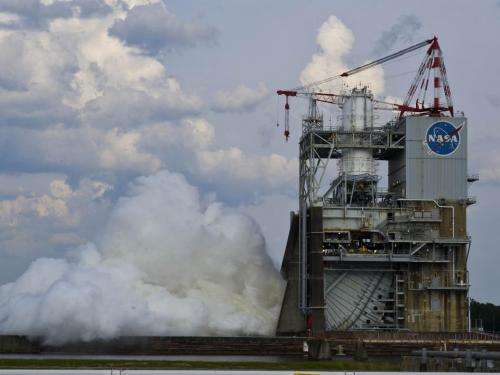
Image: The shake, rattle and roar of the J-2X engine
May 17, 2012
Credit: NASA/SSC

(Phys.org) -- The shake, rattle and roar lasted just seven seconds, but the short J-2X test conducted May 16 at NASA's John C. Stennis Space Center in south Mississippi moved the space agency ever closer to a return to deep space.

NASA operators tested the next-generation J-2X engine on the A-2 Test Stand at Stennis to collect early data on performance of the engine and test stand with the new nozzle extension and clamshell configuration. The test also provided data on startup and shutdown processes.

The J-2X engine is the first new and developed in 40 years that will be rated to carry humans into space.

The May 16 test was part of a second series of firings to collect critical data for continued development of the engine. The J-2X engine is being developed for NASA’s Marshall Space Flight Center in Huntsville, Ala., by Pratt & Whitney Rocketdyne of Canoga Park, Calif.

Explore further: British astronaut 'Major Tim' to fly to ISS

add to favorites email to friend print save as pdf

Related Stories

NASA tests deep space J-2X rocket engine

Sep 29, 2011

(PhysOrg.com) -- NASA conducted a 40-second test of the J-2X rocket engine Sept. 28, the most recent in a series of tests of the next-generation engine selected as part of the Space Launch System architecture ...

J-2X engine ready for second test series

Apr 25, 2012

(Phys.org) -- The next-generation engine that will help carry humans deeper into space than ever is back, bigger and better. The J-2X engine is currently on the A-2 Test Stand at NASA's Stennis Space Center ...

NASA's new upper stage engine passes major test

Nov 09, 2011

(PhysOrg.com) -- NASA conducted a successful 500-second test firing of the J-2X rocket engine on Wednesday, Nov. 9, marking another important step in development of an upper stage for the heavy-lift Space Launch System (SLS). ...

NASA performs first J-2X powerpack test of the year

Feb 16, 2012

(PhysOrg.com) -- Engineers at NASA's Stennis Space Center conducted an initial test of the J-2X engine powerpack Feb. 15, kicking off a series of key tests in development of the rocket engine that will carry ...

First J-2X combustion stability test a success

Dec 05, 2011

(PhysOrg.com) -- NASA conducted a key stability test firing of the J-2X rocket engine Dec. 1, marking another step forward in development of the upper-stage engine that will carry humans farther into space ...

NASA ready to test upgraded J-2X powerpack

Dec 07, 2011

(PhysOrg.com) -- For engineers working on the J-2X engine program, installation of the upgraded J-2X powerpack on the A-1 Test Stand on Dec. 5 had to feel like a long-awaited holiday gift.

Recommended for you

Proba-V opens its eyes

4 hours ago

(Phys.org) —Earth watcher Proba-V is in good health following its launch last week. The Vegetation imager has been switched on and the first image has been captured over western France.

Mice, gerbils perish in Russia space flight

May 19, 2013

A number of mice and eight gerbils sent into space in a Russian capsule destined to find out how well organisms can withstand extended flights perished during their journey, scientists said Sunday as the ...

Mars rover Opportunity examines clay clues in rock

May 18, 2013

(Phys.org) —NASA's senior Mars rover, Opportunity, is driving to a new study area after a dramatic finish to 20 months on "Cape York" with examination of a rock intensely altered by water.

NASA's STEREO detects a CME from the sun

May 17, 2013

On 5:24 a.m. EDT on May 17, 2013, the sun erupted with an Earth-directed coronal mass ejection or CME, a solar phenomenon that can send billions of tons of solar particles into space that can reach Earth ...

User comments : 0

More news stories

Slow earthquakes: It's all in the rock mechanics

(Phys.org) —Earthquakes that last minutes rather than seconds are a relatively recent discovery, according to an international team of seismologists. Researchers have been aware of these slow earthquakes, ...

Cracking the ice code

(Phys.org) —What happened the last time a vegetated Earth shifted from an extremely cold climate to desert-like conditions? And what does it tell us about climate change today?

Tiny, implantable coil promises hope for emphysema patients

A small, easily implantable device called the Lung Volume Reduction Coil (LVRC) may play a key role in the treatment of two types of emphysema, according to a study conducted in Europe. Results of the study indicate the beneficial ...