On the hunt for high-altitude microorganisms
May 21, 2012 by Jason Major, Universe Today
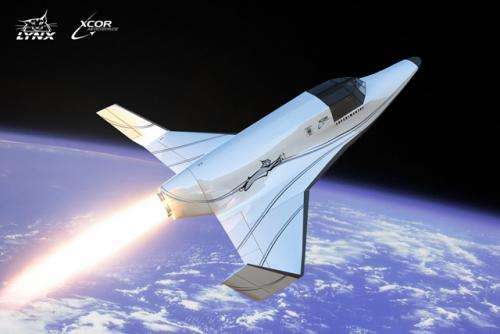
Design of an XCOR Lynx spacecraft. Credit: XCOR Aerospace

The United States Rocket Academy has announced an open call for entries in its High Altitude Astrobiology Challenge, a citizen science project that will attempt to collect samples of microbes that may be lurking in Earth’s atmosphere at the edge of space.

Earth’s biosphere has been discovered to extend much higher than once thought — up to 100,000 feet (30,480 meters) above the planet’s surface. Any microorganisms present at these high altitudes could be subject to the mutating effects of increased radiation and transported around the globe in a sort of pathogenic jet-stream.

Citizens in Space, a project run by the U.S. Rocket Academy, is offering a $10,000 prize for the development of an open-source and replicable  collection device that could successfully retrieve samples of microorganisms, and could fly as a payload aboard an XCOR Lynx spacecraft.

XCOR Aerospace is a private California-based company that has developed the Lynx, a reusable launch vehicle that has suborbital flight capabilities. Low-speed test flights are expected to commence later this year, with incremental testing to take place over the following months.

Any proposed microbe collection devices would have to fit within the parameters of the Lynx’s 2kg Aft Cowling Port payload capabilities — preferably a 10 x 10 x 20 cm CubeSat volume — and provide solutions for either its retraction (in the case of extended components) or retrieval (in the case of ejected hardware.)

The contest is open to any US resident or non-government team or organization, and submissions are due by February 13, 2013. The chosen design will fly on 10 contracted Lynx flights in late 2013 or early 2014, and possibly even future missions.

Find out more about the challenge on the Citizens in Space site here, and check out an animation of the XCOR Lynx spacecraft below:

This video is not supported by your browser at this time.


Explore further: Proba-V opens its eyes

add to favorites email to friend print save as pdf

Related Stories

XCOR Lynx slated to fly new suborbital telescope

Jul 13, 2011

Commercial space company XCOR Aerospace has signed a “Memorandum of Understanding” with the Planetary Science Institute, laying the groundwork for flying a human-operated telescope on board XCOR’s ...

Calif. space tourism firm launches S. Korea deal

Dec 18, 2009

(AP) -- A California company developing a rocket plane for space tourism announced Thursday that it has an agreement with a nonprofit group in South Korea to conduct launches in that nation.

Space science on the wings of starfighters

Nov 04, 2011

A NewSpace company based out of New Port Richey in Florida is working to provide suborbital access to space for firms with scientific payloads. The Star Lab project is an experimental suborbital launcher, ...

Recommended for you

Proba-V opens its eyes

17 hours ago

(Phys.org) —Earth watcher Proba-V is in good health following its launch last week. The Vegetation imager has been switched on and the first image has been captured over western France.

Mice, gerbils perish in Russia space flight

May 19, 2013

A number of mice and eight gerbils sent into space in a Russian capsule destined to find out how well organisms can withstand extended flights perished during their journey, scientists said Sunday as the ...

Mars rover Opportunity examines clay clues in rock

May 18, 2013

(Phys.org) —NASA's senior Mars rover, Opportunity, is driving to a new study area after a dramatic finish to 20 months on "Cape York" with examination of a rock intensely altered by water.

User comments : 2

Adjust slider to filter visible comments by rank

Display comments: newest first

kaasinees
3.7 / 5 (3) May 21, 2012
We find more and more about the composition of mass beyond earths atmosphere, so why not?
Graeme
not rated yet May 23, 2012
It would be a challenge to catch them alive. Perhaps a bacteria could be accellerated at 1000G, to the flying craft's speed, but not an insect!

More news stories

Slow earthquakes: It's all in the rock mechanics

(Phys.org) —Earthquakes that last minutes rather than seconds are a relatively recent discovery, according to an international team of seismologists. Researchers have been aware of these slow earthquakes, ...

New immune system discovered

(Medical Xpress)—A research team, led by Jeremy Barr, a biology post-doctoral fellow, unveils a new immune system that protects humans and animals from infection.

Lab sets a new record for creating heralded photons

(Phys.org) —Entanglement, by general consensus of physicists, is the weirdest part of quantum science. To say that two particles, A and B, are entangled means that they are actually two parts of an inseparable ...