New eyeglasses allow you to adjust prescription yourself
May 31, 2012 by Bob Yirka report

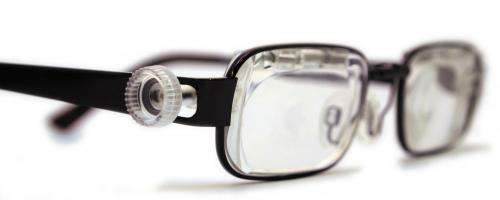
(Phys.org) -- A new kind of eyeglasses is now available from a British company that allows the wearer to adjust the prescription anytime, anywhere, via small thumb-dials on the sides. Called, Eyejusters, the glasses make use of a technology called a Slidelens, which very aptly describes how these glasses do their magic. Each lens is actually two lenses that have slightly different shapes; turning the thumb-dial causes one lens to move slightly left or right and that changes the focal point for the wearer. The lenses are moved until the person doing the focusing finds the sweet spot; which is exactly how users focus a pair of binoculars.

The web site for the Eyejusters says their main market is the , where a lot of people with can’t afford to see an eye doctor, much less the glasses that would be prescribed. Eyejusters solve both problems; when ordered, they come with an eye-chart that can be used to help discern if a person’s vision can be corrected with Eyejusters (the power range is from +4.5 to 0 D (positive) and 0 to -5.0 D (negative)) and to figure out which version they need (for near or far vision correction).

This video is not supported by your browser at this time.

The glasses were developed by four guys; Dave Crosby, Owen Reading, Richard Taylor and Greg Storey, who found a common interest in self-adjustable glasses and in the process created a company to fulfill the goal of providing low cost eyeglasses to the millions of people the world over who cannot afford a traditional pair. Their secondary market is for people who could use adjustable glasses for other than general use purposes, such as reading, working on a computer, knitting, i.e. for people as they get older and find they have trouble focusing while performing different tasks.

The Eyejusters, which come with detachable thumb-dials also come with a plastic case and special cleaning cloth. The cloth can be used to clean both sides of both lenses because the outer lens can be hinged down for easy access. The Eyejusters also offer UV protection, which has been incorporated to help prevent eye damage from the sun, another common problem in underdeveloped countries.

Another interesting aspect of the adjustable glasses is that it appears with a little tweaking, they could be used to perform self exams in more developed countries. By adding a digital display, the wearer could work out their own prescription and send it to a company that sells traditional , sidestepping an expensive trip to an ophthalmologist.

Explore further: Inventor creates Card Beams with 3D printer

Related Stories

DARPA sets sights on high-tech contact lenses

Apr 15, 2012

(Phys.org) -- A Bellevue, Washington, company specializing in display technology based on eyewear and contact lenses has sealed a deal with DARPA. Innovega, which says its technology can open a “new dimension ...

Recommended for you

Inventor creates Card Beams with 3D printer

May 23, 2013

What are card beams, you may ask? They are the building toy that allows you to build gravity-defying houses of cards with the help of friction, gravity, and two types of beams - the cap and the connector.

With high-tech guns, users could disable remotely

May 21, 2013

A high-tech startup is wading into the gun control debate with a cellphone controller that would allow gun owners to know when their weapon is being moved—and disable it remotely.

Game system castAR debuts at Maker Faire

May 21, 2013

(Phys.org) —Two tech talents, formerly employees at video game publisher Valve, have been working on their own vision in the form of game-ready glasses. Their company, Technical Illusions, will seek to ...

China police billions spell profit opportunity

May 19, 2013

Mannequins in riot gear, armoured cars and drones line a police equipment and "anti-terrorism technology" trade fair in Beijing as vendors seek to profit from China's huge internal security budget.

User comments : 2

Adjust slider to filter visible comments by rank

Display comments: newest first

dschlink
5 / 5 (2) May 31, 2012
I'm interested. I wear poly-focal lenses and any time I try looking at a close object that is above my eye level, I get nothing but blear. Looking down at the sidewalk requires tilting my head far enough so I can use the upper portion of the lens. It would be great to be able to make one adjustment for my walks, a different setting for indoors and a third one for reading or computer work. These glasses would pay for themselves by allowing me to get rid of the special pair I use for computer work.
chardo137
5 / 5 (4) May 31, 2012
We'll get these in america the same day they allow us to have blu-ray recorders. People who are far-sighted can go to the drug store and buy cheap reading glasses, but the 80% of us who need glasses and are near-sighted are still forced to go to the doctor and buy expensive eyewear. You wouldn't want to inconvenience those that already have the money and need more. They almost refuse to sell glasses made out of glass. Insurance companies telling us what we can and can't do again.

More news stories

Google eyes emerging markets networks

Google has become deeply involved in a series of projects to build and operate wireless networks in emerging markets including sub-Saharan Africa and Southeast Asia, a report said Friday.

Facial-recognition technology proves its mettle

(Phys.org) —In a study that evaluated some of the latest in automatic facial recognition technology, researchers at Michigan State University were able to quickly identify one of the Boston Marathon bombing ...

Drones may violate international law

(Phys.org) —As President Obama gives a speech on national security—including defending U.S. use of drones to combat terrorism—Leila Sadat, JD, international law expert and professor of law at Washington University in ...

The long road to the 2000-watt society

The vision of a society in which each inhabitant of the earth manages to consume only 2000 watts has already been around for 15 years. During this time, there has been a steady increase in environmental awareness ...

Galaxies fed by funnels of fuel

(Phys.org) —Computer simulations of galaxies growing over billions of years have revealed a likely scenario for how they feed: a cosmic version of swirly straws.