Cassini reveals details about charged 'nanograins' near Enceladus
(Phys.org) -- It was a call that Rice University physicist Tom Hill had waited more than 20 years to receive. It traveled almost a billion miles to reach him. And the message — once it arrived from NASA’s Cassini spacecraft near Saturn — was so enigmatic that it would take another three years to decipher.
In a new study, Hill and colleagues describe what they found in the data from Cassini: a new class of space particles — submicroscopic “nanograins” of electrically charged dust. Such particles are believed to exist throughout the universe, and this marks the first time researchers have measured and analyzed them.
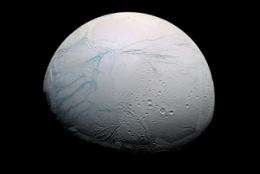
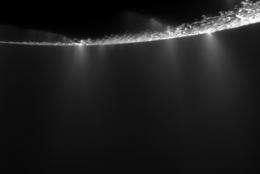
The “nanograin” measurements were made during three close flybys of Enceladus, one of Saturn’s small icy moons. Enceladus electrified the scientific community in 2005 when Cassini’s visible-light camera caught sight of a series of geysers erupting near its south pole. In addition to the visible icy dust particles, the geysers spew water vapor into space, and a trio of flybys in 2008 and 2009 offered scientists their first chance to take measurements inside the geysers’ plumes.
“The common perception of space is that it’s largely empty, but that is inaccurate,” said Hill, a space scientist who specializes in the study of planetary magnetospheres — regions dominated by a planet’s magnetic field. “The sun emits a supersonic outflow of particles called the solar wind, and this spreads throughout the solar system as a plasma of electrically charged ions and electrons.”
In the new study, which appears in the Journal of Geophysical Research, Hill and his colleagues describe how the plasma in Saturn’s magnetosphere interacts with the nanograins and imparts a negative charge to the grains as they fly away from Enceladus. The dust grains in the plumes are clumps of water molecules that come in a range of sizes, including some that contain just a few water molecules and some that are as large as smoke particles.
“The nanograins are in a ‘Goldilocks’ size regime that no one’s seen before: not too big and not too small to influence, and be influenced by, the plasma,” Hill said. “That’s one of the things that makes them interesting.”
For instance, because of their size, nanograins are noticeably affected by both gravitational and electromagnetic forces. This contrasts sharply with both larger particles that are dominated by gravity and smaller charged particles that are dominated by electromagnetic forces.
Hill, professor of physics and astronomy and a Rice alumnus, is a co-investigator on the Cassini Plasma Spectrometer, or CAPS, an instrument designed to measure charged ions and electrons. The instrument was devised and built at the Southwest Research Institute in San Antonio by an international team led by fellow Rice alum David Young.
Hill first became involved with CAPS in the mid-1980s, when Cassini researchers were still trying to secure funding to build the spacecraft. As a theorist, Hill said his main job in this early phase of the project was to describe the kind of science that CAPS would eventually perform once it reached Saturn.
“They always ask at least one theorist to help write the proposal, but after that, you mostly just wait for the spacecraft to start collecting data,” Hill said.
In the case of Cassini, Hill had quite a wait. His three children, who were born around the time the Cassini proposal was written, had graduated from Rice by the time Cassini made its 2008 Enceladus flybys.
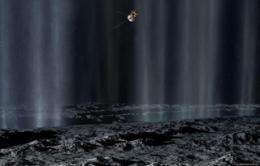
Compared with the time needed to reach Jupiter, the flybys occurred in a flash. CAPS had less than one minute to capture its crucial readings inside the plumes because Cassini passed through them flying about 30 times faster than a typical rifle bullet.
CAPS contains two electrically charged curved plates and a series of detectors. By varying the voltage across the plates, scientists can determine the energy of the charged particles – ions, electrons and nanograins — that fly between the plates and strike the detectors.
“CAPS wasn’t designed to find anything as large as these nanograins,” Hill said. “There are other instruments on the spacecraft that can measure larger particles, but those instruments cannot measure whether the particles carry an electrical charge as CAPS can.”
In analyzing the CAPS data, Hill and his colleagues found that each nanograin in the plume had one additional electron, and thus a slight negative charge.
The full implications of the findings are unknown, but scientists know that Enceladus’ geysers supply the ice grains that make up the vast E Ring — the outermost of Saturn’s rings — as well as the cloud of water vapor that, upon ionization, supplies the bulk of Saturn’s magnetospheric plasma. Cosmologists have also speculated that nanograin-sized particles are part of the dense dust clouds where stars are born.
“Having the first observations of charged nanograins is important, because they lie in a theoretically important but previously unobserved range where particles have an intermediate mass-to-charge ratio,” Hill said. “Having the first observation is the initial step toward learning more about these particles.”
More information: www.agu.org/pubs/crossref/2012/2011JA017218.shtml
Journal information: Journal of Geophysical Research
Provided by Rice University


