Organic carbon from Mars, but not biological
May 24, 2012
Mars

(Phys.org) -- Molecules containing large chains of carbon and hydrogen--the building blocks of all life on Earth--have been the targets of missions to Mars from Viking to the present day. While these molecules have previously been found in meteorites from Mars, scientists have disagreed about how this organic carbon was formed and whether or not it came from Mars.

A new paper led by Carnegie's Andrew Steele provides strong evidence that this carbon did originate on Mars, although it is not biological. These findings give researchers insight into the taking place on Mars and will help aid future quests for evidence of ancient or modern Martian life. The work is published May 24 in .

There has been little agreement among scientists about the origin of the large carbon detected in Martian meteorites. Theories about their origin include contamination from Earth or other meteorites, the results of chemical reactions on Mars, or that they are the remnants of ancient Martian biological life.
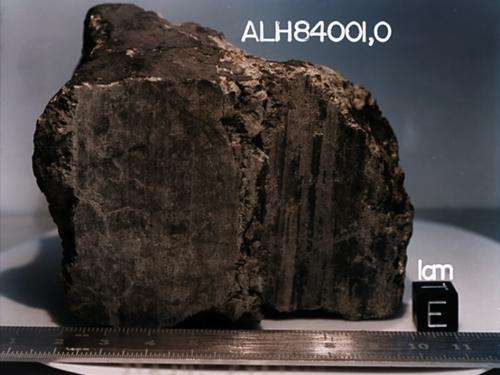
This 4.5 billion-year-old rock, labeled meteorite ALH84001, is believed to have once been a part of Mars and to contain fossil evidence that primitive life may have existed on Mars more than 3.6 billion years ago. Image credit: NASA/JSC/Stanford University

Steele's team examined samples from 11 whose ages span about 4.2 billion years of Martian history. They detected large carbon compounds in 10 of them. The molecules were found inside of grains of crystallized minerals.

Using an array of sophisticated research techniques, the team was able to show that at least some of the macromolecules of carbon were indigenous to the meteorites themselves and not contamination from Earth.

Next the team looked at the in relation to other minerals in the meteorites to see what kinds of chemical processing these samples endured before arriving on Earth. The crystalline grains encasing the carbon compounds provided a window into how the carbon molecules were created. Their findings indicate that the carbon was created during volcanism on Mars and show that Mars has been doing for most of its history.

"These findings show that the storage of reduced carbon molecules on Mars occurred throughout the planet's history and might have been similar to processes that occurred on the ancient Earth," Steele said. "Understanding the genesis of these non-biological, carbon-containing macromolecules on Mars is crucial for developing future missions to detect evidence of life on our neighboring planet."

In a separate paper published by American Mineralogist, available online, Steele and his team studied a meteorite called Allan Hills 84001 that was reported to contain relicts of ancient biological life on Mars. The paper demonstrated that these supposed remnants could have been created by chemical reactions involving the graphite form of carbon, rather than biological processes. Both of these papers reveal a pool of reduced carbon on Mars and will help scientist involved in future Mars missions distinguish these non-biologically formed molecules from potential life.

Explore further: Field tests in Mojave Desert pave way for human exploration of small bodies

More information: www.sciencemag.org/content/early/2012/05/23/science.1220715

Related Stories

Viking landers did detect organics on Mars

Jan 06, 2011

(PhysOrg.com) -- In 1976 the NASA Viking landers took samples of soil on Mars and tested them for signs of organic carbon. A reinterpretation of the results now suggests the samples did contain organic compounds, ...

Device reveals more about Mars' atmosphere

Oct 12, 2010

Instruments designed by a UT Dallas professor to measure atmospheric components on the surface of Mars have uncovered important clues about the planet’s atmosphere and climate history.

Imagining Mars

Mar 25, 2011

(PhysOrg.com) -- This composite of three artists' renderings from 1975 was only wish fulfillment for an unnamed JPL artist; however, the landscape and the rendered shapes took into account what was known about ...

Recommended for you

Mars rover Opportunity examines clay clues in rock

1 hour ago

(Phys.org) —NASA's senior Mars rover, Opportunity, is driving to a new study area after a dramatic finish to 20 months on "Cape York" with examination of a rock intensely altered by water.

NASA's STEREO detects a CME from the sun

14 hours ago

On 5:24 a.m. EDT on May 17, 2013, the sun erupted with an Earth-directed coronal mass ejection or CME, a solar phenomenon that can send billions of tons of solar particles into space that can reach Earth ...

Nine-year-old Mars rover passes 40-year-old record

23 hours ago

While Apollo 17 astronauts Eugene Cernan and Harrison Schmitt visited Earth's moon for three days in December 1972, they drove their mission's Lunar Roving Vehicle 19.3 nautical miles (22.210 statute miles ...

Bright explosion on the Moon

23 hours ago

For the past 8 years, NASA astronomers have been monitoring the Moon for signs of explosions caused by meteoroids hitting the lunar surface. "Lunar meteor showers" have turned out to be more common than anyone ...

User comments : 2

Adjust slider to filter visible comments by rank

Display comments: newest first

elektron
5 / 5 (2) May 25, 2012
The term 'organic' is outdated, it's from an era when it wasn't known that chemistry in living things was the same as chemistry in non living things it was before it was discovered that all living things are made of microscopic cells. There's no such thing as organic chemistry, there's just chemistry.

There are CH molecules all over the Galaxy and certainly the universe, C atoms join up, it's what they do don't bother to hold the presses. Aren't quarks and leptons the real building blocks of life anyway?

It's not inconceivable that the jump that led to life itself is so rare that scientists may never ever know how the crucial leap was made.
CardacianNeverid
not rated yet May 25, 2012
The term 'organic' is outdated, it's from an era when it wasn't known that chemistry in living things was the same as chemistry in non living things it was before it was discovered that all living things are made of microscopic cells. There's no such thing as organic chemistry, there's just chemistry -elektron

Agreed, but the field 'organic chemistry' still exists.

It's not inconceivable that the jump that led to life itself is so rare that scientists may never ever know how the crucial leap was made -elektron

I don't agree with that so much. Or to put it another way, I think we will definitely learn how to create life from base chemicals, but we won't necessarily be sure if that is the exact way life got started on Earth.

More news stories

Alaska volcano shoots ash 15,000 feet into the air

(AP)—One of Alaska's most restless volcanoes has shot an ash cloud 15,000 feet into the air in an ongoing eruption that has drawn attention from a nearby community but isn't expected to threaten air traffic.

Chinese, Indian airlines face EU pollution fines

Eight Chinese and two Indian airlines face fines of up to several million euros for not paying for their greenhouse gas emissions during flights within the bloc, the European Commission said on Friday.

Bright explosion on the Moon

For the past 8 years, NASA astronomers have been monitoring the Moon for signs of explosions caused by meteoroids hitting the lunar surface. "Lunar meteor showers" have turned out to be more common than anyone ...

US seizes Bitcoin operator accounts

US authorities seized the accounts of a Bitcoin digital currency exchange operator, claiming it was functioning as an "unlicensed money service business," court documents showed Friday.