Australia had 'globe-trotting' dinosaurs: study
May 07, 2012
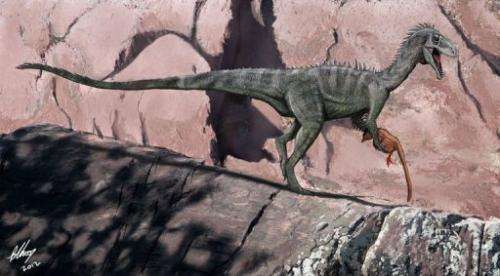
A Museum Victoria illustration shows a meat-eating dinosaur, known as a ceratosaur, which lived in Australia some 125 million years ago near Melbourne. Scientists say a new fossil discovery suggested Australia's dinosaurs were cosmopolitan globe-trotters, unlike the "unique weirdos" of its current wildlife.

Scientists said Monday a new fossil discovery suggested Australia's dinosaurs were cosmopolitan globe-trotters, unlike the "unique weirdos" of its current wildlife.

Palaeontologist Erich Fitzgerald said an ankle bone fossil found 87 kilometres (54 miles) from Melbourne indicated that meat-eating known as ceratosaurs lived in what is now Australia some 125 million years ago.

He said the finding suggested that back then Australia had the same large, well-known predators such as tyrannosaurs and allosaurs which are found around the world.

"The dinosaurs we see here are not unique weirdos like modern and on a global scale," Fitzgerald told AFP.

"Contrary to the modern animals we see in Australia, these meat-eating dinosaurs in Australia represent globe-trotting groups which spread out across the world before the continents began to separate.
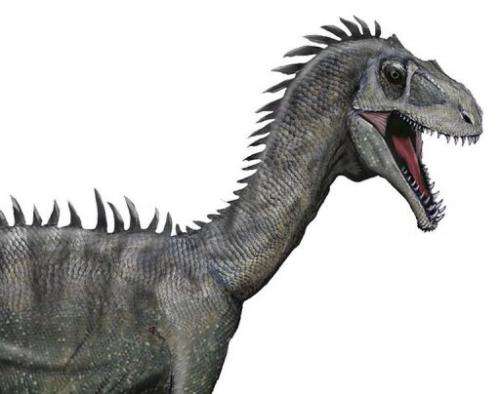
A Museum Victoria illustration shows a meat-eating dinosaur, known as a ceratosaur, which lived in Australia some 125 million years ago near Melbourne. The find suggests that back then Australia had the same large, well-known predators such as tyrannosaurs and allosaurs which are found around the world.

"We've got representatives of groups that are actually found everywhere else. We really have this melting pot... where it was really a cosmopolitan bunch of dinosaurs which called Australia home 125 million years ago."

The ceratosaur was a relatively small, meat-eating dinosaur which grew to be one to two metres high and could be as long as three metres.

The discovery, announced in the journal , adds to the picture about dinosaurs in eastern Gondwana, the continent which broke into Australia, Antarctica and India between 80 and 130 million years ago.

"It had been thought that isolation played a lead role in the formation of Australia's dinosaur fauna," said Fitzgerald, a Museum Victoria palaeontologist.

"But the ceratosaur and other new discoveries show that several dinosaur groups were here. These dinosaur lineages date back to the Jurassic, 170 million years ago, when dinosaurs could walk between any two continents.

"Until now, this group of dinosaurs has been strangely absent from Australia, but now at last we know they were here -- confirming their global distribution."

Fitzgerald added the ankle bone, found near the coastal town of San Remo by an amateur palaeontologist in 2006, was only six centimetres (2.4 inches) wide but was of great significance in understanding dinosaurs in Australia.

"Apart from Antarctica, Australia has the world's most poorly-known dinosaur record," he said, adding that even "tantalising fragments" can end up providing researchers with a wealth of information.

Explore further: Actor Johnny Depp immortalized in ancient fossil find

add to favorites email to friend print save as pdf

Related Stories

Plant-eating dinosaur discovered in Antarctica

Dec 19, 2011

For the first time, the presence of large bodied herbivorous dinosaurs in Antarctica has been recorded. Until now, remains of sauropoda - one of the most diverse and geographically widespread species of herbivorous dinosaurs ...

Scientists find first ever southern tyrannosaur dinosaur

Mar 25, 2010

(PhysOrg.com) -- Scientists from Cambridge, London and Melbourne have found the first ever evidence that tyrannosaur dinosaurs existed in the southern continents. They identified a hip bone found at Dinosaur ...

Possible dinosaur burrows clues to survival strategies

Jul 16, 2009

Internationally renowned palaeontologist and Monash University Honorary Research Associate, Dr Anthony Martin has found evidence of a dinosaur burrow along the coast of Victoria, which helps to explain how dinosaurs protected ...

Recommended for you

Tiny ancient bandicoot shines light on future

1 hour ago

(Phys.org) —A 20 million-year-old fossil skull identified as a 'pocket-sized' ancestor of the bandicoot will give insights into the future of Australia's modern endangered animals.

The eloquence of the otoliths

May 16, 2013

Fish fossils that are about 23 million years old give unprecedented insight into the evolutionary history of the gobioid order, one of the most species-rich groups among the modern bony fishes.

Light cast on lifestyle and diet of first New Zealanders

May 16, 2013

(Phys.org) —A University of Otago-led multidisciplinary team of scientists have shed new light on the diet, lifestyles and movements of the first New Zealanders by analysing isotopes from their bones and teeth.

mtDNA study shows Minoans came from Europe not Africa

May 15, 2013

(Phys.org) —A new study conducted by a team of American and Greek researchers has found that the people of the ancient Minoan civilization living on the island of Crete most likely came from Europe. In ...

User comments : 0

More news stories

Tiny ancient bandicoot shines light on future

(Phys.org) —A 20 million-year-old fossil skull identified as a 'pocket-sized' ancestor of the bandicoot will give insights into the future of Australia's modern endangered animals.

Daylight Saving Time spurs drop in crime rate

(Phys.org) —Researchers are no longer in the dark about when criminals are most likely to attack. William & Mary economist Nicholas Sanders teamed up with the University of Virginia's Jennifer Doleac to study the connection ...

Rise in type 2 diabetes amongst young

The number of young people diagnosed with type 2 diabetes has seen the sharpest rise over the last twenty years compared to a background of a general increase across the board, new University research has ...