App scans faces of bar-goers to guess age, gender
(AP) -- A watchful eye has arrived on San Francisco's bar scene, but not to keep you in check. It just wants to check you out.
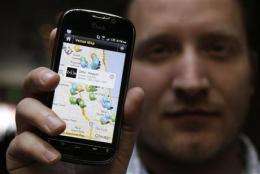
A new app launched this weekend that will scan the faces of patrons in 25 bars across the city to determine their ages and genders. Would-be customers can then check their smartphones for real-time updates on the crowd size, average age and men-to-women mix to decide whether the scene is to their liking.
The Austin, Texas-based makers of SceneTap say the app doesn't identify specific individuals or save personal information. But in a city known for its love of both libations and civil liberties, a backlash erupted even before the first cameras were switched on from bar-goers who said they would boycott any venue with SceneTap installed.
SceneTap's ability to guess how old people are and whether they're men or women relies on advances in a field known as biometrics. A camera at the door snaps your picture, and software maps your features to a grid. By measuring distances such as the length between the nose and the eyes and the eyes and the ears, an algorithm matches your dimensions to a database of averages for age and gender.
SceneTap CEO Cole Harper says the app doesn't invade patrons' privacy because the only data it stores is their estimated ages and genders and the time they arrived - not their images or measurements.
"Nothing that we do is collecting personal information. It's not recorded, it's not streamed, it's not individualized," Harper said.
Whether the company's promises are comforting or SceneTap still seems creepy, it portends a near future when any camera-equipped smartphone will have the ability to recognize faces with a click of the virtual shutter.
Already the iPhone's camera app will highlight a person's face on the screen with a green box before the picture is even snapped. And Apple's iPhoto software will try to recognize the faces of the people in users' pictures to categorize photos automatically by who's in the shot.
Facebook also uses facial recognition software that tries to identify any friends in a photo a user uploads.
SceneTap's San Francisco debut came the same day Facebook went public. Privacy experts say social media has played a major role in making it easier to attach a face to a name.
"Ten years ago if I walked down the street and took a picture of someone I didn't know, there was little I could do to find out who that person was. Today it's a very different story," said Lee Tien, a staff attorney with the Electronic Frontier Foundation, who focuses on surveillance technology and privacy.
Tien says facial recognition technology has advanced to the point that having your picture taken potentially offers up the same degree of identifying information as giving someone your fingerprints. Computer programs can break down high-resolution images in minute detail to identify the distinctive features of individual faces.
Those patterns, rather than the images themselves, make possible the tracking of individuals even without knowing who they are. In theory, a program could also match that pattern to identifiable online images such as a Facebook profile picture.
The threat to privacy from an app like SceneTap depends not just on what's being stored but how easily the system could be converted to become more intrusive, whether by a hacker or under a court order.
"Even if everything is happening the way it is supposed to, then the next question is, gee, is that good enough?" Tien said. "Is that something that you're comfortable with?"
Along with the visual images being deleted nearly as soon as they're snapped, SceneTap's sensors aren't sophisticated enough to recognize individual faces in any case, Harper said. Detecting basic characteristics like gender and age takes much less digital work than identifying individuals, he said.
The 28-year-old CEO argues SceneTap doesn't come close to intruding on personal privacy the way many other ubiquitous technologies already do. Many bars already have video cameras that record customers' every move, creating an archive that could, for example, be subpoenaed in court. And anyone who uses Facebook or Gmail is turning over reams of sensitive personal information to large companies every day.
SceneTap's business plan also hinges on the data it collects. Facebook and Google make money by targeting individuals as precisely as possible. Harper says SceneTap only has the combined data on bar customers' genders and ages. The company hopes advertisers will ultimately covet that data to target bar-goers through the app. The bars themselves can use the statistics to determine what mix of people come in when to adjust their inventories, advertising and promotions, Harper said.
SceneTap is already in use in six other cities across the country, including Chicago and several college towns.
Charles Hall, general manager of Bar None in San Francisco's Marina District, said he decided to install SceneTap to give potential customers another way to interact with the business. He said his decision to use it depended on the company's promise that no information was being collected on individuals.
"I have nothing to gain from doing something that people are going to be up in arms about," Hall said the day before the official launch.
A few hours later, the bar briefly got cold feet because of the negative attention SceneTap had received in the local media. But as of 10 p.m. Friday night, Bar None was "lively," according to the app: a little less than half full, a nearly even mix of sexes, average age 22.
©2012 The Associated Press. All rights reserved. This material may not be published, broadcast, rewritten or redistributed.


