Ancient tree-ring records from southwest U.S. suggest today's megafires are truly unusual
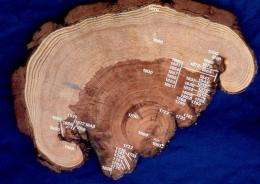
Today’s mega forest fires of the southwestern U.S. are truly unusual and exceptional in the long-term record, suggests a new study that examined hundreds of years of ancient tree ring and fire data from two distinct climate periods.
Researchers constructed and analyzed a statistical model that encompassed 1,500 years of climate and fire patterns to test, in part, whether today’s dry, hot climate alone is causing the megafires that routinely destroy millions of acres of forest, according to study co-author and fire anthropologist Christopher I. Roos, Southern Methodist University, Dallas.
The researchers found that even when ancient climates varied from each other — one hotter and drier and the other cooler and wetter — the frequencies of year-to-year weather patterns that drive fire activity were similar.
The findings suggest that today’s megafires, at least in the southwestern U.S., are atypical, according to Roos and co-author Thomas W. Swetnam, the University of Arizona. Furthermore, the findings implicate as the cause not only modern climate change, but also human activity over the last century, the researchers said.
“The U.S. would not be experiencing massive large-canopy-killing crown fires today if human activities had not begun to suppress the low-severity surface fires that were so common more than a century ago,” said Roos, an assistant professor in the SMU Department of Anthropology.
Today’s extreme droughts caused by climate change probably would not cause megafires if not for a century of livestock grazing and firefighting, which have combined to create more dense forests with accumulated logs and other fuels that now make them more vulnerable than ever to extreme droughts. One answer to today’s megafires might be changes in fire management.
“If anything, what climate change reminds us is that it’s pretty urgent that we deal with the structural problems in the forests. The forests may be equipped to handle the climate change, but not in the condition that they’re currently in. They haven’t been in that condition before,” Roos said.
Roos and Swetnam, director of the University of Arizona Laboratory of Tree-Ring Research, published their findings in the scientific journal The Holocene.
Study combines fire-scar records and tree-ring data of U.S. southwest
This new study is based on a first-of-its-kind analysis that combined fire-scar records and tree-ring data for Ponderosa Pine forests in the southwest United States.
Earlier research by other scientists has looked at forest fire records spanning the years from 1600 to the mid-1800s — a climate period known as the Little Ice Age — to understand current forest fire behavior. Those studies have found that fires during the Little Ice Age occurred frequently in the grasses and downed needles on the surface of the forest floor, but stayed on the floor and didn’t burn into the canopies.
Critics dispute the relevance of the Little Ice Age, however, saying the climate then was cooler and wetter than the climate now. They say a better comparison is A.D. 800 to 1300, known as the Medieval Warm Period, when the climate was hotter and drier, like today’s.
Scientists who favor that comparison hypothesize that forest fires during the Medieval Warm Period probably were similar to today’s megafires and probably more destructive than during the Little Ice Age.
Tree rings and fire scars provide the evidence for moisture, drought and burn activity
Scientists rely on tree rings not only to calculate a tree’s age, but also to determine wet and dry weather patterns of moisture and drought. Similarly, scientists’ best evidence for fire activity is the scarring on tree rings that dates the occurrence of fires. While tree-ring data for climate are available for long time periods, annual forest fire records don’t yet exist for the Medieval Warm Period.
In response to the need for data, Roos and Swetnam tested the Medieval Warm Period hypothesis by calibrating a statistical model that combined 200 years of Little Ice Age fire-scar data and nearly 1,500 years of climate data derived from existing tree rings. With that they were able to predict what the annual fire activity would have been almost 1,500 years ago.
They discovered that the Medieval Warm Period was no different from the Little Ice Age in terms of what drives frequent low-severity surface fires: year-to-year moisture patterns.
“It’s true that global warming is increasing the magnitude of the droughts we’re facing, but droughts were even more severe during the Medieval Warm Period,” Roos said. “It turns out that what’s driving the frequency of surface fires is having a couple wet years that allow grasses to grow continuously across the forest floor and then a dry year in which they can burn. We found a really strong statistical relationship between two or more wet years followed by a dry year, which produced lots of fires.”
Modeling of tree-ring and fire-scar data can be applied to any locale
The research, “A 1416-year reconstruction of annual, multidecadal, and centennial variability in area burned for ponderosa pine forests of the southern Colorado Plateau region, Southwest USA,” was funded by the International Arid Lands Consortium.
“The best way to look at how fires may have varied — if climate were the only driver — is to do this type of modeling,” Roos said. “Our study is the first in the world to go this far back using this methodology. But this method can be used anyplace for which there is a fire-scar record.”
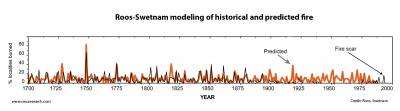
The study’s tree-ring-derived climate data are from the southern Colorado Plateau, a region that includes the world’s largest continuous stand of Ponderosa Pine stretching from Flagstaff, Ariz., into New Mexico. Large Ponderosa Pine forests have existed in the area for more than 10,000 years.
Fire-scar data for the region go back as far as the 1500s, but are most prevalent during the Little Ice Age period. Fire scientists have analyzed fire-scars from hundreds of trees from more than 100 locations across the Southwest. All fire-scar data are publically available through the International Multiproxy Paleofire Database, maintained by the federal National Oceanic and Atmospheric Administration’s paleoclimatology program.
Ancient fires were frequent, but didn’t burn the forest canopy
Fire scientists know that in ancient forests, frequent fires swept the forest floor, often sparked by lightning. Many of the fires were small, less than a few dozen acres. Other fires may have been quite large, covering tens of thousands of acres before being extinguished naturally. Fuel for the fires included grass, small trees, brush, bark, pine needles and fallen limbs on the ground.
“The fires cleaned up the understory, kept it very open, and made it resilient to climate changes because even if there was a really severe drought, there weren’t the big explosive fires that burn through the canopy because there were no fuels to take it up there,” Roos said. “The trees had adapted to frequent surface fires, and adult trees didn’t die from massive fire events because the fires burned on the surface and not in the canopy.”
Today’s huge canopy fires are the cumulative result of human activity
The ancient pattern of generally small, frequent fires changed by the late 1800s. The transcontinental railroad had pushed West, bringing farmers, ranchers, cattle and sheep. Those animals grazed the forest floor, consuming the grasses that fueled small fires but leaving small saplings and brush, which then grew up into dense, mature bushes and trees. In addition, the U.S. began to restrict the traditional land use of the region’s Native American communities, including confining them to reservations. This removed another source for frequent surface fires in the forests — burning by Native Americans for horticulture and hunting.
By the early 20th century, the U.S. Forest Service had been established, and fighting fires was a key part of the agency’s mission. Without continuous fuel, fires on the forest floor ceased.
“Many of our modern forests in central Arizona and New Mexico haven’t had a fire of any kind on them in 130 or 140 years,” Roos said. “That’s very different from the records of the ancient forests. The longest they would have gone without fires was 40 or 50 years, and even that length of time would have been exceptional.”
The research reported in The Holocene is the basis for a new four-year, $1.5 million grant from the National Science Foundation in which Roos and Swetnam are co-principal investigators. That project will examine how human activities have changed forests and forest fires over the past 1,000 years of Native American occupation, as well as the influence of droughts during the Medieval Warm Period and Little Ice Age in New Mexico’s Jemez Mountains.
Journal information: The Holocene
Provided by Southern Methodist University


