Beyond Traditional Borders wins Science magazine's IBI Prize
Science magazine has awarded a Science Prize for Inquiry-Based Instruction (IBI) to Rice University's hands-on engineering education program Beyond Traditional Borders (BTB) as a model for other schools. In the program's first six years, more than 10 percent of Rice undergraduates have participated in BTB and produced 58 low-cost health technologies, including two that have already been broadly distributed at a national level.
As an IBI prize winner, the BTB program is highlighted in Science this week in an essay aimed at spreading the word about BTB and showing other educators how to replicate the program on their campuses.
"The essence of the BTB approach to learning is captured in the Haitian saying, 'You don't learn to swim in the library; you learn to swim in the river,'" said BTB founder Rebecca Richards-Kortum, Rice's Stanley C. Moore Professor of Bioengineering.
BTB, which was launched in 2006 with a $2.2 million grant from the Howard Hughes Medical Institute (HHMI) through its Undergraduate Science Education Program, challenges students to come up with practical solutions to real-world health care problems in the developing world. It uses the engineering design method to teach students from all disciplines to meet global health challenges.
BTB has captured the imagination of Rice's students in a remarkably short time. More than 10 percent of Rice undergraduates -- including many nonengineering majors -- have taken a BTB course. Thanks to HHMI funding, which was renewed in 2010, approximately 12 Rice students travel abroad each summer to implement their designs in partnership with physicians in local clinics in Africa and Latin America.
"Today students really want to make a difference and have impact, and BTB provides the possibility for incredible experiences for the students that decide to take on real-world challenges," said Ned Thomas, dean of Rice's George R. Brown School of Engineering. "Professor Richards-Kortum and her team find critically important global health problems, and the students solve them and bring working prototypes to the field, refine their designs and in some cases go on to deploy thousands of actual medical devices."
Notable BTB technologies include:
- A hand-powered centrifuge for laboratory blood testing constructed for $35 using a salad spinner and found to be as accurate as a commercially available model costing 10 times more.
- LED-based phototherapy lights to treat neonatal jaundice made for less than $100. A clinical study in Guatemala found the low-cost lights were as effective in treating neonatal hyperbilirubinemia as conventional phototherapy lights that cost thousands of dollars.
- A portable, battery-operated fluorescence microscope made for $240. In a side-by-side comparison with a laboratory-grade instrument, the low-cost microscope proved as effective at detecting tuberculosis-infected sputum samples in more than 98 percent of samples.
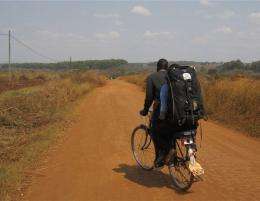
- The Lab-in-a-Backpack, an ultraportable backpack containing a microscope, centrifuge, pulse oximeter, otoscope and other clinical tools. Lab-in-a-Backpack was deployed countrywide by Ecuador's Ministry of Health.
- "DoseRight" syringe clips, which fit into the barrel of an oral syringe to ensure accurate dosing of HIV/AIDS medication. Swaziland health officials oversaw the countrywide distribution last year of approximately 214,000 DoseRight syringe clips.
- A low-cost, student-designed "continuous positive airway pressure," or bubble CPAP device, which assists babies in respiratory distress. This technology was refined with support from the National Collegiate Inventors and Innovators Alliance and the U.S. Agency for International Development. A clinical trial is under way in Malawi.
"We have discovered that giving students the opportunity to solve real global health problems not only creates leaders for tomorrow's global health technology workforce, but also produces technologies with the potential to revolutionize health care delivery in poor settings," they wrote.
BTB has already been replicated in a number of high school classrooms. The curriculum has been adapted for high school students, and the Texas Education Agency has approved the curriculum to count toward the state's graduation requirement in science. Since 2007, more than 2,000 Houston-area high school students have participated in courses based on this curriculum.
More information: The essay by Richards-Kortum, Oden and Gray is available online from Science at: www.sciencemag.org/content/336/6080/430.summary
For more information about BTB, visit: www.beyondtraditionalborders.rice.edu/
For more information about Science's IBI Prize, visit: www.sciencemag.org/site/featur … data/prizes/inquiry/
High school course materials are freely available online at: www.owlnet.rice.edu/~bioe301/kortum/index.html
Provided by Rice University


