Solar wind, moon dust and Martian lights
Apr 16, 2012 By Suzette Chan
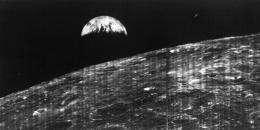
UAlberta is leading a study of how solar winds affect Earth's moon and Mars. Image: NASA

The Canadian Space Agency has funded a University of Alberta-led project to study the effects of solar winds on Earth’s moon and on Mars. The results are anticipated to influence design of spacecraft for robotic and human exploration.

“We have limited data regarding the environments in which equipment and astronauts must function and how these environments respond to solar activity,” says Clare Watt, a research associate with the project. “There is small room for error in these high-cost missions, especially when there are lives at stake.”

The Cluster for Lunar and Planetary Sciences project is a multiple-university undertaking led by Department of Physics professor Robert Rankin. The three-year, $450,000 award is split evenly between the University of Alberta and the University of Waterloo. The University of Toronto also has a piece, and the University of Calgary is part of the group in an advisory capacity.

“Researchers will combine state-of-the-art simulation models of our solar system in order to study the and its interaction with rocky planetary surfaces such as our moon and Mars,” says Watt. She adds that the Clusters project also allows for collaboration between scientists who study the atmosphere around planetary bodies and scientists who study the surfaces.

Watt leads a part of the project that looks specifically at the effect of solar winds on the moon. For example, solar winds intensify the static electric charge of dust storms on the moon. “You don’t want to land in one,” she says. “Lunar dust is not like the dust we have here on . It’s very fine and difficult to shield against. It’s electrically charged, so it’s attracted to the metal [on landing craft and the electronics in them] and could create short circuits.”

Another University of Alberta group, led by professor Ian Mann, will concentrate on Martian aurorae. Discovered in 2005, aurora activity on Mars is little understood. Watt says, “Martian aurorae can provide key information about how the solar wind interacts with the Martian surface, and will provide valuable insight into how the atmosphere and surface have been eroded through thousands of years of solar wind weathering.”

Besides the possible technological applications, the Clusters project will allow students to hone computer modelling skills using recent exploratory data from NASA and the European Space Agency. Students working with mature software that simulates the larger scale will be customizing it in light of new data. Students working on the smaller scale—the “up close” data from Mars and our moon—will be building new simulation models from scratch.

“There are a lot of new skills involved,” says Watt. “They will have to be creative to envision the environments on the and on Mars.”

Explore further: Collisions of coronal mass ejections can be super-elastic

add to favorites email to friend print save as pdf

Related Stories

Earth's magnetic field provides vital protection

Mar 08, 2012

(PhysOrg.com) -- A chance alignment of planets during a passing gust of the solar wind has allowed scientists to compare the protective effects of Earth’s magnetic field with that of Mars’ naked ...

Looking at the volatile side of the Moon

Jun 01, 2011

Four decades after the first Moon landing, our only natural satellite remains a fascinating enigma. Specialists from Europe and the US have been looking at ESA’s proposed Lunar Lander mission to find ...

Earth could spread life across the Milky Way

Sep 02, 2011

Most of us are familiar with the concept of panspermia – where living organisms can be “seeded” from comet or asteroid impacts – but where does the life-giving content come from? According ...

Solar power blooms in warren

Nov 18, 2011

General Motors is introducing a solar charging canopy that moves with the sun. The Tracking Solar Tree is located at GM Company Vehicle Operations.

Russia sets its sights on the moon for 2020

Feb 07, 2012

Looks like Republican Presidential hopeful Newt Gingrich might have some competition if he wants to be the first to build a base on the Moon. Last week, the Russian Space Agency Roscosmos announced plans to ...

Recommended for you

Forecast for Titan: Wild weather could be ahead

13 hours ago

(Phys.org) —Saturn's moon Titan might be in for some wild weather as it heads into its spring and summer, if two new models are correct. Scientists think that as the seasons change in Titan's northern hemisphere, ...

SDO observes mid-level solar flare

13 hours ago

UPDATE 16:30 p.m. EDT: The M7-class flare was also associated with a coronal mass ejection or CME, another solar phenomenon that can send billions of tons of particles into space. While this CME was not Ea ...

NASA's IRIS mission readies for a new challenge

22 hours ago

(Phys.org) —The time draws near. NASA is getting ready to launch a new mission, a mission to observe a largely unexplored region of the solar atmosphere that powers its dynamic million-degree outer atmosphere and drives ...

User comments : 0

More news stories

Forecast for Titan: Wild weather could be ahead

(Phys.org) —Saturn's moon Titan might be in for some wild weather as it heads into its spring and summer, if two new models are correct. Scientists think that as the seasons change in Titan's northern hemisphere, ...

Scientists announce Top 10 New Species from 2012

An amazing glow-in-the-dark cockroach, a harp-shaped carnivorous sponge and the smallest vertebrate on Earth are just three of the newly discovered top 10 species selected by the International Institute for ...

Theorists weigh in on where to hunt dark matter

(Phys.org) —Now that it looks like the hunt for the Higgs boson is over, particles of dark matter are at the top of the physics "Most Wanted" list. Dozens of experiments have been searching for them, but ...