Plants mimic scent of pollinating beetles
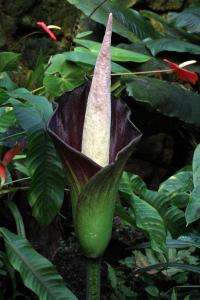
The color and scent of flowers and their perception by pollinator insects are believed to have evolved in the course of mutual adaptation. However, an evolutionary biologist from the University of Zurich has now proved that this is not the case with the arum family at least, which evolved its scent analogously to the pre-existing scents of scarab beetles and thus adapted to the beetles unilaterally. The mutual adaptation between plants and pollinators therefore does not always take place.
Soon, the gardens and fields will be blooming, fragrant and buzzing again. Bees, flies and beetles fly, as they have done for millions of years, from flower to flower in search of food or mates, drawn by flower shapes, colors and the scents of the individual plants. Often, pollinating insects favor certain scents and preferentially visit the flowers in question. Previously, researchers always assumed that floral scents and the fondness of pollinating insects for a specific scent evolved mutually via coevolution of plants and insects. However, the evolutionary biologist Florian Schiestl from the University of Zurich now proves that this was not the case with the arum family and their pollinators.
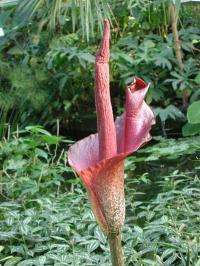
Schiestl and a colleague from Bayreuth studied the arum family and one of its pollinators, the scarab beetles. In the beetles, they discovered many scent molecules used for chemical communication that were also found in the plants. Based on a phylogenetic reconstruction, they realized that these scents were already present in the ancestors of today's scarab beetles. Evidently, these prehistoric scarab beetles already used the same or similar scents back in the Jurassic period to find food or mates. Unlike today's scarab beetles, these ancestors did not pollinate plants, the first members of the arum family to be pollinated by beetles not appearing until around 40 million years later. "In the course of evolution, the arum family mimicked the scents of scarab beetles to attract pollinating insects more efficiently," says Schiestl.
In research, coevolution is regarded as a driving force behind the development of a mutual adaptation between two organisms. However, this is not true of the arum family, which developed its scent along the pre-existing communication of scarab beetle scents. "Coevolution between plants and pollinating insects might well be less common than we thought," Schiestl concludes.
More information: Florian P. Schiestl, and Stefan Dötterl. The Evolution of Floral Scent and Olfactory Preferences in Pollinators: Coevolution or Pre-Existing Bias? Evolution. International Journal of Organic Evolution. March 12, 2012. doi: 10.1111/j.1558-5646.20
Provided by University of Zurich


