MESSENGER reveals Mercury’s colors
Apr 23, 2012 by Jason Major, Universe Today
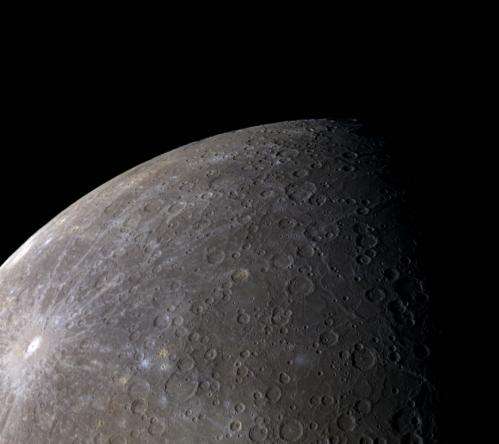
MESSENGER image of Mercury, acquired with its Wide Angle Camera on March 21, 2012.

The subtle yet surprisingly varied colors of Mercury are revealed in the latest images from NASA’s MESSENGER spacecraft, now in its extended mission and second year in orbit.

The image above, a composite of Wide Angle Camera acquired in 996, 748 and 433 nanometers for red, green and blue, shows a semi-lit limb of Mercury with the bright rayed crater Debussy visible at left. (The image has been rotated 180 degrees from the original, and color saturation was boosted by 25%.)

Named for the French composer Claude Debussy of “Claire de Lune” fame, the crater itself is approximately 50 miles (80 km) wide. It was first detected by ground-based radar telescopes in 1969 as a bright spot.

Now, 43 years later, we have a spacecraft in orbit sending back images like this. Amazing.
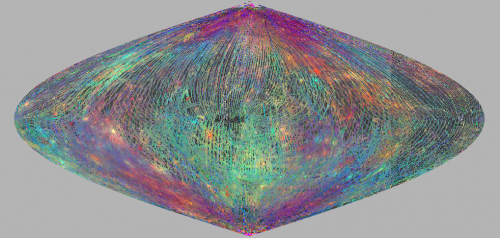
Sinusoidal equal area projection map of Mercury from MESSENGER's VIRS instrument.

The various colors seen across Mercury are due to different mineral compositions of the geologic regions. The exact compositions are not yet known, and the current puzzle that researchers are trying to solve with MESSENGER is to figure out what materials make up Mercury’s complex, multi-hued surface. That will also give a clue as to what’s inside the planet and how it evolved… as well as how it is currently evolving today.

The image below is from MESSENGER’s Visual and Infrared Spectrograph (VIRS) and shows a map of Mercury’s surface, with RGB colors corresponding to different mineralogical compositions.

Younger surface materials that are brighter at visible wavelengths and less affected by space weathering show up in reds, yellows and greens. Materials that may have relatively higher iron contents show up in blue.

These are ’s “other ”… maybe not what we would see with our own eyes, but beautiful nonetheless to planetary scientists!

See the above image on the website here.

Explore further: Collisions of coronal mass ejections can be super-elastic

add to favorites email to friend print save as pdf

Related Stories

Bright peaks, dark shadows

Feb 20, 2012

The 68-mile (109-km) -wide Amaral crater on Mercury reveals its brightly-tipped central peaks in this image, acquired by NASA’s MESSENGER spacecraft on Feb. 4, 2012. Long shadows are cast by the crater’s ...

Kuiper's color close-up

Feb 14, 2012

The pale-orange coloration around the 39-mile (62-km) -wide Kuiper crater on Mercury is evident in this image, a color composition made from targeted images acquired by NASA’s MESSENGER spacecraft on ...

More 'hollowed ground' on Mercury

Jan 05, 2012

The latest featured image from NASA’s MESSENGER spacecraft, soon to complete its first year in orbit around Mercury, shows the central peak of the 78-mile (138-km) – wide crater Eminescu surrounded ...

MESSENGER gets it Donne

Apr 09, 2012

Named after the 17th-century metaphysical poet, Mercury’s Donne crater was captured in this image by NASA’s MESSENGER spacecraft. The 53-mile (83-km) -wide crater features a large, rounded central ...

MESSENGER Returns Images from Oct. 6 Mercury Fly-By

Oct 07, 2008

MESSENGER is the first mission sent to orbit the planet closest to the sun. On Oct. 6, 2008, at roughly 4:40 a.m. ET, MESSENGER flew by Mercury for the second time this year. During the encounter, the probe ...

Recommended for you

NASA head views progress on asteroid lasso mission

9 hours ago

Surrounded by engineers, NASA chief Charles Bolden inspected a prototype spacecraft engine that could power an audacious mission to lasso an asteroid and tow it closer to Earth for astronauts to explore.

Ecuador satellite collides with Russian space junk

9 hours ago

A small Ecuadoran satellite collided in orbit with the remains of a Russian rocket, but it is too soon to know how much damage it might have sustained, Quito's space agency said Thursday.

Forecast for Titan: Wild weather could be ahead

May 22, 2013

(Phys.org) —Saturn's moon Titan might be in for some wild weather as it heads into its spring and summer, if two new models are correct. Scientists think that as the seasons change in Titan's northern hemisphere, ...

SDO observes mid-level solar flare

May 22, 2013

UPDATE 16:30 p.m. EDT: The M7-class flare was also associated with a coronal mass ejection or CME, another solar phenomenon that can send billions of tons of particles into space. While this CME was not Ea ...

User comments : 1

Adjust slider to filter visible comments by rank

Display comments: newest first

katesisco
1 / 5 (1) Apr 23, 2012
Whatever the makeup is it occurred with alternating pressure and release. This is the way the samuri swords and the famous Toledo steel were created: heating and pressure (hammering)

More news stories

A hidden population of exotic neutron stars

(Phys.org) —Magnetars – the dense remains of dead stars that erupt sporadically with bursts of high-energy radiation - are some of the most extreme objects known in the Universe. A major campaign using ...

Hubble reveals the ring nebula's true shape

(Phys.org) —The Ring Nebula's distinctive shape makes it a popular illustration for astronomy books. But new observations by NASA's Hubble Space Telescope of the glowing gas shroud around an old, dying, ...

NASA head views progress on asteroid lasso mission

Surrounded by engineers, NASA chief Charles Bolden inspected a prototype spacecraft engine that could power an audacious mission to lasso an asteroid and tow it closer to Earth for astronauts to explore.

Controlling mood through the motions of mitochondria

(Medical Xpress)—Regulating the distribution of power in neurons is done by a system that makes the national electric grid look simple by comparison. Each neuron has several thousand mitochondria confined ...