Lego pirate proves, survives, super rogue wave
Apr 04, 2012
Lego pirate proves, survives, super rogue wave
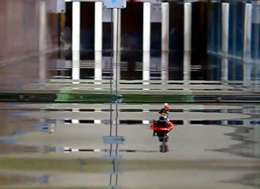
The pirate prepares for the oncoming super rogue wave.

(PhysOrg.com) -- Scientists have used a Lego pirate floating in a fish tank to demonstrate for the first time that so-called ‘super rogue waves’ can come from nowhere in apparently calm seas and engulf ships.

The research team, led by Professor Nail Akhmediev of the Research School of Physics and Engineering at ANU, working with colleagues from Hamburg University of Technology and the University of Turin have been conducting experiments in nonlinear dynamics, to try and explain so-called rogue or killer waves. These high-impact ‘monsters of the deep’, can appear in otherwise tranquil oceans causing danger, and even sinking ships.

Using a scientific fish tank, a wave generator and a Lego man on a ship floating on the water surface, the scientists were able to demonstrate that much bigger than previously thought can occur. The team have labelled these ‘super rogue waves’, as they can be up to five times bigger than the other waves around them. A video of the experiment can be seen here:

This video is not supported by your browser at this time.

“This observation could have far-reaching consequences for our efforts to understand these waves that are, by far, still mysterious,” said Dr. Akmediev.

“The large amplification of the rogue wave peak above the normal waves around it suggests the existence of a new class of waves – the so-called ‘super rogue waves’. Our results show that, even in a sea characterised by small waves, rogue waves can naturally develop due to the nonlinear dynamics of the surface elevation.

“This is an extraordinary fact that could explain some mysterious observations of rogue waves in calm sea states.”

Rogue waves have only recently been accepted as science fact, rather than fishermans’ tales of the deep sea. Despite decades of debate among scientists, a prototype of how a rogue wave could develop – called the Peregrine soliton – was only very recently observed experimentally in fibre optics.

This study, published in Physical Review, shows that the theory is crucial in understanding the development of super rogue waves that could develop in the deep oceans of the world.

“Of course, in real oceans the problem will require more careful analysis, but we expect the result to have a significant impact on the studies of extreme ocean waves and more generally, extreme events in nature and society.”

The pirate survived unharmed. However, nature is rarely so benign. In the last month several events have shown that monstrous waves appear more often than expected.

Explore further: Physicists develop revolutionary low-power polariton laser

Provided by Australian National University

4.9 /5 (9 votes)

Related Stories

Understanding freak waves

Sep 27, 2011

(PhysOrg.com) -- Rogue waves, once considered nothing more than a sailor’s myth, are more predictable than ever thanks to new research from the oceanography team at Swinburne University of Technology.

Making monster waves

Oct 19, 2009

Rogue waves -- giant waves that spring up suddenly and tower over the seas around them—have inspired physicists to look for an analogue in light. These high-intensity pulses can cross large distances without ...

Rogue wave recreated in laboratory tank

May 24, 2011

(PhysOrg.com) -- A team of researchers have used a mathematical equation to create a so called "rogue" wave; the giant kind that appear out of nowhere in the open ocean to topple ships and drown their crews. ...

Peregrine's 'Soliton' observed at last

Aug 23, 2010

(PhysOrg.com) -- An old mathematical solution proposed as a prototype of the infamous ocean rogue waves responsible for many maritime catastrophes has been observed in a continuous physical system for the ...

Scientists discover new water waves

Jul 19, 2011

(PhysOrg.com) -- By precisely shaking a container of shallow water, researchers have observed wave behavior that has never been seen before. In a new study, Jean Rajchenbach, Alphonse Leroux, and Didier Clamond ...

Recommended for you

Breakthrough calls time on bootleg booze

May 20, 2013

(Phys.org) —Using a laser, the St Andrews scientists can now carry out detailed analysis of a spirit sample no bigger than a teardrop and can even confirm whether it is toxic or not. It's hoped the testing ...

Bringing life into focus

May 17, 2013

Spinning-disk confocal microscopy is an optical imaging technique that can be used to generate detailed three-dimensional fluorescence images of living cells and their contents. Although a powerful tool for ...

User comments : 4

Adjust slider to filter visible comments by rank

Display comments: newest first

Doug_Huffman
1.5 / 5 (8) Apr 04, 2012
More evidence of The Black Swan putting the lie to induction. Read Nassim Nicholas Taleb. Reality is fractally complex.
Vendicar_Decarian
not rated yet Apr 04, 2012
How come no one threw him a life saver? O.
julianpenrod
1 / 5 (4) Apr 05, 2012
It was recently admitted that laboratory measurements of the half life of samarium 146 is off by 30%.
The near identical compositions of earth and moon were claimed "proof" the moon was carved from the earth by a collision wityh a rogue planet. Now, the closeness of the compsositions is claimed to "disproive" it since there should be alien compositions from the rogue planet.
PhysOrg itself printed an article saying it was once assumed by "science" that earth had the same composition as chondritic meteorites only because chondritic meteorite compositions were easy to determine.
Only a few years ago, after thousands of years on the oceans, it was "discovered" that sharks leap from the water.
Now, after thousands of years on the oceans, and years studying wave formation, it's announced that "rogue waves" can occur.
It seems only a mtter of time before every statement by "science" is "corrected".
BloodSpill
1 / 5 (1) Apr 05, 2012
@Previous comment
Everyone who starts using excessive quotation marks is an dark-ager nutcase.

More news stories

Making quantum encryption practical

One of the many promising applications of quantum mechanics in the information sciences is quantum key distribution (QKD), in which the counterintuitive behavior of quantum particles guarantees that no one can eavesdrop on ...

Lab sets a new record for creating heralded photons

(Phys.org) —Entanglement, by general consensus of physicists, is the weirdest part of quantum science. To say that two particles, A and B, are entangled means that they are actually two parts of an inseparable ...

Encouraging signs for bee biodiversity

Declines in the biodiversity of pollinating insects and wild plants have slowed in recent years, according to a new study. Researchers led by the University of Leeds and the Naturalis Biodiversity Centre in the Netherlands ...

If you can remember it, you can remember it wrong

(Medical Xpress)—Native peoples in regions where cameras are uncommon sometimes react with caution when their picture is taken. The fear that something must have been stolen from them to create the photo ...

B vitamins could delay dementia

(Medical Xpress)—Despite spending billions of dollars on research and development, drug companies have been unable to come up with effective treatments for dementia and Alzheimer's Disease (AD). Now, A. ...