Birds cultivate decorative plants to attract mates
Apr 23, 2012
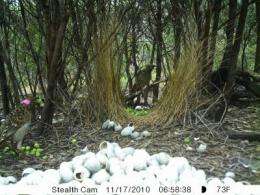
An international team of scientists has uncovered the first evidence of a non-human species cultivating plants for use other than as food. Instead, bowerbirds propagate fruits used as decorations in their sexual displays. Credit: University of Exeter

An international team of scientists has uncovered the first evidence of a non-human species cultivating plants for use other than as food. Instead, bowerbirds propagate fruits used as decorations in their sexual displays. The researchers discovered male bowerbirds had unusually high numbers of fruit-bearing plants growing around their bowers, and used these fruits in order to attract females.

Published today, in the research was carried out by the Universities of Exeter (UK), Postdam (Germany), Deakin and Queensland (Australia).

This is the first time a species other than humans has been found to cultivate non-food . However, the scientists do not believe the are intentionally cultivating the plants: it is more likely that they are growing around their bowers as a result of the birds gathering fruits for display.
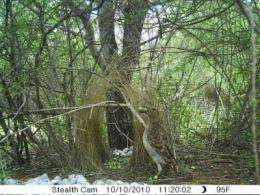
An international team of scientists has uncovered the first evidence of a non-human species cultivating plants for use other than as food. Instead, bowerbirds propagate fruits used as decorations in their sexual displays. Credit: University of Exeter

Native to Australia and , bowerbirds are well known for their unique behaviour, which involves males building ornate bowers. Males gather brightly-coloured objects to decorate their bowers, in order to attract females.

The research team observed bowerbirds in Taunton National Park, Central Queensland. They found higher numbers of Solanum ellipticum, or potato bush, plants around bowers than in other locations. These plants have bright purple flowers and green fruit. Their research showed that the birds were not selecting locations with a high number of the plants, but rather that they were growing plants around their bowers.

Bowers with many fruit on them are especially attractive to choosy females. Males collect the fruits, but when the fruits shrivel, they discard them nearby. This results in seeds germinating in the ground around the bower. Bowerbirds clear the area around their bower of grass and , making ideal conditions for new plants to germinate. Male bowerbirds can maintain a bower in the same location for up to ten years, so will benefit from establishing plants that may survive for several years.
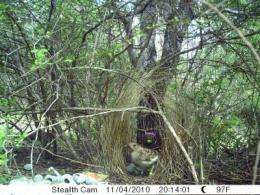
An international team of scientists has uncovered the first evidence of a non-human species cultivating plants for use other than as food. Instead, bowerbirds propagate fruits used as decorations in their sexual displays. Credit: University of Exeter

The researchers found that, like farmers selecting for fatter pigs or larger seeds, the bird's behaviour may lead to a change in the appearance of fruits. The fruits from plants close to the bowers were slightly greener in colour than those found on other plants. The researchers tested the males' choices and found they preferred this colour to that of the other .

Lead researcher Dr Joah Madden said: "Until now, humans have been the only species known to cultivate plants for uses other than food. We grow plants for all kinds of things – from drugs, to clothing, to props that we use in our sexual displays such as roses – but it seems we are not unique in this respect.

"We do not believe bowerbirds are intentionally growing these plants, but this accumulation of preferred objects close to a site of habitation is arguably the way any cultivation begins. It will be very interesting to see how this mutually-beneficial relationship between bowerbirds and these plants develops."

Explore further: CU-Boulder helps tap crowds to digitize museum records of bugs and plants

Related Stories

Stress may explain vocal mimicry in Bowerbirds

May 11, 2011

(PhysOrg.com) -- Spotted Bowerbirds (Ptilonorhynchus maculatus) are best known for their nests, but these birds are also capable of mimicking the vocalizations of many different species of birds. It was be ...

Grafted watermelon plants take in more pesticides

Jan 25, 2012

The widely used farm practice of grafting watermelon and other melon plants onto squash or pumpkin rootstocks results in larger amounts of certain pesticides in the melon fruit, scientists are reporting in a new study. Although ...

New strawberry a delight for gardeners

Jul 01, 2011

A new, versatile strawberry has been introduced for home gardeners. 'Roseberry' is predicted to be very popular as an ornamental addition to gardens. The strawberry features attractive pink blooms and produces ...

In birds, masters of illusion are lucky in love

Jan 19, 2012

Many male birds use their flashy colored feathers to lure females, but the great bowerbird of Australia has mastered the art of illusion to captivate the ladies, researchers said Thursday.

Recommended for you

Bittersweet: Bait-averse cockroaches shudder at sugar

5 hours ago

Sugar isn't always sweet to German cockroaches, especially to the ones that avoid roach baits. In a study published May 24 in the journal Science, North Carolina State University entomologists show the ne ...

White tiger mystery solved

7 hours ago

White tigers today are only seen in zoos, but they belong in nature, say researchers reporting new evidence about what makes those tigers white. Their spectacular white coats are produced by a single change ...

Scientists announce Top 10 New Species from 2012

14 hours ago

An amazing glow-in-the-dark cockroach, a harp-shaped carnivorous sponge and the smallest vertebrate on Earth are just three of the newly discovered top 10 species selected by the International Institute for ...

User comments : 1

Adjust slider to filter visible comments by rank

Display comments: newest first

Telekinetic
not rated yet Apr 23, 2012
A heart-shaped box of chocolate-covered worms would also do the trick.

More news stories

Scientists discover how rapamycin slows cell growth

University of Montreal researchers have discovered a novel molecular mechanism that can potentially slow the progression of some cancers and other diseases of abnormal growth. In the May 23 edition of the prestigious journal ...

Future doctors unaware of their obesity bias

Two out of five medical students have an unconscious bias against obese people, according to a new study by researchers at Wake Forest Baptist Medical Center. The study is published online ahead of print in the Journal of ...

WHO: Scientific red tape mars efforts vs. virus

International efforts to combat a new pneumonia-like virus that has now killed 22 people are being slowed by unclear rules and competition for the potentially profitable rights to disease samples, the head ...