S. Africa issues shark warning around washed-up whale
Apr 13, 2012
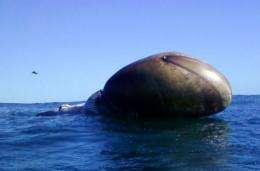
The carcass of a 14-meter whale that washed ashore in the South African tourist town of Knysna is seen floating. South African coastal authorities have warned beachgoers that sharks were moving into the area, feeding on the remains of the whale.

South African coastal authorities on Friday warned beachgoers around the tourist town of Knysna that sharks were moving into the area, feeding on the remains of a whale that ran ashore two days ago.

After sea crews failed to dislodge the 14-metre (46-foot) whale from the rocks off the southern coast, workers from nearby towns began chopping up the carcass and hauling parts away by road, the National Sea Rescue Institute said.

"It is normal behaviour for sharks to on , when there are such, at sea and therefore common for sharks to be attracted to the overspill of waste from the carcass into the sea during the efforts to remove the carcass," said spokesman Craig Lambinon.

"Fishermen and boaters are informing NSRI of an apparent increase in shark activity around the site," he added.

"Increased shark activity can be expected along the Southern Cape coastline as a result, and the public are urged to be aware of this and to be cautious," he said.

Lambinon said it was not yet clear how long it would take to finish removing the carcass.

Originally identified as a southern , Lambinon said that upon closer inspection the whale was determined to be a Bryde's whale, a type of baleen whale found in .

Explore further: Front-row seats to climate change

add to favorites email to friend print save as pdf

Related Stories

Whale carcass washes ashore in S.Africa

Apr 12, 2012

The carcass of a 14-metre (46-foot) southern right whale has washed ashore in the south coast tourist town of Knysna, where volunteers Thursday were trying to haul it from rocks and back out to sea.

Huge sperm whale washes up on Sydney beach

Apr 28, 2011

A dead 10-metre (32-feet) sperm whale has washed up on a Sydney beach, with rescuers struggling Thursday to remove it as the animal's blood runs into the water, attracting sharks.

Recommended for you

Front-row seats to climate change

20 hours ago

By day, insects provide the white noise of the South, but the night belongs to the amphibians. In a typical year, the Southern air hangs heavy from the humidity and the sounds of wildlife.

Captured in silken netting and sticky hairs

May 16, 2013

The great ecological success of spiders is often substantiated by the evolution of silk and webs. Biologists of the Kiel University and the University of Bern now found an alternative adaptation to hunting ...

User comments : 0

More news stories

Front-row seats to climate change

By day, insects provide the white noise of the South, but the night belongs to the amphibians. In a typical year, the Southern air hangs heavy from the humidity and the sounds of wildlife.

Morocco to harness the wind in energy hunt

Morocco is ploughing ahead with a programme to boost wind energy production, particularly in the southern Tarfaya region, where Africa's largest wind farm is set to open in 2014.

US psychiatry gets makeover in new manual

The latest makeover to a massive psychiatric tome honored by some, reviled by others and even called the "Bible" of mental disorders is being released Saturday with a host of new changes.

New case of SARS-like virus in Saudi: ministry

A new case of the deadly coronavirus has been detected in Saudi Arabia where 15 people have already died after contracting it, the health ministry announced on Saturday on its Internet website.