University team says Canadian oil sands mining plans don’t include damage to peatlands
Mar 13, 2012 by Bob Yirka report
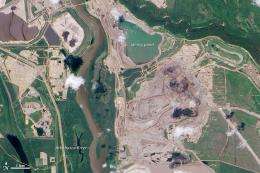
Athabasca Oil Sands NASA Earth Observatory image by Jesse Allen and Robert Simmon using EO-1 ALI data courtesy of the NASA EO-1 team.

(PhysOrg.com) -- David Schindler and colleagues at the University of Alberta have published a paper in the Proceedings of the National Academy of Sciences in which they detail what they believe is the true impact of oil sands mining in Alberta Canada. In it, they dispute the degree of environmental impact given by mining companies, saying that such reports thus far have neglected to take into account damage to peatlands that will not be restored following mining operations.

Oil sands mining in Canada has become a hot topic of late due to the heavy toll it exerts on the environment. Because the oil in such deposits doesn’t sit in underground pools as has been the case with most previous mining operations, which require little more than digging a well, it must be either surface mined and processed or steam injected to remove it from the sand in which is embedded, a dirty and energy intensive process.

Making matters worse, say Schindler et al, is the fact that 65% of the proposed mining land is made up of peatlands, which are of course by nature, wet. They also say that the peatlands under consideration are currently holding on to 11-47 million metric tons of that will be released into the atmosphere as part of the mining process. And then, because the mining companies plan to return the land to dry forest instead of the original , the area will lose the ability to sequester carbon in the future; this they say will add up to about 5,700-7,200 mt of carbon each year, which they say should be looked at as a net gain of carbon emissions each year.

Then of course, once the oil is extracted, it will be refined and sold, adding the group says, 22 billion more metric tons of carbon to the atmosphere. And even that is not the end of the story. By adding more carbon to the atmosphere, global temperatures will rise, thawing some of the permafrost in Canada (and elsewhere) adding as much as 30 to 60 billion mt more carbon to the atmosphere over the next thirty years. They also point out that restoring the land to dry forest will increase the number of forest fires each year, which will release even more carbon.

Schindler and his team conclude by suggesting that the public should be made fully aware of the true consequences of before public officials make decisions regarding whether to go ahead with such projects or not.

Explore further: Slovenian flyer lands in France on return trip from Arctic

More information: Oil sands mining and reclamation cause massive loss of peatland and stored carbon, PNAS, Published online before print March 12, 2012, doi: 10.1073/pnas.1117693108

Abstract
We quantified the wholesale transformation of the boreal landscape by open-pit oil sands mining in Alberta, Canada to evaluate its effect on carbon storage and sequestration. Contrary to claims made in the media, peatland destroyed by open-pit mining will not be restored. Current plans dictate its replacement with upland forest and tailings storage lakes, amounting to the destruction of over 29,500 ha of peatland habitat. Landscape changes caused by currently approved mines will release between 11.4 and 47.3 million metric tons of stored carbon and will reduce carbon sequestration potential by 5,734–7,241 metric tons C/y. These losses have not previously been quantified, and should be included with the already high estimates of carbon emissions from oil sands mining and bitumen upgrading. A fair evaluation of the costs and benefits of oil sands mining requires a rigorous assessment of impacts on natural capital and ecosystem services.

Related Stories

Oil sands pollution comparable to a large power plant

Feb 22, 2012

It takes a lot of energy to extract heavy, viscous and valuable bitumen from Canada's oil sands and refine it into crude oil. Companies mine some of the sands with multi-story excavators, separate out the bitumen, and process ...

Recommended for you

Century-old science helps confirm global warming

20 hours ago

(Phys.org) —Ocean measurements taken more than 135 years ago during the scientific expedition of HMS Challenger have provided further confirmation of human-produced global warming over the past century.

Be prepared for weather extremes

22 hours ago

Unsettled weather is an Iowa mainstay, and so is Inside's annual reminder of the university's severe weather safety and preparedness guidelines—for storms, extreme heat, flooding and more.

User comments : 5

Adjust slider to filter visible comments by rank

Display comments: newest first

Jimee
2.9 / 5 (7) Mar 13, 2012
Poison as many as you can as fast as you can while raping the consumer. Like the tobacco companies, mass murderers and too big to fail.
Noumenon
2.5 / 5 (8) Mar 13, 2012
That oil will be extracted, so stop your tree-hugger bed-wetting.
RitchieGuy
1.3 / 5 (4) Mar 15, 2012
Poison as many as you can as fast as you can while raping the consumer. Like the tobacco companies, mass murderers and too big to fail.


Seems like the consumer is enjoying the rape while getting to and from work and other places by way of oil and gasoline under the hood. It's better than sitting under a bridge or overpass while unemployed.
Callippo
2 / 5 (2) Mar 15, 2012
It essentially has no meaning to criticize oil companies, when we're traveling every day with car many kilometers and when we're not willing to support the cold fusion. It's just an environmentalist hypocrisy after then.
Shelgeyr
1 / 5 (3) Mar 15, 2012
My only issue with Canadian oil sands - and believe me, I hardly like using the term "issue" here since it is so minor - is that unlike deep/ultra-deep abiotic petroleum wells (beneath the salt layer and/or outside the oil window), the oil sands won't naturally refill upon depletion, at least within any reasonable time frame.

So while oil itself is a self-replenishing resource overall, for all practical purposes oil sands aren't.

Again, minor issue. I'm still all in favor of mining and extracting as much of them as possible.

More news stories

A hidden population of exotic neutron stars

(Phys.org) —Magnetars – the dense remains of dead stars that erupt sporadically with bursts of high-energy radiation - are some of the most extreme objects known in the Universe. A major campaign using ...

Hubble reveals the ring nebula's true shape

(Phys.org) —The Ring Nebula's distinctive shape makes it a popular illustration for astronomy books. But new observations by NASA's Hubble Space Telescope of the glowing gas shroud around an old, dying, ...

Century-old science helps confirm global warming

(Phys.org) —Ocean measurements taken more than 135 years ago during the scientific expedition of HMS Challenger have provided further confirmation of human-produced global warming over the past century.

Hormone replacement therapy—clarity at last

The British Menopause Society and Women's Health Concern have today released updated guidelines on Hormone Replacement Therapy (HRT) to provide clarity around the role of HRT, the benefits and the risks. The new guidelines ...

Controlling mood through the motions of mitochondria

(Medical Xpress)—Regulating the distribution of power in neurons is done by a system that makes the national electric grid look simple by comparison. Each neuron has several thousand mitochondria confined ...

A quantum simulator for magnetic materials

Physicists understand perfectly well why a fridge magnet sticks to certain metallic surfaces. But there are more exotic forms of magnetism whose properties remain unclear, despite decades of intense research. ...