Sediment sleuthing: Radioactive medicine being tracked through rivers
Mar 22, 2012
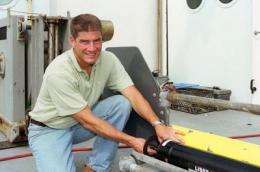
Chris Sommerfield is tracking radioactive iodine, used in medical treatments, through waterways to learn how substances travel along rivers to the ocean. Credit: Bob Bowden

A University of Delaware oceanographer has stumbled upon an unusual aid for studying local waterways: radioactive iodine. Trace amounts of the contaminant, which is used in medical treatments, are entering waterways via wastewater treatment systems and providing a new way to track where and how substances travel through rivers to the ocean.

"This is a really interesting convergence of medicine, public health and environmental science," said Christopher Sommerfield, associate professor of oceanography in UD's College of Earth, Ocean, and Environment.

Sommerfield found small quantities of , also called radioiodine or I-131, by accident while sampling the Delaware River, the main source of freshwater to Delaware Bay. The amounts were at low concentrations that do not pose a threat to humans or the environment, according to the (EPA).

Sommerfield measures naturally occurring radionuclides, variants of elements emitting radiation, that attach to mud particles carried along by water. The work is part of his research on how move through estuaries to the coastal ocean and influence the sea floor and coast.

When I-131 showed up in his samples, he thought it was a mistake.

"I-131 is a man-made radionuclide produced in nuclear reactors, so when we first detected it my heart skipped a beat," Sommerfield said. "However, after further research and consultation with , I realized that it was I-131 waste from thyroid cancer treatments."

Therapeutic I-131 administered at hospitals enters urban sewage after thyroid cancer patients return home and excrete the medicine. Last summer the Philadelphia Water Department discovered extremely low levels of I-131 in the Schuylkill River, which serves as a drinking water source for the city, in samples collected following the Fukushima in Japan.

The department determined that the substance was coming from local medical treatments. Like the amounts Sommerfield found throughout the Delaware Estuary around the same time, the levels were well below the maximum accepted level set by the EPA, which periodically monitors I-131 at a limited number of sites.

Sommerfield shared his findings with Philadelphia and Delaware officials, who continue to examine the situation. He discovered that the highest I-131 concentrations were present in the highly urbanized section of the Delaware River, which receives a large amount of treated wastewater from municipalities, and that levels steadily decreased downstream to zero in Delaware Bay.

I-131 has a half-life of eight days, meaning its radioactivity decreases by half during that time period as it transforms to non-radioactive elements. Sommerfield was unable to find much information about the fate of I-131 in coastal waterways.

"There are only a few recent research papers documenting the behavior I-131 in rivers and estuaries worldwide, and nothing for Delaware," he said.

Sommerfield recently shared his experience at the international Ocean Sciences Meeting in Utah, where fellow researchers were interested in learning more about how I-131 could be used as a water and sediment tracer. Radionuclides help oceanographers study transport processes in estuaries and coastal waters, and I-131 has the potential to fill a void among natural and man-made radionuclides that are typically measured because it has a very short half-life and comes from a specific source.

"Wastewater-derived I-131 provides a tool to better understand how estuaries disperse water and suspended particles," Sommerfield said. "With further research, we expect to learn more about how sediment from the is delivered to the estuary and fringing tidal marshlands, which require muddy sediments for nutrients and stability."

Explore further: Climate change and wildfire: Synthesis of recent findings

add to favorites email to friend print save as pdf

Related Stories

Radioactivity in Europe, no public risk: IAEA

Nov 11, 2011

The UN atomic agency said Friday "very low levels" of radioactive iodine-131 had been detected in the air in the Czech Republic and in other countries, but presented no risk to human health.

Radiation from Japan detected in Cleveland

Mar 28, 2011

A researcher at Case Western Reserve University has detected tiny amounts of Iodine 131 from Japan in rainwater collected from the roof of a campus building.

Fukushima nuke pollution in sea 'was world's worst'

Oct 27, 2011

France's nuclear monitor said on Thursday that the amount of caesium 137 that leaked into the Pacific from the Fukushima disaster was the greatest single nuclear contamination of the sea ever seen.

The case for maintaining current regulations on I-131 therapy

May 05, 2011

Two articles in the June issue of The Journal of Nuclear Medicine make a case for maintaining current U.S. Nuclear Regulatory Commission (NRC) regulations on the release of patients who undergo radioactive iodine treatments for th ...

Recommended for you

Farmers plant rice near crippled Fukushima site

9 minutes ago

Farmers have resumed planting rice for market only 15 kilometres (nine miles) from Japan's crippled Fukushima Daiichi nuclear power station, a local official said Wednesday.

Meeting the 'grand challenge' of a sustainable water supply

35 minutes ago

Scientists and engineers must join together in a major new effort to educate the public and decision makers on a crisis in providing Earth's people with clean water that looms ahead in the 21st century. That's the focus of ...

Could pond waste be the 'new' fertiliser?

1 hour ago

The University of Stirling is to lead a new project to develop a strategy for using nutrient-rich aquatic biomass waste – from ponds, wetlands and other water-bodies – in farming, as an environmentally ...

Eco database to map landscape projects

1 hour ago

Environmental projects which map some of the most important benefits we get from nature have been brought together for the first time in an online database, following national survey work by researchers in the University ...

Climate change and wildfire: Synthesis of recent findings

18 hours ago

Concerns continue to grow about the effects of climate change on fire. Wildfires are expected to increase 50 percent across the United States under a changing climate, over 100 percent in areas of the West by 2050 as projected ...

User comments : 0

More news stories

Volcanoes cause climate gas concentrations to vary

Trace gases and aerosols are major factors influencing the climate. With the help of highly complex installations, such as MIPAS on board of the ENVISAT satellite, researchers try to better understand the ...

Explainer: Why are tornadoes so destructive?

Tornadoes are a part of life for people living in the Great Plains of the United States. In Oklahoma, a state that averages 62 tornadoes a year, people are prepared as best as they can be and are well warned.

Could pond waste be the 'new' fertiliser?

The University of Stirling is to lead a new project to develop a strategy for using nutrient-rich aquatic biomass waste – from ponds, wetlands and other water-bodies – in farming, as an environmentally ...

Theorists weigh in on where to hunt dark matter

(Phys.org) —Now that it looks like the hunt for the Higgs boson is over, particles of dark matter are at the top of the physics "Most Wanted" list. Dozens of experiments have been searching for them, but ...

DNA damage: The dark side of respiration

(Phys.org) —Adventitious changes in cellular DNA can endanger the whole organism, as they may lead to life-threatening illnesses like cancer. Researchers at LMU now report how byproducts of respiration cause mispairing ...