Another piece of the ion pump puzzle
Mar 16, 2012
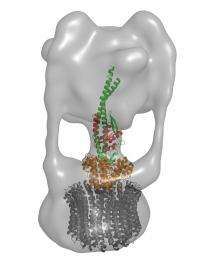
Figure 1: The D (green) and F (red) subunits of the enzyme V-ATPase form a central axis that connects the components of the catalytic V1 segment (upper) and the membrane-bound V0 segment (lower; orange and grey). Credit: 2012 Takeshi Murata

From bacteria to humans, all cells use molecules of adenosine triphosphate (ATP) as fuel to power a broad range of biochemical reactions. For example, massive multi-subunit enzymes known as V-ATPases convert ATP molecules into energy that helps drive the transport of ions across cellular membranes.

V-ATPases consist of a so-called ‘V complex’, which transfers energy derived from ATP hydrolysis into rotational motion, thereby promoting ion transport through to the membrane-bound V0 complex. These two complexes are joined by three ‘stalks’, including a central stalk composed of subunits named D and F, although this segment of the protein is poorly characterized. “The of this central axis of V-ATPase has not been obtained,” says Takeshi Murata of the RIKEN Systems and Structural Biology Center in Yokohama, “and we believe such structural studies are very important to understand this protein’s precise mechanism.”

Murata and colleagues recently succeeded in obtaining high-resolution structural information about the DF complex of V-ATPase obtained from the Enterococcus hirae1. By comparing this structural information against an equivalent segment from F-ATPase, which synthesizes rather than hydrolyzes ATP, the researchers were able to identify functional domains that may be specifically required by V-ATPases.

They determined that the E. hirae D subunit is composed of a pair of long helical structures coiled around each other, with a short hairpin-shaped loop at one end. According to Murata, the discovery of this latter structure was unexpected. “This short beta-hairpin region is a unique structure, although the rest of the D structure is very similar to that of other rotary complexes such as F-ATPase and flagellar motors,” he says. This segment does not appear to be essential for V-ATPase assembly, but ATP processing efficiency was reduced when the researchers deleted this hairpin from the subunits.

In contrast, the E. hirae F subunit assumed a more compact structure, relatively similar to its A- and F-ATPase counterparts; the researchers determined that it specifically associates with the middle portion of the D subunit’s coiled helical segment, an interaction that depends heavily on a particular helix within the F subunit. 

Although untangling this structure represents a major step forward, this complex must also be understood as part of a far larger entity (Fig. 1). Murata and colleagues have already begun tackling this. “We recently succeeded at solving the structure of V1-ATPase with a resolution of 2.1 Angstroms,” says Murata, “and we are now preparing this manuscript for publication.”

Explore further: RNA capable of catalyzing electron transfer on early earth with iron's help, study says

More information: Saijo, S.,et al. Crystal structure of the central axis DF complex of the prokaryotic V-ATPase. Proceedings of the National Academy of Sciences USA 108, 19955–19960 (2011).

add to favorites email to friend print save as pdf

Related Stories

Deciphering the mechanism of an ion pump

Dec 16, 2011

From an analysis of the sodium-transporting vacuolar ATPases (V-ATPases) of the bacterium Enterococcus hirae, Takeshi Murata of the RIKEN Systems and Structural Biology Center, Yokohama, and colleagues recently ...

Energy-saving chaperon Hsp90

Jan 13, 2012

A special group of proteins, the so-called chaperons, helps other proteins to obtain their correct conformation. Until now scientists supposed that hydrolyzing ATP provides the energy for the large conformational ...

NIH grant ratchets up ASU research in molecular motors

May 30, 2011

Empowered by a $1.2 million grant from the National Institutes of Health (NIH), Arizona State University scientist Wayne Frasch is deciphering how one of the world’s smallest molecular motors works in ...

Recommended for you

Attacking MRSA with metals from antibacterial clays

May 17, 2013

In the race to protect society from infectious microbes, the bugs are outrunning us. The need for new therapeutic agents is acute, given the emergence of novel pathogens as well as old foes bearing heightened antibiotic resistance.

Keeping fruit, vegetables and cut flowers fresh longer

May 15, 2013

New technology offers the promise of reducing billions of dollars of losses that occur each year from the silent, invisible killer of fruits, vegetables and cut flowers—a gas whose effects are familiar to everyone who has ...

Why don't beetles freeze in the winter?

May 14, 2013

For 37 years, Queen's University Biochemistry professor Peter Davies has been unraveling the mystery of why some organisms including insects and fish don't freeze in the winter. His research into insect antifreeze protein ...

The molecular basis of strawberry aroma

May 13, 2013

You know that summer is here when juicy red strawberries start to appear on the shelves. In Germany, this seasonal fruit has never been more popular: on average 3.5 kilos per head were consumed in 2012—a ...

A new dimension for 3-D protein structures

May 13, 2013

(Phys.org) —3D structures of biological molecules like proteins directly affect the way they behave in our bodies. EPFL scientists have developed a new infrared-UV laser method to more accurately determine ...

User comments : 0

More news stories

Attacking MRSA with metals from antibacterial clays

In the race to protect society from infectious microbes, the bugs are outrunning us. The need for new therapeutic agents is acute, given the emergence of novel pathogens as well as old foes bearing heightened antibiotic resistance.

Beautiful 'flowers' self-assemble in a beaker

By simply manipulating chemical gradients in a beaker of fluid, materials scientists at Harvard have found that they can control the growth behavior of crystals to create precisely tailored structures—such ...

Heat-related deaths in Manhattan projected to rise

Residents of Manhattan will not just sweat harder from rising temperatures in the future, says a new study; many may die. Researchers say deaths linked to warming climate may rise some 20 percent by the 2020s, ...

Kinks and curves at the nanoscale

One of the basic principles of nanotechnology is that when you make things extremely small—one nanometer is about five atoms wide, 100,000 times smaller than the diameter of a human hair—they are going ...