'Nanoslinky': A novel nanofluidic technology for DNA manipulation and measurement
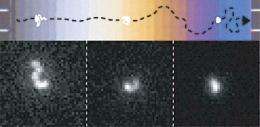
Remember Slinky, the coiled metal spring that “walks” down stairs with just a push, momentum and gravity? Researchers at the National Institute of Standards and Technology (NIST) have developed their own version of this classic—albeit 10 million times smaller—as a novel technology for manipulating and measuring DNA molecules and other nanoscale (billionth of a meter) materials.
In the first of two recent papers*, Samuel Stavis, Elizabeth Strychalski and colleagues demonstrated that a nanoscale fluidic channel shaped like a staircase with many steps (developed previously at NIST and Cornell University) can be used to control the otherwise random drift of a DNA molecule through a fluid. Squeezed into the shallowest step at the top of the staircase, a strand of DNA diffuses randomly across that step. The DNA molecule seeks to increase its entropy—the universal tendency towards disorder in a system—by relieving its confinement, and therefore, “walks” down onto the next deeper step when it reaches the edge. The motion of the molecule down the staircase, which the researchers termed “entropophoresis” (entropy-driven transport), ends when it becomes trapped on the deepest step at the bottom. Because this motion resembles that of a Slinky, the researchers nicknamed their system the “nanoslinky.” The researchers found that DNA molecules of different sizes and shapes descended the staircase at different rates—which suggests the structure could be used to separate, concentrate and organize mixtures of nanoscale objects.
Stavis says that this novel technology provides advantages over traditional nanofluidic methods for manipulating and measuring DNA. “Control over the behavior of a DNA molecule is built into the staircase structure. After placing the molecule on the top step [by driving the DNA strand up the staircase with an electric field], no external forces are needed to make it move,” Stavis says. “The staircase is a passive nanofluidic technology that automates complex manipulations and measurements of DNA.”
This NIST advance in nanofluidic technology dovetails nicely with a NIST innovation in measurement science—specifically, determining the size of a DNA molecule in nanofluidic “slitlike confinement” imposed by the narrow gap between the floor of each step and the ceiling of the channel. In the “nanoslinky” system, Strychalski explains, the coiled and folded DNA strand contracts progressively as it moves down the steps. “Because there are many steps, we can make more detailed measurements than previous studies,” she says.
Getting the most from those measurements was the goal of the research reported in the NIST team’s second paper.** “The challenge was to make our measurements of DNA size more quantitative,” Strychalski says.
Previous measurements of DNA dimensions in nanofluidic systems, Strychalski says, have been limited by imaging errors from the optical microscopes used to measure the dimensions of DNA molecules labeled with a fluorescent dye. “The first problem is the diffraction limit, or the optical resolution, of the fluorescence microscope,” she says. “The second problem is the pixel resolution of the camera. Because a DNA molecule is not much larger than the wavelength of light and the effective pixel size, images of fluorescent DNA molecules are blurred and pixilated, and this increases the apparent size of the molecule.”
To improve their measurements of DNA molecules during their descent, the NIST researchers used models to approximate the effects of diffraction and pixilation. Applying these “numerical simulations” to the images of DNA molecules confined by the staircase made the final measurements of DNA size the most quantitative to date. These measurements also showed that more work is needed to fully understand this complicated system.
According to Stavis and Strychalski, the staircase is a simple prototype of a new class of engineered nanofluidic structures with complex three-dimensional surfaces. With further refinements, the technology may someday be mass produced for measuring and manipulating not just DNA molecules, but other types of biopolymers and nanoscale materials for health care and nanomanufacturing.
More information: *S.M. Stavis, et al. DNA molecules descending a nanofluidic staircase by entropophoresis. Lab on a Chip (2012). DOI: 10.1039/c21c21152a
**E.A. Strychalski, et al. Quantitative measurements of the size scaling of linear and circular DNA in nanofluidic slitlike confinement. Macromolecules (2012). DOI: 10.1021/ma202559k
Provided by National Institute of Standards and Technology


