The origin of the moon's craters
Mar 19, 2012
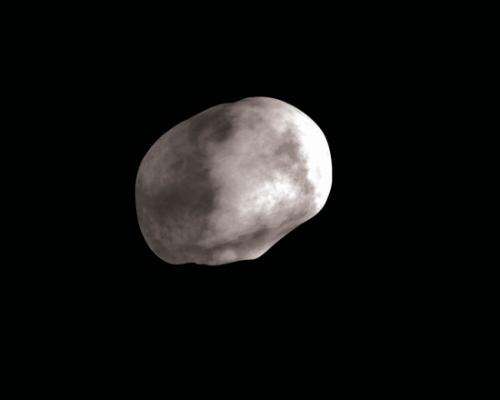
A Hubble image of the asteroid Vesta. A new paper on the origins of the Moon's craters proposes that asteroids from the neighborhood of Mars, some as large as Vesta, could have been responsible. Credit: NASA/Hubble

(PhysOrg.com) -- Moon's craters, together with samples of the surface returned during the Apollo program, tell the story of impacts from two different populations of small bodies. The first rocky collection was gradually depleted over time: About 3.85 billion years ago (the Moon formed about 4.5 billion years ago) there was a cataclysmic heavy bombardment of material onto the surface that lasted only a few hundred million years. The second collection of bodies appears not to have been depleted, however, and their impacts have continued at a steady pace. We observe this latter group today as Earth-orbit-crossing objects, and their numbers are apparently renewed at about the same rate that they are lost. All these details are important to our understanding of the Moon, the history of the bombardment of the Earth by the same populations of asteroids, and - not least - to a better understanding of how the solar system evolved and thus how planetary systems around other stars might look during different stages of their evolution.

One of the outstanding questions in the study of lunar impacts has been where these two sets of bodies came from - especially the population that caused what is known as the heavy . If it were primordial (dating from the early days of the solar system itself), then to cause a heavy bombardment so suddenly the collection must have been disrupted into an unstable configuration, probably by some kind of migration of the planets in their orbits. What caused that migration is not known. But if the collection was not primordial, then where did it come from?

CfA astronomer Matija Cuk offers a new, if still tentative, explanation in the latest issue of the journal Icarus. The details are complicated, but in summary he argues that the data do not support the idea of a simple disruption by planetary migration. Those data include a revised measurement of the size distribution of lunar craters, and the local magnetic fields on the Moon. Cuk proposes that most of the likely impactors came from a population of small, primordial objects whose orbits crossed the of Mars - but not the orbits of either Earth or Jupiter. These objects would have had only slightly unstable configurations because Mars is relatively small, and so provide an intermediate class of solution. Numerical simulations of the behavior of this collection of asteroids suggests that they could have produced most of the lunar craters; the collisional breakup of one very large body in this group and the subsequent impacts from its debris could explain many other features. The new hypotheses need to be confirmed with improved data on lunar craters and compositions, but directly address some basic puzzles of lunar history.

Explore further: NASA head views progress on asteroid lasso mission

Related Stories

Lunar scientists shed light on Moon's impact history

Feb 28, 2012

(PhysOrg.com) -- A team of researchers from the NASA Lunar Science Institute (NLSI) at NASA Ames Research Center, Moffett Field, Calif., have discovered that debris that caused a "lunar cataclysm" on the moon ...

Recommended for you

NASA head views progress on asteroid lasso mission

13 hours ago

Surrounded by engineers, NASA chief Charles Bolden inspected a prototype spacecraft engine that could power an audacious mission to lasso an asteroid and tow it closer to Earth for astronauts to explore.

Ecuador satellite collides with Russian space junk

13 hours ago

A small Ecuadoran satellite collided in orbit with the remains of a Russian rocket, but it is too soon to know how much damage it might have sustained, Quito's space agency said Thursday.

Forecast for Titan: Wild weather could be ahead

May 22, 2013

(Phys.org) —Saturn's moon Titan might be in for some wild weather as it heads into its spring and summer, if two new models are correct. Scientists think that as the seasons change in Titan's northern hemisphere, ...

SDO observes mid-level solar flare

May 22, 2013

UPDATE 16:30 p.m. EDT: The M7-class flare was also associated with a coronal mass ejection or CME, another solar phenomenon that can send billions of tons of particles into space. While this CME was not Ea ...

User comments : 0

More news stories

A hidden population of exotic neutron stars

(Phys.org) —Magnetars – the dense remains of dead stars that erupt sporadically with bursts of high-energy radiation - are some of the most extreme objects known in the Universe. A major campaign using ...

Hubble reveals the ring nebula's true shape

(Phys.org) —The Ring Nebula's distinctive shape makes it a popular illustration for astronomy books. But new observations by NASA's Hubble Space Telescope of the glowing gas shroud around an old, dying, ...

Century-old science helps confirm global warming

(Phys.org) —Ocean measurements taken more than 135 years ago during the scientific expedition of HMS Challenger have provided further confirmation of human-produced global warming over the past century.

Hormone replacement therapy—clarity at last

The British Menopause Society and Women's Health Concern have today released updated guidelines on Hormone Replacement Therapy (HRT) to provide clarity around the role of HRT, the benefits and the risks. The new guidelines ...

Controlling mood through the motions of mitochondria

(Medical Xpress)—Regulating the distribution of power in neurons is done by a system that makes the national electric grid look simple by comparison. Each neuron has several thousand mitochondria confined ...