Single molecules in a quantum movie
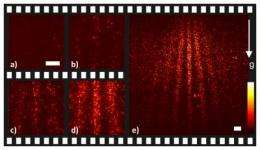
The quantum physics of massive particles has intrigued physicists for more than 80 years, since it predicts that even complex particles can exhibit wave-like behaviour – in conflict with our everyday ideas of what is real or local. An international team of scientists now succeeded in shooting a movie which shows the build-up of a matter-wave interference pattern from single dye molecules which is so large (up to 0.1 mm) that you can easily see it with a camera.
This visualizes the dualities of particle and wave, randomness and determinism, locality and delocalization in a particularly intuitive way. Seeing is believing: the movie by Thomas Juffmann et al. will be published on March 25 in Nature Nanotechnology.
A quantum premiere with dye molecules as leading actors
Physicist Richard Feynman once claimed that interference effects caused by matter-waves contain the only mystery of quantum physics. Understanding and applying matter waves for new technologies is also at the heart of the research pursued by the Quantum Nanophysics team around Markus Arndt at the University of Vienna and the Vienna Center for Quantum Science and Technology.
The scientists now premiered a movie which shows the build-up of a quantum interference pattern from stochastically arriving single phthalocyanine particles after these highly-fluorescent dye molecules traversed an ultra-thin nanograting. As soon as the molecules arrive on the screen the researchers take live images using a spatially resolving fluorescence microscope whose sensitivity is so high that each molecule can be imaged and located individually with an accuracy of about 10 nanometers. This is less than a thousandth of the diameter of a human hair and still less than 1/60 of the wavelength of the imaging light.
A breath of nothing
In these experiments van der Waals forces between the molecules and the gratings pose a particular challenge. These forces arise due to quantum fluctuations and strongly affect the observed interference pattern. In order to reduce the van der Waals interaction the scientists used gratings as thin as 10 nanometers (only about 50 silicon nitride layers). These ultra-thin gratings were manufactured by the nanotechnology team around Ori Cheshnovski at the Tel Aviv University who used a focused ion beam to cut the required slits into a free-standing membrane.
Tailored nanoparticles
Already in this study the experiments could be extended to phthalocyanine heavier derivatives which were tailor-made by Marcel Mayor and his group at the University of Basel. They represent the most massive molecules in quantum far-field diffraction so far.
Motivation and continuation
The newly developed and combined micro- and nanotechnologies for generating, diffracting and detecting molecular beams will be important for extending quantum interference experiments to more and more complex molecules but also for atom interferometry.
The experiments have a strongly didactical component: they reveal the single-particle character of complex quantum diffraction patterns on a macroscopic scale that is visible to the eye. You can see them emerge in real-time and they last for hours on the screen. The experiments thus render the wave-particle duality of quantum physics particularly tangible and conspicuous.
The experiments have a practical side, too. They allow to access molecular properties close to solid interfaces and they show a way towards future diffraction studies at atomically thin membranes.
More information: Real-time single-molecule imaging of quantum interference: Thomas Juffmann, Adriana Milic, Michael Müllneritsch, Peter Asenbaum, Alexander Tsukernik, Jens Tüxen, Marcel Mayor, Ori Cheshnovsky and Markus Arndt. Nature Nanotechnology (2012). DOI: 10.1038/NNANO.2012.34
Journal information: Nature Nanotechnology
Provided by University of Vienna


