Flying jewels spell death for baby spiders
Mar 02, 2012
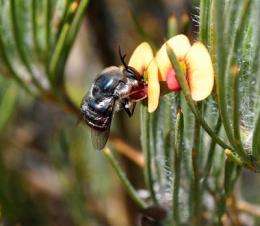
An adult spider fly (Panops baudini) feeds on flowers of a desert pea, photographed during September in Boorabbin National Park, Western Australia. Credit: Photograph by Dan Schoknecht (Western Australian Museum)

Spider flies are a rarely collected group of insects. Adults are considered important pollinators of flowers, while larvae live as internal parasitoids of juvenile spiders. Eight genera are recorded in Australasia, including four genera in the subfamily Panopinae, a group of large, hairy, often metallic coloured adults whose larvae specialize as parasitizing mygalomorph spiders such as tarantulas, trap door and funnel web spiders.

In this study, four new species of the genus Panops are described from Australia. These flies typically have large round bodies covered with dense hairs and black or metallic green to blue colouration, giving a jewel-like appearance. In some species, the mouthparts are greatly elongated to be able to feed at flowers with nectar at the base of long corolla tubes. The study was published in the open access journal ZooKeys.
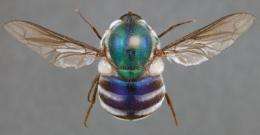
This is an adult spider fly (Panops austrae) preserved specimen. Credit: Photograph by Shaun Winterton

All species in Panops have that internally parasitize spiders in Australia, such as the trap door spider and Sydney funnel web spider. In all known cases, only the juvenile spider is parasitized and the maggot may live inside the spider for years, prolonging the life of the spider and preventing it from developing into an adult. Eventually, the spider fly maggot will eat the spider from the inside out, leaving behind only the skin and will itself then pupate to develop into an adult.
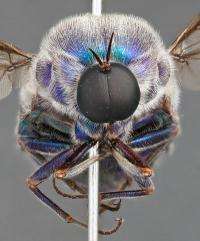
This is an adult spider fly (Panops jade) preserved specimen. Credit: Photograph by Shaun Winterton


Explore further: Front-row seats to climate change

More information: Winterton SL (2012) Review of Australasian spider flies (Diptera, Acroceridae) with a revision of Panops Lamarck. ZooKeys 172: 7-75. doi: 10.3897/zookeys.172.1889

add to favorites email to friend print save as pdf

Related Stories

Male black widows look for well-fed mates

Jul 07, 2011

(PhysOrg.com) -- According to a new study published in Animal Behaviour, a male black widow spider is able to identify a female spider that has eaten well by simply taking a few steps on the web she spins. ...

Male wolf spiders cannibalize females

Apr 13, 2011

(PhysOrg.com) -- While most people are familiar with the fact that many species of female spiders eat their male counterparts, new research findings published in the Biological Journal of the Linnean Society show h ...

Largest spider fossil found in China

Apr 21, 2011

(PhysOrg.com) -- According to Paul Selden, the director of the Paleontological Institute at the University of Kansas, he and his team members have discovered the largest spider fossil. The fossil was discovered ...

Recommended for you

Front-row seats to climate change

May 17, 2013

By day, insects provide the white noise of the South, but the night belongs to the amphibians. In a typical year, the Southern air hangs heavy from the humidity and the sounds of wildlife.

Captured in silken netting and sticky hairs

May 16, 2013

The great ecological success of spiders is often substantiated by the evolution of silk and webs. Biologists of the Kiel University and the University of Bern now found an alternative adaptation to hunting ...

User comments : 0

More news stories

Morocco to harness the wind in energy hunt

Morocco is ploughing ahead with a programme to boost wind energy production, particularly in the southern Tarfaya region, where Africa's largest wind farm is set to open in 2014.

Galaxy's Ring of Fire

Johnny Cash may have preferred this galaxy's burning ring of fire to the one he sang about falling into in his popular song. The "starburst ring" seen at center in red and yellow hues is not the product of ...