Highest honors for quantum computer pioneer
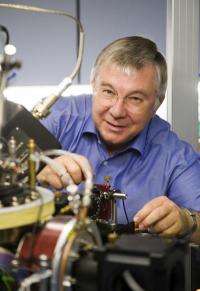
Experimental physicist Rainer Blatt from the Institute for Quantum Optics and Quantum Information (IQOQI) in Innsbruck, Austria, will receive the Stern-Gerlach Medal of the German Physical Society. The medal will be presented by Germany's Research Minister Anette Schavan in Berlin on Tuesday 27 March 2012. It is the most prestigious and important award in the field of experimental physics, awarded by the biggest physics society in the world. Rainer Blatt is the first Austrian scientist given the honor to receive this award.
Rainer Blatt is being recognized for his work in the fields of metrology and quantum information processing with electromagnetically stored ions. In its decision the German Physical Society states that "The experimental demonstration of basic building blocks and algorithms of a quantum computer, teleportation of quantum states of matter, the first realization of quantum bytes and the simulation of quantum systems have opened up new scientific research fields and paved the way for future quantum technology." The Stern-Gerlach Medal is the highest honor of the German Physical Society in the field of experimental physics and it is made of pure gold.
Pioneer of quantum computer research
A future quantum computer uses the particular nature of quantum mechanics, which will make calculations possible that are not feasible in classic data processing. In trailblazing experiments Rainer Blatt showed that trapped ions offer a unique experimental platform to encode, process and measure quantum bits. All quantum logical operations are realized by a complex series of laser pulses. A well-known example of quantum algorithms is teleportation; Rainer Blatt and his research group succeeded in producing entangled states, which they then used for quantum algorithms. They started by entangling two ions, in 2008 they entangled eight ions in one quantum byte and now they have pushed the record to 14 entangled ions.
In another experiment Rainer Blatt and his team of scientists showed that trapped ions can also be used in a digital quantum simulator. This research area is based on the propositions of Richard Feynman, who suggested simulating states and dynamics in a highly controlled quantum system to better understand complex many-body systems. If scientists can tailor the quantum state of a many-body system, this quantum technology could be used for applications such as the atomic clock which uses entanglement of ions to achieve an even higher grade of precision.
Inspiration for others
The work done by Rainer Blatt's research group at the Institute for Experimental Physics of the University of Innsbruck and the Institute for Quantum Optics and Quantum Information (IQOQI) of the Austrian Academy of Sciences has inspired researchers beyond the field of Quantum Optics and Quantum Information influencing research in the fields of ultracold atoms and condensed matter physics. "His work provides the basis for future technological application of quantum information," writes the German Physical Society.
The award ceremony will take place during the 76th Annual Meeting of the Society in Berlin, which will be attended by over 6,000 physicists from all over the world. The German Physical Society, whose tradition dates back to 1845, is the oldest national physics society in the world, and with 61,000 members, also the biggest.
More information: A detailed CV of Prof. Rainer Blatt can be found at iqoqi.at/people&v=i&i=290995
Provided by University of Innsbruck


