Dye-sensitized solar cells with carbon nanotube transparent electrodes offer significant cost savings
Mar 15, 2012
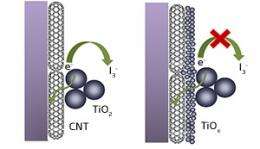
Carbon nanotube electrodes. The use of carbon nanotubes has a significant cost advantage. However, in earlier designs (left), the carbon nanotubes degraded through chemical processes (e-: electrons, I3-: ions in the liquid). Using a thin protective layer of titanium oxide now stabilizes the nanotubes (right), increasing the performance of these cells. Credit: 2011 AIP

Solar energy is one of the most promising forms of renewable energy, but the high cost of conventional solar cells has so far limited its popularity. To increase the competitiveness of solar energy, scientists have turned to the development of dye-sensitized solar cells — solar cells that use low-cost organic dyes and titanium dioxide (TiO2) nanoparticles in place of expensive semiconductor and rare earth elements to absorb sunlight. Zhaohong Huang at the A*STAR Institute of Materials Research and Engineering and co-workers have now reduced the cost of dye-sensitized solar cells even further by replacing indium tin oxide (ITO) — the standard material for transparent electrodes — with carbon nanotubes.

A typical dye-sensitized solar cell comprises a porous layer of TiO2 nanoparticles immersed in an organic dye. The dye absorbs the sunlight and converts the energy into electricity, which flows into the TiO2 nanoparticles. The sun-facing side of the solar cell is usually covered with a transparent electrode that carries the charge carriers away from the TiO2 and out of the solar cell. “Unfortunately, ITO electrodes are brittle and crack easily,” says Huang. “They are also expensive and could incur up to 60% of the total cost of the dye-sensitized solar cell.”

Huang and his team therefore replaced the ITO electrode with a thin film of carbon nanotubes. Carbon nanotubes conduct electricity and are almost transparent, flexible and strong, which make them the ideal material for transparent electrodes. The only drawback is that photo-generated charge carriers in the nanotube may recombine with ions in the dye, which reduces the power conversion efficiency of the solar cell.

To overcome this problem, Huang and his team placed a TiO2 thin film in between the thin film and the porous layer. They found that the performance of dye-sensitized with TiO2 thin film was significantly better than those without. However, they also found that the solar conversion efficiency of their new dye-sensitized solar cells was only 1.8%, which is lower than that of conventional solar cells using ITO electrodes. This is due to the higher electrical resistances and reduced optical transparency of the carbon nanotube films, which limits the amount of sunlight entering the cell.

“We are now studying different ways to enhance the conductivity and transparency of the films,” says Huang. “Furthermore, we are planning to replace the bottom platinum electrode with carbon nanotube thin film to reduce the cost of dye-sensitized solar cells further.”

If successful, the results could have a great impact on the cost and stability of dye-sensitized solar cells.

Explore further: Building 3-D fractals on a nanoscale: Structure repeats itself from micro to nano

More information: Research article in Applied Physics Letters.

Provided by Agency for Science, Technology and Research (A*STAR)

3.3 /5 (4 votes)
add to favorites email to friend print save as pdf

Related Stories

Dye-sensitized solar cells break a new record

Nov 14, 2011

(PhysOrg.com) -- Dye-sensitized Grätzel solar cells have just set a new efficiency benchmark. By changing the composition and color of the cells, an EPFL team has increased their efficiency to more than ...

Solar cells go thin and flimsy

Sep 04, 2006

The next generation of solar cells made out of plastics and microscopic crystals instead of silicon are taking shape at UQ (University of Queensland). UQ Master of Physics student Michael Deceglie is working ...

Affordable solar technology

Jan 06, 2011

An innovative Oxford company has developed new solar cell technology that is manufactured from cheap, abundant, non-toxic and non-corrosive materials and can be scaled to any volume.

Recommended for you

Hybrid material as gold-leaf substitute

Jun 18, 2013

(Phys.org) —A team of researchers headed by Professor Raffaele Mezzenga has created a hybrid material out of gold and milk proteins that looks like a wafer-thin gold leaf. Thanks to its properties, it could ...

Antioxidant with a long shelf life

Jun 17, 2013

(Phys.org) —Scientists from ETH Zurich have developed a nanomaterial that protects other molecules from oxidation. Unlike many such active substances in the past, the ETH-Zurich researchers' antioxidant ...

Fast pollutant degradation by nanosheets

Jun 17, 2013

(Phys.org) —Waste from textile and paint industries often contains organic dyes such as methylene blue as pollutants. Photocatalysis is an efficient means of reducing such pollution, and molybdenum trioxide ...

Unzipped nanotubes unlock potential for batteries

Jun 13, 2013

(Phys.org) —Researchers at Rice University have come up with a new way to boost the efficiency of the ubiquitous lithium ion (LI) battery by employing ribbons of graphene that start as carbon nanotubes.

Nanoparticle opens the door to clean-energy alternatives

Jun 13, 2013

(Phys.org) —Cheaper clean-energy technologies could be made possible thanks to a new discovery. Research team members led by Raymond Schaak, a professor of chemistry at Penn State University, have found ...

User comments : 0

More news stories

Sound waves precisely position nanowires

(Phys.org) —The smaller components become, the more difficult it is to create patterns in an economical and reproducible way, according to an interdisciplinary team of Penn State researchers who, using ...

An environmentally friendly battery made from wood

Taking inspiration from trees, scientists have developed a battery made from a sliver of wood coated with tin that shows promise for becoming a tiny, long-lasting, efficient and environmentally friendly energy ...

3D printing tiny batteries

(Phys.org) —3D printing can now be used to print lithium-ion microbatteries the size of a grain of sand. The printed microbatteries could supply electricity to tiny devices in fields from medicine to communications, ...

Hybrid nanostructures: Getting to the core

Material scientists expect the new multifunctional properties of hybrid nanostructures will transform the development of high-performance devices, including batteries, high-sensitivity sensors and solar cells. ...

EUROnu project recommends building Neutrino Factory

(Phys.org) —The European Union's Seventh Framework Programme, EUROnu, has submitted its findings to a panel at CERN. Charged with choosing a project to study the nature of matter and antimatter, the project ...

'Ugly' finding: Unattractive workers suffer more

People who are considered unattractive are more likely to be belittled and bullied in the workplace, according to a first-of-its-kind study led by a Michigan State University business scholar.