Cassini to make closest pass yet over Enceladus South Pole
Mar 27, 2012 By Jia-Rui C. Cook
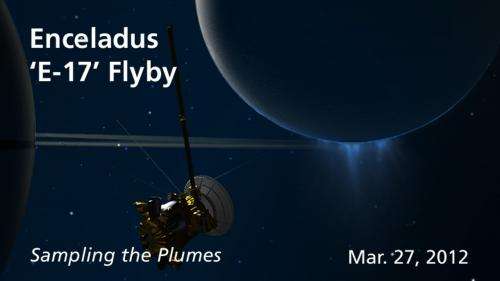
Artist's concept of the Mar. 27, 2012, flyby of Saturn's moon Enceladus by NASA's Cassini spacecraft. Credit: NASA/JPL-Caltech

(PhysOrg.com) -- NASA's Cassini spacecraft is preparing to make its lowest pass yet over the south polar region of Saturn's moon Enceladus, where icy particles and water vapor spray out in glittering jets. The closest approach, at an altitude of about 46 miles (74 kilometers), will occur around 11:30 a.m. PDT (2:30 p.m. EDT) on March 27.

This flyby is primarily designed for Cassini's ion and neutral mass spectrometer, which will attempt to "taste" particles from the jets. Scientists using this spectrometer will utilize the data to learn more about the composition, density and variability of the plume. The Cassini plasma spectrometer, which team members worked to return to service so it could gather high-priority measurements during this flyby, will also be analyzing Saturn's magnetic and plasma environment near Enceladus and sampling the plume material near closest approach.

In addition, the will also be looking for hot spots on Enceladus, and the imaging cameras will be snapping pictures.

A flyby in October 2015 will bring Cassini about 16 miles (25 kilometers) closer to the Enceladus surface near the south pole. Cassini's closest approach to any part of Enceladus occurred on Oct. 9, 2008, when it flew within about 16 miles (25 kilometers) of the surface at the equator.

The Cassini-Huygens mission is a cooperative project of NASA, the and the Italian Space Agency. NASA's Jet Propulsion Laboratory, a division of the California Institute of Technology in Pasadena, manages the mission for NASA's Science Mission Directorate in Washington. The and its two onboard cameras were designed, developed and assembled at JPL.

Explore further: Dark, massive asteroid to fly by Earth on May 31

More information: For more information about the Cassini-Huygens mission visit: www.nasa.gov/cassini and saturn.jpl.nasa.gov/ .

add to favorites email to friend print save as pdf

Related Stories

Latest Cassini images of Enceladus on view

Oct 21, 2011

(PhysOrg.com) -- Raw, unprocessed images from the successful Oct. 19 flyby of Saturn's moon Enceladus by NASA's Cassini spacecraft provide new views of the moon and the icy jets that burst from its southern ...

Saturn's geyser moon Enceladus shows off for Cassini

Oct 04, 2011

(PhysOrg.com) -- NASA's Cassini spacecraft successfully completed its Oct. 1 flyby of Saturn's moon Enceladus and its jets of water vapor and ice. At its closest approach, the spacecraft flew approximately ...

Cassini flyby focuses on Saturn's moon Enceladus

Nov 08, 2011

(PhysOrg.com) -- Saturn's moon Enceladus shows its icy face and famous plumes in raw, unprocessed images captured by NASA's Cassini spacecraft during its successful flyby on Nov. 6, 2011.

Cassini presents Saturn moon quintet

Sep 19, 2011

(PhysOrg.com) -- With the artistry of a magazine cover shoot, NASA's Cassini spacecraft captured this portrait of five of Saturn's moons poised along the planet's rings.

Recommended for you

Dark, massive asteroid to fly by Earth on May 31

May 24, 2013

It's 1.7 miles long. Its surface is covered in a sticky black substance similar to the gunk at the bottom of a barbecue. If it impacted Earth it would probably result in global extinction. Good thing it is ...

Research team explains 'Lazarus' comets

May 24, 2013

Astronomers from the University of Antioquia have discovered a graveyard of comets. These once-dormant comets, dubbed by astronomers as "The Lazarus comets," are now rejuvenated.

NASA ships sensors for seafaring satellite to France

May 24, 2013

(Phys.org) —Three NASA-built instruments that are integral components of the next in a series of U.S./European ocean altimetry satellites have arrived in France for integration with their spacecraft in ...

Trip into space with DiCaprio costs $1.55m

May 24, 2013

Leonardo DiCaprio is going to get closer to stars of a different kind as he heads into space aboard the Virgin Galactic, and a well-heeled bidder at the Cannes Film Festival has paid 1.2 million euros (1.5 million) to be ...

User comments : 0

More news stories

Galaxies fed by funnels of fuel

(Phys.org) —Computer simulations of galaxies growing over billions of years have revealed a likely scenario for how they feed: a cosmic version of swirly straws.

Century-old science helps confirm global warming

(Phys.org) —Ocean measurements taken more than 135 years ago during the scientific expedition of HMS Challenger have provided further confirmation of human-produced global warming over the past century.