Bird ranges shift north, but not as fast as climate
Mar 28, 2012 By Hugh Powell
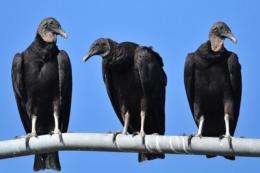
Due to climate change, black vultures have spread northward in the last 35 years and now winter as far north as Massachusetts, where the minimum winter temperature is similar to what it was in Maryland in 1975.

(PhysOrg.com) -- As warmer winter temperatures become more common, one way for some animals to adjust is to shift their ranges northward. But a new study of 59 North American bird species indicates that doing so is not easy or quick -- it took about 35 years for many birds to move far enough north for winter temperatures to match where they historically lived.

"This is a problem, because birds are among the most mobile of animals, and yet they take decades to respond to warming," said Frank La Sorte, a postdoctoral researcher at the Cornell Lab of Ornithology and lead author of the study, which was published online by the this month. "Climatic conditions are steadily moving northward, whether particular animals come along or not. As conservation biologists we need to know how well animals are keeping up."

Earlier studies of responses to climate change examined shifts in species' geographic ranges. "Our work adds important realism and a temporal dimension to these models for a critical aspect of climate: minimum winter temperature," said co-author Walter Jetz of Yale University.

The researchers used 35 years of data from the North American Christmas Bird Count to match to where birds were seen. They tested 59 individually and found that they responded differently to climate change. When summarized across bird species, there was evidence for a strong delay lasting about 35 years.

For example, black vultures have spread northward in the last 35 years and now winter as far north as Massachusetts, where the minimum winter temperature is similar to what it was in Maryland in 1975. On the other hand, the endangered red-cockaded did not alter its range at all despite the , possibly because its very specific habitat requirements precluded a range shift.

Both of these scenarios could represent problems for birds, La Sorte said. Species that do not track changes in climate may wind up at the limits of their physiological tolerance, or they may lose important habitat qualities, such as favored food types, as those species pass them by. But they also can't move their ranges too fast if the habitat conditions they depend on also tend to lag behind climate.

"When you think about it, it makes sense that species move slower than the rate at which climate is changing," La Sorte said. "They're not just tracking temperature -- many of them need to follow a prey base, a type of vegetation, or they need certain kinds of habitat that will create corridors for movement."

Variability in climate warming is likely to affect how species respond, too, La Sorte said. If warming trends weaken, as they did over the past few years, birds may be able to catch up. But accelerated warming, which is likely as global carbon emissions continue to increase, may put additional strain on birds. The study highlights these challenges and the high potential climate change has for disrupting natural systems. It also underscores the challenges ecologists face in predicting the long-term consequences of for many simultaneously.

The study was supported by the National Science Foundation.

Explore further: Climate change may have little impact on tropical lizards

add to favorites email to friend print save as pdf

Related Stories

A mountain bird's survival guide to climate change

Jun 08, 2010

Researchers at Yale University have found that the risk of extinction for mountain birds due to global warming is greatest for species that occupy a narrow range of altitude. In fact, a species' vertical distribution is a ...

Climate adaptation difficult for Europe's birds

Jan 17, 2012

Åke Lindström is Professor of Animal Ecology at Lund University, Sweden. Together with other European researchers he has looked at 20 years' worth of data on birds, butterflies and summer temperatures. During this ...

Recommended for you

Climate change may have little impact on tropical lizards

18 hours ago

A new Dartmouth College study finds human-caused climate change may have little impact on many species of tropical lizards, contradicting a host of recent studies that predict their widespread extinction in a rapidly warming ...

Wetlands: value to locals matters most

18 hours ago

A new way of valuing ecosystem services, incorporating the local perspective, is the driving force behind a project assessing aquatic ecosystems in highland areas of Asia

Symbolic saviour of an endangered species

May 16, 2013

In 2006 Berlin Zoo saw the birth of their first polar bear cub in 33 years. A retired circus polar bear gave birth to two cubs at the zoo. One of them died soon after, but Knut survived. At only a month old he became the ...

User comments : 4

Adjust slider to filter visible comments by rank

Display comments: newest first

gwrede
1 / 5 (2) Mar 28, 2012
The birds aren't stupid. It's not practical to move at the front of changing climate, because the next year will be different, and you don't know how.

Plus, you don't want to start learning a new neighbourhood unnecessarily, because that puts you seriously at a disadvantage compared to your peers. Learning the weather patterns, wind patterns, and temporal patterns of prey, predators and peers at a site is a multi-year non-trivial chore.

So, you only move North when it's beginning to look reasonably sure that you don't have to suddenly move back.
Shelgeyr
1 / 5 (4) Mar 28, 2012
"This is a problem, because birds are among the most mobile of animals, and yet they take decades to respond to warming,"


This is not a problem, because "Global Warming Models Are Wrong Again":
http://online.wsj..._LEADTop
Cluebat from Exodar
1 / 5 (2) Mar 28, 2012
I seem to recall record cold this past winter in some regions.

Alarmist much?
LariAnn
3.7 / 5 (3) Mar 28, 2012
And record warmth in many areas - the question is whether there are more records broken for warmth than for cold. IMHO, if there are extremes in one direction (warmth), it is inevitable that there will also be found some extremes in the other direction happening in the same season.

More news stories

Front-row seats to climate change

By day, insects provide the white noise of the South, but the night belongs to the amphibians. In a typical year, the Southern air hangs heavy from the humidity and the sounds of wildlife.

Climate change may have little impact on tropical lizards

A new Dartmouth College study finds human-caused climate change may have little impact on many species of tropical lizards, contradicting a host of recent studies that predict their widespread extinction in a rapidly warming ...

US seizes Bitcoin operator accounts

US authorities seized the accounts of a Bitcoin digital currency exchange operator, claiming it was functioning as an "unlicensed money service business," court documents showed Friday.

Chinese, Indian airlines face EU pollution fines

Eight Chinese and two Indian airlines face fines of up to several million euros for not paying for their greenhouse gas emissions during flights within the bloc, the European Commission said on Friday.

Alaska volcano shoots ash 15,000 feet into the air

(AP)—One of Alaska's most restless volcanoes has shot an ash cloud 15,000 feet into the air in an ongoing eruption that has drawn attention from a nearby community but isn't expected to threaten air traffic.