Artemis: the ATV whisperer
Mar 27, 2012
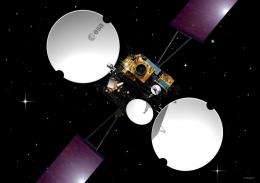
Carrying three payloads plus a number of experiments, Artemis (Advanced Relay and Technology Mission Satellite) has been developed to test and operate new telecommunications techniques. The L-band mobile payload will allow two-way voice and data communications via satellite, between fixed Earth stations and land mobiles - trucks, trains or cars - anywhere in Europe and North Africa. Artemis carries two payloads for communicating directly between satellites:a laser-optical relay terminal called SILEX, and a double S/Ka-band terminal called SKDR. Data will be received from low-Earth-orbiting satellites and then transmitted directly to Europe. Artemis was launched the 12 July 2001 from Europe's spaceport in Kourou from an Ariane 5 launcher. Credits: ESA - J.Huart

(PhysOrg.com) -- ESA’s Artemis communications satellite is in action again to ensure the safe arrival of Europe’s third Automated Transfer Vehicle at the International Space Station with vital supplies.

Containing fresh supplies of fuel, water, oxygen, air, food, clothing, experiments and spare parts, ATV Edoardo Amaldi is a true lifeline to the astronauts on the Space Station. prompt arrival is critical for the orbital outpost.

Artemis is dedicated to ATV-3 throughout the vessel’s free-flying phase up to the docking with the Station Wednesday night. NASA’s own satellites provide backup to Artemis during the attached phase, while Artemis will act as backup during the other phases and in emergency situations.

Artemis is handling communications between Edoardo Amaldi and the ATV Control Centre in Toulouse, France.

Hovering some 36 000 km above the equator at 21.4ºE – directly over the Democratic Republic of the Congo – Artemis is routing telemetry and commands to and from the control centre whenever the satellite has the Station or ATV in its view.

As ATV-3 circles the globe, Artemis has close to 40 minutes of continuous contact at a time.
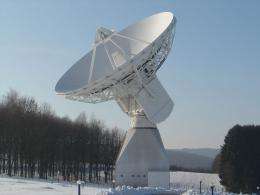
Antenna at ESA's Redu station, which is located in the Ardennes region of Belgium. Credits: ESA - D. Galardini

The first two ATV missions were also supported by Artemis. Working in parallel with NASA, Artemis was used as the main relay while the ATVs were attached to the Station and provided back up for commands and telemetry during rendezvous, docking, undocking and reentry.  

ESA’s first data-relay satellite has been orbiting Earth for more than 10 years and pioneered many of the advances used in satcoms today.

Artemis created the first laser data link between satellites in different orbits; it was the first telecommunications to be extensively reprogrammed in orbit; it was the first to power its way to geostationary orbit, 36 000 km up, with ion thrusters after surviving the longest-ever drift to its destination.

is the precursor to Europe’s new European Data Relay System, now being built in a public–private partnership between ESA and Astrium Services.

Explore further: NASA head views progress on asteroid lasso mission

add to favorites email to friend print save as pdf

Related Stories

Artemis provides communications for Jules Verne ATV

Mar 14, 2008

ESA's Artemis data relay satellite, controlled from Fucino (Italy) and with its mission control centre and Earth terminal located at Redu (Belgium), is providing communications between the Jules Verne ATV ...

Celebrating 10 years of Artemis

Jul 13, 2011

(PhysOrg.com) -- ESA’s pioneering Artemis satellite today marks a decade in space. The Advanced Relay and Technology Mission was a breakthrough in telecommunications satellites for Europe, packed with ...

ATV Edoardo Amaldi set for liftoff

Mar 22, 2012

ESA’s third Automated Transfer Vehicle, Edoardo Amaldi, is ready for launch to the International Space Station. ESA’s formal Launch Readiness Review on Monday revealed no problems with the vessel. ...

ARTEMIS spacecraft believed stuck by object

Oct 25, 2010

Flight Dynamics data from THEMIS-B (one of the two ARTEMIS spacecraft) indicated that one of the EFI (electric field instrument)spherical tip masses may have been struck by a meteoroid at 0605 UT on October ...

Recommended for you

Dark, massive asteroid to fly by Earth on May 31

1 hour ago

It's 1.7 miles long. Its surface is covered in a sticky black substance similar to the gunk at the bottom of a barbecue. If it impacted Earth it would probably result in global extinction. Good thing it is ...

Research team explains 'Lazarus' comets

5 hours ago

Astronomers from the University of Antioquia have discovered a graveyard of comets. These once-dormant comets, dubbed by astronomers as "The Lazarus comets," are now rejuvenated.

NASA ships sensors for seafaring satellite to France

5 hours ago

(Phys.org) —Three NASA-built instruments that are integral components of the next in a series of U.S./European ocean altimetry satellites have arrived in France for integration with their spacecraft in ...

Trip into space with DiCaprio costs $1.55m

6 hours ago

Leonardo DiCaprio is going to get closer to stars of a different kind as he heads into space aboard the Virgin Galactic, and a well-heeled bidder at the Cannes Film Festival has paid 1.2 million euros (1.5 million) to be ...

User comments : 0

More news stories

Dark, massive asteroid to fly by Earth on May 31

It's 1.7 miles long. Its surface is covered in a sticky black substance similar to the gunk at the bottom of a barbecue. If it impacted Earth it would probably result in global extinction. Good thing it is ...

Source of life running out: water scientists

The majority of people on Earth people will face severe water shortages within a generation or two if pollution and waste continues unabated, scientists warned at a conference in Bonn Friday.