World's most efficient nanoplasmonic solar cells developed
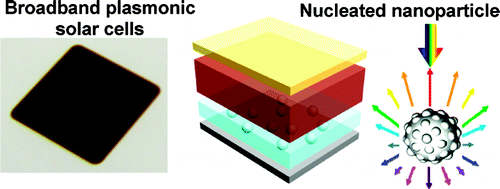
(PhysOrg.com) -- In a boon for the local solar industry, a team of researchers from Swinburne University of Technology and Suntech Power Holdings have developed the worlds most efficient broadband nanoplasmonic solar cells.
In a paper published in Nano Letters, the researchers describe how they have manufactured thin film solar cells with an absolute efficiency of 8.1 per cent.
The research was conducted under the auspices of the Victoria-Suntech Advanced Solar Facility (VSASF) at Swinburne. The group is working to dramatically increase the efficiency of thin film solar technology.
According to Swinburne Professor Min Gu, Director of the VSASF, thin film cells have attracted enormous research interest as a cheap alternative to bulk crystalline silicon cells. However, the significantly reduced thickness of their silicon layer makes it more difficult for them to absorb sunlight.
Light trapping technology is of paramount importance to increase the performance of thin film solar cells and make them competitive with silicon cells, Professor Gu said. One of the main potential applications of the technology will be to cover conventional glass, enabling buildings and skyscrapers to be powered entirely by sunlight.
The VSASF group has been improving thin film cell efficiency by embedding gold and silver nanoparticles into the cells. This increases the wavelength range of the absorbed light, improving the conversion of photons into electrons.
In their most efficient cells yet, the researchers went one step further, using what are known as nucleated or bumpy nanoparticles.
Senior Research Fellow at Swinburne Dr Baohua Jia said: The broadband plasmonic effect is an exciting discovery of the team. It is truly a collaborative outcome between Swinburne and Suntech over the last 12 months.
Dr Jia believes that this new technology will have an important impact on the solar industry. What we have found is that nanoparticles that have an uneven surface scatter light even further into a broadband wavelength range. This leads to greater absorption, and therefore improves the cells overall efficiency.
Professor Gu applauded the quick timeframe in which the research group has been able to achieve 8.1 per cent total efficiency, however he believes there is still considerable scope to improve the cells and transform the way the world sources energy.
We are on a rapid upwards trajectory with our research and development. With our current rate of progress we expect to achieve 10 per cent efficiency by mid 2012, he said. We are well on track to reach the VSASFs target to develop solar cells that are twice as efficient and run at half the cost of those currently available.
Professor Gu said that another advantage of the groups approach is that nanoparticle integration is inexpensive and easy to upscale and therefore can easily be transferred to the production line.
We have been using Suntech solar cells from the outset, so it should be very straightforward to integrate the technology into mass manufacturing. We expect these cells to be commercially available by 2017.
Suntech CEO Dr Zhengrong Shi said: Our team has achieved an impressive milestone with the world record for the most efficient broadband nanoplasmonic thin-film cell. This is an important step in demonstrating the potential of nanotechnology in leading the next generation of solar cells.
The Nano Letters paper was authored by Dr Xi Chen, Dr Baohua Jia, Dr Jhantu Saha, Mr Boyuan Cai, Dr Nicholas Stokes, and Professor Min Gu from Swinburne and Dr Qi Qiao, Dr Yongqian Wang and Dr Zhengrong Shi from Suntech.
More information: Paper online: http://pubs.acs.or … 21/nl203463z
Provided by Swinburne University of Technology
-
From lemons to lemonade: Reaction uses carbon dioxide to make carbon-based semiconductor,
33 comments
-
Thioridazine kills cancer stem cells in human while avoiding toxic side-effects of conventional cancer treatments,
3 comments
-
SpaceX private rocket blasts off for space station (Update),
42 comments
-
Landmark calculation clears the way to answering how matter is formed,
55 comments
-
Research team claims to have found evidence Lake Cheko is impact crater for Tunguska Event,
18 comments
-
How to determine the flexural rigidity of a composite
9 hours ago
-
microstructure of titanium
May 26, 2012
-
Steam in My Espresso Machine
May 26, 2012
-
Density question
May 24, 2012
-
Mass transport originating from a point source at a solid gas interface
May 22, 2012
-
Ammonia dispersion in Air
May 22, 2012
- More from Physics Forums - Materials & Chemical Engineering
More news stories
Stunning image of smallest possible five-ringed structure
Scientists have created and imaged the smallest possible five-ringed structure about 100,000 times thinner than a human hair and you'll probably recognise its shape.
6 hours ago |
4.5 / 5 (6) |
1
|
'Unzipped' carbon nanotubes could help energize fuel cells, batteries
Multi-walled carbon nanotubes riddled with defects and impurities on the outside could replace some of the expensive platinum catalysts used in fuel cells and metal-air batteries, according to scientists at ...
Nanotechnology / Nanomaterials
12 hours ago |
3 / 5 (2) |
0
|
Dopant gives graphene solar cells highest efficiency yet
(Phys.org) -- By taking advantage of graphenes favorable electrical and optical properties, and then adding an organic dopant, researchers have achieved the highest power conversion efficiency yet for ...
In nanorod crystal growth, nanoparticles seen as artificial atoms
In the growth of crystals, do nanoparticles act as "artificial atoms" forming molecular-type building blocks that can assemble into complex structures? This is the contention of a major but controversial theory ...
May 24, 2012 |
4.8 / 5 (6) |
0
|
First direct observation of oriented attachment in nanocrystal growth
Berkeley Lab researchers have reported the first direct observation of nanoparticles undergoing oriented attachment, the critical step in biomineralization and the growth of nanocrystals. A better understanding ...
May 24, 2012 |
4.7 / 5 (3) |
0
|
Change in developmental timing was crucial in the evolutionary shift from dinosaurs to birds: study
At first glance, it's hard to see how a common house sparrow and a Tyrannosaurus Rex might have anything in common. After all, one is a bird that weighs less than an ounce, and the other is a dinosaur that ...
Computer model used to pinpoint prime materials for efficient carbon capture
When power plants begin capturing their carbon emissions to reduce greenhouse gases and to most in the electric power industry, it's a question of when, not if it will be an expensive undertaking.
T cells 'hunt' parasites like animal predators seek prey, study shows
By pairing an intimate knowledge of immune-system function with a deep understanding of statistical physics, a cross-disciplinary team at the University of Pennsylvania has arrived at a surprising finding: T cells use a movement ...
Yale study concludes public apathy over climate change unrelated to science literacy
Are members of the public divided about climate change because they don't understand the science behind it? If Americans knew more basic science and were more proficient in technical reasoning, would public consensus match ...
Land and sea species differ in climate change response: study
(Phys.org) -- Marine and terrestrial species will likely differ in their responses to climate warming, new research by Simon Fraser University and Australia’s University of Tasmania has found.
10 million years needed to recover from mass extinction
It took some 10 million years for Earth to recover from the greatest mass extinction of all time, latest research has revealed.

Feb 14, 2012
Rank: 3.3 / 5 (3)
Feb 14, 2012
Rank: not rated yet
Feb 15, 2012
Rank: not rated yet
It is better than the sunlight-to-biomass(photosynthetic efficiency) of all but a few exceptional plants under laboratory conditions(sugar cane, some cyanobacteria and algae); so they're not doing completely terrible I suppose.
The problem with solar energy is not so much efficiency(although it's not a good thing to use large areas of land, it doesn't even begin to compare with farming). It's that sunshine isn't when and where people want it. That means really long power lines and really large batteries; even if PV modules are gratis, it's nowhere close to economical(although it can be economical for individual people, but that's just feed-in-tariffs, mandates and other forms of graft).
Feb 15, 2012
Rank: 3 / 5 (2)
Feb 20, 2012
Rank: not rated yet
If the modules themselves were free, it would be economical to produce synthetic fuels by electrolytic processes. Would be more efficient use of land than biofuels even if the efficiency was poor.
Feb 21, 2012
Rank: not rated yet