World's first 300mm-fab compatible directed self-assembly process line
February 10, 2012

World's first 300mm-fab compatible directed self-assembly process line

Enlarge

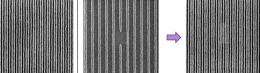
14nm polystyrene lines on 28nm pitch after PMMA removal fabricated by DSA using 193nm immersion based 84nm pitch pre-pattern (left) and demonstration of the ability to repair a 200nm gap in the pre-pattern (right).

At next week’s SPIE Advanced Lithography conference (San Jose, CA), imec announces the successful implementation of the world first 300mm fab-compatible Directed Self-Assembly (DSA) process line all-under-one-roof in imec’s 300mm cleanroom fab. The upgrade of an academic lab-scale DSA process flow to a fab-compatible flow was realized in collaboration with the University of Wisconsin, AZ Electronic Materials and Tokyo Electron Ltd. Imec’s DSA collaboration aims to address the critical hurdles to take DSA from the academic lab-scale environment into high-volume manufacturing.

Directed (DSA) is gaining momentum as a means for extending optical beyond its current limits. DSA is an alternative patterning technology that enables frequency multiplication through the use of block copolymers. When used in conjunction with an appropriate pre-pattern that directs the orientation for patterning, DSA can reduce the pitch of the final printed structure. Moreover, DSA can be used to repair defects and repair uniformity in the original print. This repair feature is especially useful in combination with EUV lithography, which today is characterized by local variation in the CD (critical dimension), especially in case of small contacts.

Imec now has the complete toolset on-site including a dedicated and specially configured DSA coater/developer manufactured by TEL with installed DSA materials in gallon-size quantities, the metrology toolkit including DSA defect inspection, and in-house pattern transfer capabilities all in a representative 300mm cleanroom fab environment. With established 248nm, 193nm (dry and immersion) and EUV lithography tool sets on site, imec is uniquely positioned to study DSA defectivity aiming at increasing the pattern reliability of DSA for semiconductor fab standards. Moreover, imec aims at further developing the possibilities of DSA repair in combination with EUV lithography, pushing imec’s ambition to bring EUV Lithography to production level.

Kurt Ronse, Director Lithography Department at imec: We are excited with this achievement, as this enables us to expand the scope of our research offering and toolset bringing more value to our partners. The availability of a DSA processing line enables us to further push the limits of 193nm immersion lithography and overcome some of the critical concerns for EUV lithography. This allows us to further push the limits of Moore’s law.”

"With this process, imec has taken an important step towards fulfilling the low cost, high resolution promise of bottom up DSA lithography," says Ralph Dammel, CTO of AZ Electronic Materials. "We are committed to providing the high performance materials the industry needs to make DSA a commercial reality."

Prof. Paul Nealey: “Juan de Pablo and I and the University of Wisconsin team are very pleased to have the opportunity to partner with imec. Our work together results in unprecedented integration of DSA with manufacturing-ready tools and materials, allows investigation of the ultimate potential and possible limits of DSA not possible in an academic setting, and provides exceptional educational opportunities for our students. We are gratified to be on a pathway with imec towards commercialization of technology we have spent almost 15 years developing.”

This research offering is part of imec’s Advanced lithography program, available to imec’s partners in its core CMOS programs. Imec’s key core CMOS partners are Globalfoundries, INTEL, Micron, Panasonic, Samsung, TSMC, Elpida, Hynix, Fujitsu and Sony.

Provided by IMEC


Rank 4 /5 (1 vote)
Relevant PhysicsForums posts
  • Transformer currents in primary and secondary question
    created2 hours ago
  • Wanting to pursue electronics engineering
    created3 hours ago
  • How to select a low-pass filter
    created10 hours ago
  • Diodes, supplies, and graphs.
    created20 hours ago
  • describing the voltage out of a rectifier
    created21 hours ago
  • Statistics of random processes passed through an LTI system
    createdMay 27, 2012
  • More from Physics Forums - Electrical Engineering

More news stories

Browser wars flare in mobile space

The browser wars are heating up again, but this time the fight is for dominance of the mobile Internet.

Technology / Software

created 20 hours ago | popularity 4 / 5 (4) | comments 3

Probability of contamination from severe nuclear reactor accidents is higher than expected: study

Catastrophic nuclear accidents such as the core meltdowns in Chernobyl and Fukushima are more likely to happen than previously assumed. Based on the operating hours of all civil nuclear reactors and the number ...

Technology / Energy & Green Tech

created May 22, 2012 | popularity 3.6 / 5 (25) | comments 57 | with audio podcast

HyperSolar shows dirty water no barrier to power world

(Phys.org) -- The Santa Barbara, California, company, HyperSolar, is set to transparently share the ups and downs of its research experiences toward the company’s ultimate vision, successfully producing ...

Technology / Energy & Green Tech

created May 24, 2012 | popularity 4.8 / 5 (16) | comments 17 | with audio podcast report

Tesla to launch electric sedan in US on June 22

Tesla Motors said Tuesday it would begin deliveries of "the world's first premium electric sedan" on June 22, slightly ahead of schedule.

Technology / Energy & Green Tech

created May 22, 2012 | popularity 4.5 / 5 (12) | comments 18

SpotterRF debuts Radar Backpack Kit (w/ Video)

(Phys.org) -- SpotterRF has announced a special radar backpack kit designed to enhance situational awareness for soldiers on the ground. The company says its special radar is designed for warfighters as part ...

Technology / Hi Tech & Innovation

created May 26, 2012 | popularity 5 / 5 (5) | comments 13 | with audio podcast report


Stunning image of smallest possible five-ringed structure

Scientists have created and imaged the smallest possible five-ringed structure – about 100,000 times thinner than a human hair – and you'll probably recognise its shape.

'Unzipped' carbon nanotubes could help energize fuel cells, batteries

Multi-walled carbon nanotubes riddled with defects and impurities on the outside could replace some of the expensive platinum catalysts used in fuel cells and metal-air batteries, according to scientists at ...

Change in developmental timing was crucial in the evolutionary shift from dinosaurs to birds: study

At first glance, it's hard to see how a common house sparrow and a Tyrannosaurus Rex might have anything in common. After all, one is a bird that weighs less than an ounce, and the other is a dinosaur that ...

Computer model used to pinpoint prime materials for efficient carbon capture

When power plants begin capturing their carbon emissions to reduce greenhouse gases – and to most in the electric power industry, it's a question of when, not if – it will be an expensive undertaking.

T cells 'hunt' parasites like animal predators seek prey, study shows

By pairing an intimate knowledge of immune-system function with a deep understanding of statistical physics, a cross-disciplinary team at the University of Pennsylvania has arrived at a surprising finding: T cells use a movement ...

Yale study concludes public apathy over climate change unrelated to science literacy

Are members of the public divided about climate change because they don't understand the science behind it? If Americans knew more basic science and were more proficient in technical reasoning, would public consensus match ...