Spaceborne precipitation radar ships from Japan to U.S.
February 9, 2012 By Steve Cole and Rani Gran
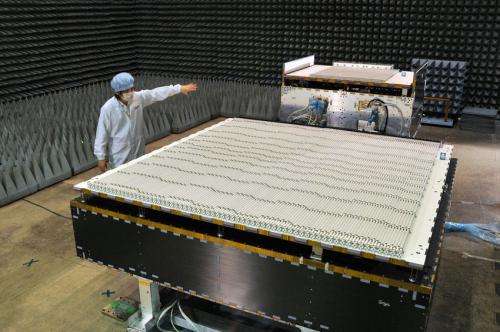
A JAXA scientist standing next to the Dual-frequency Precipitation Radar (DPR) instrument for the GPM Core Observatory satellite. The Japanese-built radar is a new instrument designed to take 3-D measurements of raindrops and snowflakes. Credit: NASA / JAXA
(PhysOrg.com) -- Japanese scientists and engineers have completed construction on a new instrument designed to take 3-D measurements of the shapes, sizes and other physical characteristics of both raindrops and snowflakes. The instrument will be shipped from Japan to NASA's Goddard Space Flight Center, Greenbelt, Md., to be integrated into an upcoming NASA Earth science satellite.
Designed and built by the Japan Aerospace Exploration Agency (JAXA) and Japan's National Institute of Information and Communications Technology, the Dual-frequency Precipitation Radar is one of two instruments that will fly aboard NASA's Core Observatory for the Global Precipitation Measurement (GPM) mission.
The radar instrument will provide insights into a storm's physical structures. Its data will not only expand our knowledge of precipitation science, the Earth's water cycle, and the supply of fresh water around the world, it also will aid forecasts of hurricanes, floods and other natural disasters.
The instrument is the first space-borne radar to use both Ku and Ka bands in the microwave range of frequencies to study precipitation. It obtains three-dimensional information about precipitation droplets by measuring reflected energy by these particles at different heights within the clouds. The 'dual' in the radar's name refers to the way the two microwave bands of the instrument complement each other, allowing the radar to provide new information about the size distribution of raindrops and snowflakes as they fall.
After the instrument arrives at Goddard in March, engineers will integrate both the radar and another instrument, the NASA-supplied GPM Microwave Imager (GMI), onto the main body or 'bus' of the mission's Core Observatory. After extensive testing, the satellite will then be shipped to Japan for launch in 2014.
"Knowing the global distribution of precipitation is critical for predicting weather and for understanding the roles of water in defining the Earth's climate," said Michael Freilich, director of NASA's Earth Science Division in the Science Mission Directorate. "The measurements from GPM will provide unique insight into the atmospheric processes that generate and control precipitation, as well as the impacts of rain and snowfall on the availability of fresh water for all of the Earth's inhabitants."
GPM's three-dimensional observations of rain and snow will usher in a new generation of space-based observations of global precipitation, a key element of the Earth's climate. The mission will extend to global scales the space-based measurement of precipitation initiated by the NASA-JAXA Tropical Rainfall Measuring Mission (TRMM) in 1997.
"This mission will provide rain and snow measurements of unprecedented accuracy worldwide, every three hours," said Arthur Hou, GPM mission scientist at Goddard. "This joint mission builds on the continued success of TRMM and our strong collaboration with JAXA. The GPM Core Observatory will serve as a new standard to unify precipitation measurements from the GPM constellation of satellites, which includes missions by the Centre National dEtudes Spatiales (CNES) of France, the Indian Space Research Organization (ISRO), the European Organization for the Exploitation of Meteorological Satellites (EUMETSAT) and other U.S. and international partners operating both research and operational satellites."
This international network of satellites is part of the GPM mission concept in which they work in concert providing next-generation global observations of rain and snow. The NASA Core Observatory is the centerpiece of this constellation.
More information: For more information about GPM, visit: http://www.nasa.gov/gpm
Provided by
JPL/NASA
-
From lemons to lemonade: Reaction uses carbon dioxide to make carbon-based semiconductor,
33 comments
-
Thioridazine kills cancer stem cells in human while avoiding toxic side-effects of conventional cancer treatments,
3 comments
-
SpaceX private rocket blasts off for space station (Update),
42 comments
-
Landmark calculation clears the way to answering how matter is formed,
55 comments
-
Research team claims to have found evidence Lake Cheko is impact crater for Tunguska Event,
18 comments
-
Distance of planets from stars and revolution
13 hours ago
-
revamping general concept and cosmological principle
May 25, 2012
-
Transiting Exoplanet Light Curve
May 25, 2012
-
Math behind Theoretical Physics
May 24, 2012
-
Do we know whats at the center of galaxies yet?
May 23, 2012
-
Structure of the Milky Way?
May 20, 2012
- More from Physics Forums - General Astronomy
More news stories
Yale study concludes public apathy over climate change unrelated to science literacy
Are members of the public divided about climate change because they don't understand the science behind it? If Americans knew more basic science and were more proficient in technical reasoning, would public consensus match ...
13 hours ago |
4.8 / 5 (6) |
30
|
Land and sea species differ in climate change response: study
(Phys.org) -- Marine and terrestrial species will likely differ in their responses to climate warming, new research by Simon Fraser University and Australia’s University of Tasmania has found.
11 hours ago |
4 / 5 (5) |
9
|
10 million years needed to recover from mass extinction
It took some 10 million years for Earth to recover from the greatest mass extinction of all time, latest research has revealed.
Space & Earth / Earth Sciences
13 hours ago |
4.2 / 5 (5) |
5
|
Sophisticated simulations predict future warming
The chances of our planet being hit by a global warming of 3 degrees Celsius by 2050 is as likely as it being hit by an increase of 1.4 degrees, new research shows. Presented in the journal Nature Geoscience, the British study ...
Space & Earth / Earth Sciences
May 22, 2012 |
3.8 / 5 (11) |
51
Kyoto Protocol architect 'frustrated' by climate dialogue
UN climate talks are going nowhere, as politicians dither or bicker while the pace of warming dangerously speeds up, one of the architects of the Kyoto Protocol told AFP.
May 23, 2012 |
3.4 / 5 (8) |
44
Stunning image of smallest possible five-ringed structure
Scientists have created and imaged the smallest possible five-ringed structure about 100,000 times thinner than a human hair and you'll probably recognise its shape.
'Unzipped' carbon nanotubes could help energize fuel cells, batteries
Multi-walled carbon nanotubes riddled with defects and impurities on the outside could replace some of the expensive platinum catalysts used in fuel cells and metal-air batteries, according to scientists at ...
Change in developmental timing was crucial in the evolutionary shift from dinosaurs to birds: study
At first glance, it's hard to see how a common house sparrow and a Tyrannosaurus Rex might have anything in common. After all, one is a bird that weighs less than an ounce, and the other is a dinosaur that ...
Computer model used to pinpoint prime materials for efficient carbon capture
When power plants begin capturing their carbon emissions to reduce greenhouse gases and to most in the electric power industry, it's a question of when, not if it will be an expensive undertaking.
T cells 'hunt' parasites like animal predators seek prey, study shows
By pairing an intimate knowledge of immune-system function with a deep understanding of statistical physics, a cross-disciplinary team at the University of Pennsylvania has arrived at a surprising finding: T cells use a movement ...
Browser wars flare in mobile space
The browser wars are heating up again, but this time the fight is for dominance of the mobile Internet.