Scientists launch rocket into aurora
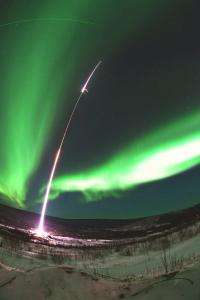
(PhysOrg.com) -- With the full sky shimmering in green aurora, Saturday night (Feb. 18, 2012) a team of scientists, including space physicist Marc Lessard and graduate students from the University of New Hampshire's Space Science Center, launched an instrument-laden, two-stage sounding rocket from the Poker Flat Research Range in Fairbanks, Alaska. The precision measurements from the rocket's instruments will shed new light on the physical processes that create the northern lights and further our understanding of the complex sun-Earth connection.
Funded by the National Aeronautics and Space Administration (NASA), the Magnetosphere-Ionosphere Coupling in the Alfvén resonator (MICA) mission sent a 40-foot Terrier-Black Brant rocket arcing through aurora 186 miles above Earth. The rocket sent a stream of real-time data back before landing some 200 miles downrange shortly after the launch.
Instruments onboard, including those built at UNH, sampled electric and magnetic fields as well as charged particles in Earth's upper atmosphere (ionosphere) that get sloshed back and forth by a specific form of electromagnetic energy known as Alfvén waves. These waves are thought to be a key driver of "discrete" aurora - the typical, well-defined band of shimmering lights about six miles thick and stretching east to west from horizon to horizon.
The mission involves collaborators from Cornell University, Dartmouth College, the Southwest Research Institute, the University of Alaska Fairbanks, and the University of Oslo.
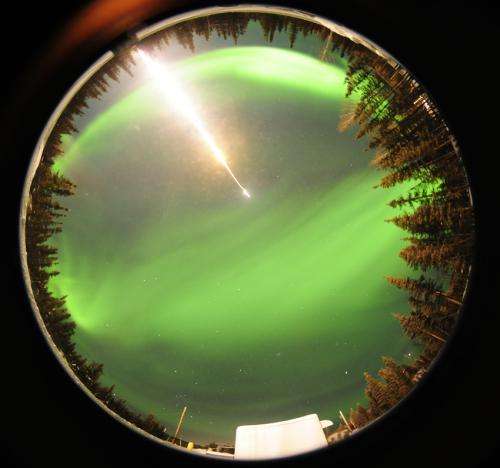
According to Lessard, an associate professor at the UNH Institute for the Study of Earth, Oceans, and Space (EOS) and department of physics, the Alfvén resonator is a structure in the ionosphere that acts like a guitar string when "plucked" by energy delivered by the solar wind to Earth's magnetosphere high above.
"The ionosphere, some 62 miles up, is one end of the guitar string and there's another structure over a thousand miles up in space that is the other end of the string. When it gets plucked by incoming energy we can get a fundamental frequency and other 'harmonics' along the background magnetic field sitting above the ionosphere," Lessard says.
The Alfvén resonator is a narrow, confined area of space - a channel that is perhaps several hundreds of miles tall but only six miles wide. It is hypothesized that energy from the sun accelerates a beam of electrons producing aurora and also increasing the overall electrical conductivity within the channel. Understanding how the ionosphere participates in providing the downward current is a critical component of understanding magnetosphere-ionosphere coupling.
"The process turns on an auroral arc and then these waves develop on both sides of the resonator moving up and down. That's the theory and it appears to be valid, but there's never been any really good measurement of the process in action. That's what MICA is all about," Lessard says.
MICA will provide insight into these wave-driven aurora specifically, but Lessard notes there are other types of aurora that are initiated by different processes and these, too, were investigated at ground-based stations during the MICA launch by scientists, including Allison Jaynes and Ian Cohen, both Ph.D. students working with Lessard in the Magnetosphere-Ionosphere Research Laboratory at EOS.
UNH has a rich history of sounding rocket development and launches dating back to the early 1960s. As Lessard notes, rocket work is ideal training ground for graduate students, as it was for him at UNH, because, unlike satellite missions, rocket missions generally offer "soup to nuts" involvement from design, construction, launch, and data analysis. Rockets also offer relatively quick and inexpensive access to space compared to satellite missions.
As for the significance of continued investigation into auroral processes, Lessard notes, "It's all about understanding how the energy of the solar wind gets coupled to Earth's magnetic field and eventually gets dumped into the our upper atmosphere."
Provided by University of New Hampshire


