Scientists cautious over Russia's Antarctic lake drilling
February 6, 2012 by Richard Ingham and Christine Courcol
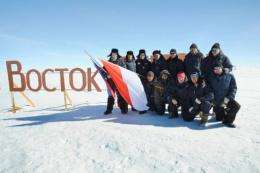
Prince Albert II of Monaco (3rd L) poses with the scientists of the Russia's research station Vostok near the Southern Pole of Inaccessibility and the South Geomagnetic Pole, in 2009. Experts on Monday raised questions over the scientific benefit and environmental impact of Russia's feat in drilling into a virgin lake under Antarctica's icesheet.
Experts on Monday raised questions over the scientific benefit and environmental impact of Russia's feat in drilling into a virgin lake under Antarctica's icesheet.
Kerosene, which the Russians used as antifreeze to prevent the borehole from closing up in the extremely cold depths of the icesheet, was a potential contamination risk for samples and for the pristine lake itelf, they said.
Professor Martin Siegert, head of the school of geosciences at the University of Edinburgh, said these concerns marred "a milestone... a major achievement" by Russia in drilling through to Lake Vostok.
But, he added in a phone interview, "It's very difficult for them to convince (others) that their experiment is going to be clean, when you have essentially two miles (3.5 kilometres) of kerosene to cross before you get to the lake surface."
The lake, lying at a depth of 3,768 metres (12,246 feet), has lain untouched for possibly a million years, he said.
Sub-glacial lakes are extreme environments. The hope is that samples will show whether microbial life could exist in water suspected to lie beneath the frozen surface of Mars, the Saturnian moon of Enceladus and Jupiter's satellite, Europa.
But Siegert cautioned that only recovering water from the top of the Lake Vostok would give no indication about the "water column," meaning the enormous depth of the lake.
Nor would it say anything about the sediment on its bottom, which could hold vital clues.
And kerosene contamination could skew the samples, he feared. In the last stretch of drilling, the Russians used a more environmentally-friendly antifreeze, freon.
"I don't think there's going to be widespread contamination of the lake. But it's difficult for them to convince that the experiment is going to be clean -- and not just clean, but ultra-sterile -- with the current technique they are using."
Jean Jouzel, a scientist at France's Atomic Energy Commission (CEA), said he had "reservations" about the Vostok project and dismissed claims from Russia that the breakthrough would give insights into climate change through ancient bubbles of carbon dioxide (CO2) stored in the ice.
Deep coring of Antarctic ice has already provided historical data on stored CO2.
"From a technological point of view, the drilling is a genuine feat. But from the scientific point of view I don't think it will lead to big discoveries," he said.
"It could cause pollution, which the Russians think would be temporary and minor, but this argument has still to be proved," he said.
Jouzel said French experts had previously taken part in the drilling at Vostok with the Russians.
However, they and the Russians decided to put the project on hold, in the early days of the last decade, out of pollution concerns when the drill bit was just 120 metres (390 feet) from the lake ceiling.
Scientists working in Antarctic have to declare their projects to an international panel, comprising national academies, called the Scientific Committee for Antarctic Research (SCAR).
However, it is up to national authorities to give the go-ahead, Jouzel said.
Pointing to what he said was its sense of competition with Britain, Russia gave the OK to complete the drilling.
"It is a very clear case of national prestige," said Jouzel.
"National prestige thus becomes more important than the interest of the (scientific) community, which is to preserve this lake until non-polluting technology emerges," he said. "It's regrettable."
Siegert said he would shortly lead a team to drill into another subglacial lake in Antarctica called Lake Ellsworth, using a different technique called hot-water drilling.
Under this, water heated to 90 degrees Celsius (194 degrees Fahrenheit) is used to melt ice, whose water is then filtered and heated in turn, thus acting as a drill.
It means that access is kept as clean as possible in the arduous working conditions of Antarctica, although once the hole is opened, scientists only have a day or so to recover samples before it freezes over, Siegert said.
(c) 2012 AFP
-
From lemons to lemonade: Reaction uses carbon dioxide to make carbon-based semiconductor,
33 comments
-
Thioridazine kills cancer stem cells in human while avoiding toxic side-effects of conventional cancer treatments,
3 comments
-
SpaceX private rocket blasts off for space station (Update),
42 comments
-
Landmark calculation clears the way to answering how matter is formed,
55 comments
-
Research team claims to have found evidence Lake Cheko is impact crater for Tunguska Event,
18 comments
-
Hypothetical desert earth
May 26, 2012
-
More human population = greater mass?
May 25, 2012
-
Conversion from aircraft bearing to normal degrees
May 23, 2012
-
Interpretation/Analysis of the Lab results(HEPA filter)
May 22, 2012
-
Has anyone here attended the The Urbino Summer School in Paleoclimatology?
May 22, 2012
-
Earthquakes: Mag 6 N. Italy and Mag 5.6 W. Bulgaria
May 21, 2012
- More from Physics Forums - Earth
More news stories
Yale study concludes public apathy over climate change unrelated to science literacy
Are members of the public divided about climate change because they don't understand the science behind it? If Americans knew more basic science and were more proficient in technical reasoning, would public consensus match ...
12 hours ago |
4.8 / 5 (6) |
29
|
Land and sea species differ in climate change response: study
(Phys.org) -- Marine and terrestrial species will likely differ in their responses to climate warming, new research by Simon Fraser University and Australia’s University of Tasmania has found.
10 hours ago |
4 / 5 (5) |
9
|
10 million years needed to recover from mass extinction
It took some 10 million years for Earth to recover from the greatest mass extinction of all time, latest research has revealed.
Space & Earth / Earth Sciences
12 hours ago |
4.2 / 5 (5) |
5
|
Sophisticated simulations predict future warming
The chances of our planet being hit by a global warming of 3 degrees Celsius by 2050 is as likely as it being hit by an increase of 1.4 degrees, new research shows. Presented in the journal Nature Geoscience, the British study ...
Space & Earth / Earth Sciences
May 22, 2012 |
3.8 / 5 (11) |
51
Kyoto Protocol architect 'frustrated' by climate dialogue
UN climate talks are going nowhere, as politicians dither or bicker while the pace of warming dangerously speeds up, one of the architects of the Kyoto Protocol told AFP.
May 23, 2012 |
3.4 / 5 (8) |
44
Stunning image of smallest possible five-ringed structure
Scientists have created and imaged the smallest possible five-ringed structure about 100,000 times thinner than a human hair and you'll probably recognise its shape.
'Unzipped' carbon nanotubes could help energize fuel cells, batteries
Multi-walled carbon nanotubes riddled with defects and impurities on the outside could replace some of the expensive platinum catalysts used in fuel cells and metal-air batteries, according to scientists at ...
Change in developmental timing was crucial in the evolutionary shift from dinosaurs to birds: study
At first glance, it's hard to see how a common house sparrow and a Tyrannosaurus Rex might have anything in common. After all, one is a bird that weighs less than an ounce, and the other is a dinosaur that ...
Computer model used to pinpoint prime materials for efficient carbon capture
When power plants begin capturing their carbon emissions to reduce greenhouse gases and to most in the electric power industry, it's a question of when, not if it will be an expensive undertaking.
T cells 'hunt' parasites like animal predators seek prey, study shows
By pairing an intimate knowledge of immune-system function with a deep understanding of statistical physics, a cross-disciplinary team at the University of Pennsylvania has arrived at a surprising finding: T cells use a movement ...
Browser wars flare in mobile space
The browser wars are heating up again, but this time the fight is for dominance of the mobile Internet.